
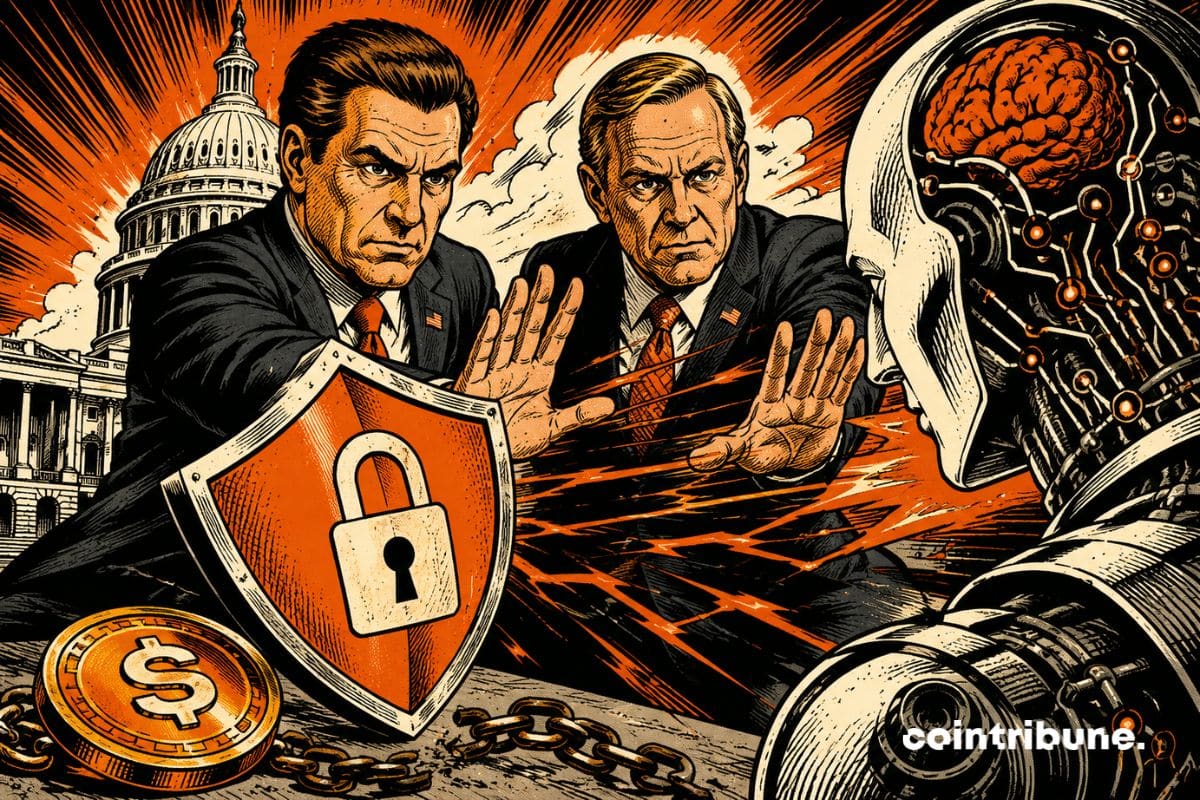
As soon as the GENIUS Act was adopted to regulate stablecoins, Washington opened a new front. This time, it is artificial intelligence (AI) technologies that are at the heart of the United States' concerns. Behind this initiative lies a broader strategy: protecting a technological advantage that has become a real power issue.
In brief
- The United States wants to strengthen the protection of AI against technology transfers to rival powers.
- AI is becoming a strategic asset, just like semiconductors and critical infrastructure.
- The debate goes beyond geopolitics: between medical promises and societal fears, AI also raises questions about its own risks.
Two US senators introduce bill to secure AI
The Trump administration continues its rise in strategic technologies. After participating in the adoption of the GENIUS Act intended to structure stablecoins, Republican senators Tim Scott and Bill Hagerty now want to strengthen the protection of American artificial intelligence against “foreign adversaries”. To this end, the bill presented to the Senate aims to give more powers to the Department of Commerce to control exports of AI technologies, whether models, software or critical infrastructure.
The objective is toprevent innovations developed in the United States from do not strengthen the technological capabilities of rival countries like China. This text therefore illustrates a profound evolution of American doctrine. As a result, semiconductors are no longer the only assets considered sensitive! AI models also become resources of sovereignty. In this new technological war, algorithms are now treated as critical infrastructure, just like energy networks or defense systems.
The US wants to secure AI… but do they really know what they’re building?
The debate around artificial intelligence now goes beyond simple competition between great powers. In the United States, AI nourishes two radically opposed imaginations. For some, it represents a direct threat to employment, capable of automating millions of tasks. For others, on the contrary, it embodies a tremendous hope, that of accelerating the discovery of treatments against cancer and revolutionizing medicine. This paradox raises a question: has AI become too powerful?
By seeking to block access to these technologies to preserve its geopolitical advantage, the United States implicitly recognizes that AI has become an unprecedented tool of power. But technology powerful enough to transform the world can also produce unforeseen effects. Notably :
- Economic dependence;
- Automated disinformation;
- The concentration of technological power.
Securing AI against adversaries is one thing; ensuring that it does not itself become a source of vulnerability is another. Isn't it best to bet on crypto and bitcoin in particular?
With this new legislative offensive, the United States shows that artificial intelligence is now as strategic an issue as stablecoins. The protection of innovation becomes an instrument of power. However, in this race for technological sovereignty, who will really take the time to secure AI… against itself?
Maximize your Tremplin.io experience with our 'Read to Earn' program! For every article you read, earn points and access exclusive rewards. Sign up now and start earning benefits.


