
The Bitcoin network is showing signs of strong activity despite moderate price action. A significant increase in small transactions linked to data registrations is pushing blockchain to new levels of use. This dynamic raises questions about possible congestion in the Bitcoin network, as users compete more for space available in the blocks.

In brief
- Low-value Bitcoin transactions now account for almost 80% of the network's daily activity.
- The increasing use of OP_RETURN increases the demand for block space.
- The Ordinals, Runes and BRC-20 protocols reinforce the increase in data registrations.
- The Bitcoin mempool reaches around 128,000 unconfirmed transactions.
- Current congestion remains lower than previous peaks observed in 2023 and 2024.
Bitcoin regains strong activity with the rise of microtransactions
As speculation around the Bitcoin market increases, the network is experiencing a marked increase in the number of daily transactions, driven mainly by low-value operations. Fromafter data published by CryptoQuantthis category of transactions now occupies a dominant place in the network's activity.
The increase is explained in particular by the growing use of Ordinals, Runes protocols and other systems for recording data on the blockchain. The main figures which illustrate this situation are as follows:
- Nearly 80% of daily transactions are for amounts less than 0.01 BTC;
- The threshold for microtransactions is set at 0.01 BTC;
- In 2023, these small transactions represented approximately 44% of all trade;
- The share of microtransactions has increased significantly since 2023;
- 2023 corresponds to the start of the acceleration linked to Ordinals, Runes protocols and data inscriptions;
- The network activity index returned to positive territory for the first time since 2024.
Thus, the Bitcoin network activity index monitored by CryptoQuant displays a notable rebound after a long period of weakness. This development comes at a time when the market is showing limited price growth, but increased use of transactional capacity.
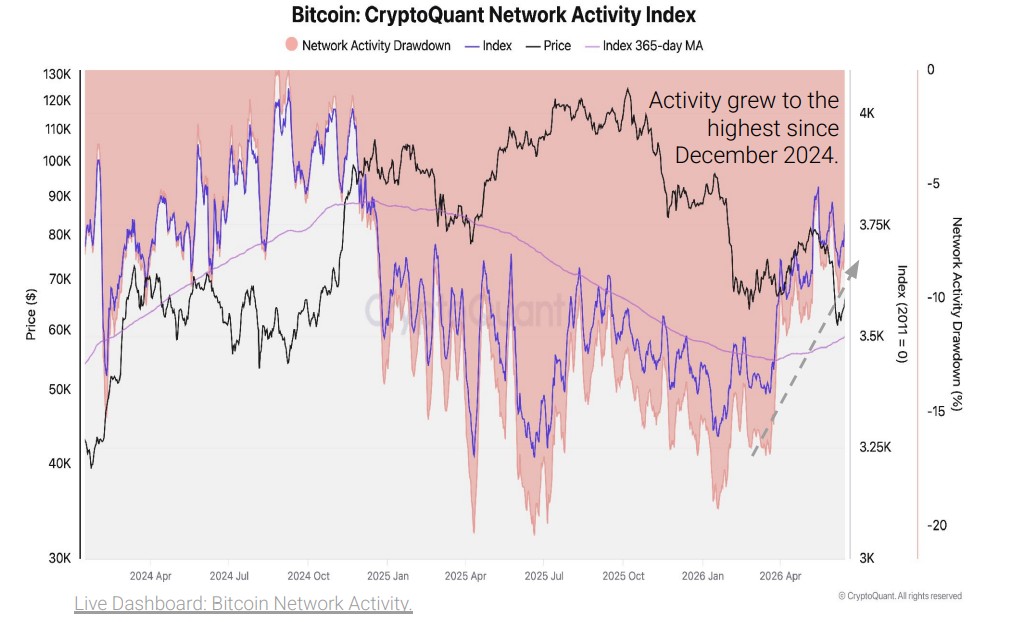
The report by Julio Moreno, head of research at CryptoQuant, highlights that the growth of non-financial activities can increase competition for the block space. It could also put pressure on fees linked to traditional economic transactions.
Data registrations increase pressure on blockchain
There current congestion however, remains below the levels observed during previous periods of intense activity on Bitcoin. The episodes linked to Ordinals and BRC-20 tokens had already caused significant delays in 2023.
At that time, users directly added images, text and information related to digital assets on the blockchain. Then, the launch of the Runes protocol at the end of 2024 caused a further increase in transaction volumes.
Today, Runes, Ordinals, BRC-20 tokens, and timestamp services generate many low-value transactions. These activities largely explain the recent growth of microtransactions on the network.
The OP_RETURN opcode also plays a central role in this evolution. This mechanism allows data to be integrated into the chain without creating spendable outputs. Its use has reached near record levels in 2026.
This development had created debates within the Bitcoin community in 2025. The removal of a relay limit of 80 bytes by the developers of Bitcoin Core had in particular sparked criticism concerning the storage of non-financial data.
Bitcoin mempool hits high amid new demands
The increase in low-value transactions directly influences the functioning of the network. Protocols using OP_RETURN can generate many exchanges containing only a few hundred satoshis.
According to CryptoQuant, the opcode can integrate up to 100,000 bytes of on-chain data. It has become a tool used by several data-related protocols on Bitcoin.
This increased usage helps further fill the mempool, the space where transactions wait for confirmation before being added into a block. The number of unconfirmed transactions reached around 128,000 units, a level not seen since February 2025.
The current situation therefore shows an increase in demand for block space. Future developments will depend on the network's ability to absorb these varied uses while maintaining efficient processing of traditional transactions.
If this trend continues, Bitcoin could enter a new phase of increased competition for available block space, with a possible impact on confirmation times and transaction fees. This development comes as bitcoin has just stalled towards $62,000, adding an additional element of monitoring for market participants in the face of changes in activity on the network.
Maximize your Tremplin.io experience with our 'Read to Earn' program! For every article you read, earn points and access exclusive rewards. Sign up now and start earning benefits.