
The digital assets market is going through a delicate period. In recent weeks, bitcoin has come under increasing pressure as several sources of demand have slowed simultaneously. On the one hand, capital outflows from American spot bitcoin ETFs continue. On the other hand, companies that usually accumulate reserves in cryptocurrencies have sharply reduced their purchases. This combination helps maintain a cautious climate around the market.

In brief
- Bitcoin remains under pressure after a marked decline in demand on several fronts.
- Companies holding cryptocurrency reserves have significantly slowed down their purchases.
- The 11 U.S. Spot ETFs saw $213.85 million in net outflows on Wednesday.
- Cumulative Spot ETF redemptions exceed $5.72 billion since the second week of May.
- Strategy's partial return to the market was not enough to sustainably stabilize prices.
Bitcoin facing a marked decline in demand
While bitcoin fell towards the $60,000 zone after trading above $70,000 in recent weeks. This decline is partly explained by the loss of significant buyer support, particularly among companies that accumulate cryptocurrencies as treasury assets. According to the Glassnode datathese companies have clearly slowed down their acquisitions.
At the same time, inflows from these companies have declined sharply. Daily purchases, which previously reached several hundred million dollars, are now only a fraction of the pace seen in the spring. This slowdown reduces an important source of demand for BTC, in an already fragile market.
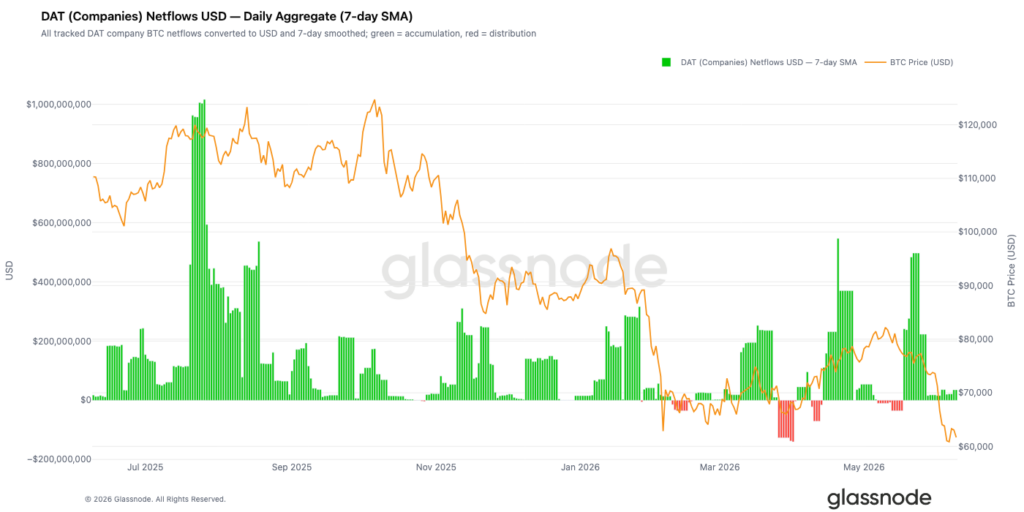
Glassnode analysts point out that “ these companies remain net buyers overall ». However, their current caution removes an important source of demand at a time when overall market sentiment remains fragile. Consequently, bitcoin is evolving in an environment where new buyers are becoming rarer.
This drop in accumulation appears particularly visible in comparison with the months of April and May, a period during which several peaks in daily purchases exceeded $500 million.
ETFs continue to fuel capital outflows
At the same time, US-listed Spot ETFs continue to experience significant drawdowns. These funds now represent a major indicator of the level of interest from institutional investors.
THE main figures to remember illustrate the extent of the movement observed in recent weeks:
- $213.85 million in net outflows recorded in a single day, Wednesday;
- 11 American Spot ETFs affected by these withdrawals;
- $5.72 billion in cumulative redemptions since the second week of May.
This trend naturally reduces the demand exerted on the market. The negative flows observed within Bitcoin Spot ETFs also limit the prospects of a lasting price rebound. Indeed, when capital leaves these investment vehicles, buying pressure gradually decreases.
In this context, US Spot ETFs remain a key factor in understanding recent market developments. As long as pullbacks persist, investors remain attentive to the impact of these movements on overall price dynamics.
An accelerated correction despite the return of certain buyers
The simultaneous decline in corporate purchases and inflows contributed to bitcoin's rapid decline. This situation partly explains the correction observed between recent highs near $74,000 and the levels below $60,000 reached last week. At the time of writing, the price of bitcoin is moving around $62,800.
Some observers also attribute part of the movement to Strategy, the largest listed holder of bitcoin. The company reported selling 32 BTC in the last week of May. However, she later returned to the market with an acquisition estimated at around $100 million in BTC.
Despite this return, selling pressure remained dominant. The BTC price failed to maintain the $60,000 threshold. In addition, continued outflows in ETFs continue to fuel questions about the market's ability to quickly return to more favorable dynamics.
In the short term, the evolution of flows in investment funds and the behavior of companies holding digital reserves will remain decisive indicators for assessing the future direction of the BTC market. Investors will be particularly watching the eventual return of demand, which is essential to supporting a more robust price recovery.
Maximize your Tremplin.io experience with our 'Read to Earn' program! For every article you read, earn points and access exclusive rewards. Sign up now and start earning benefits.