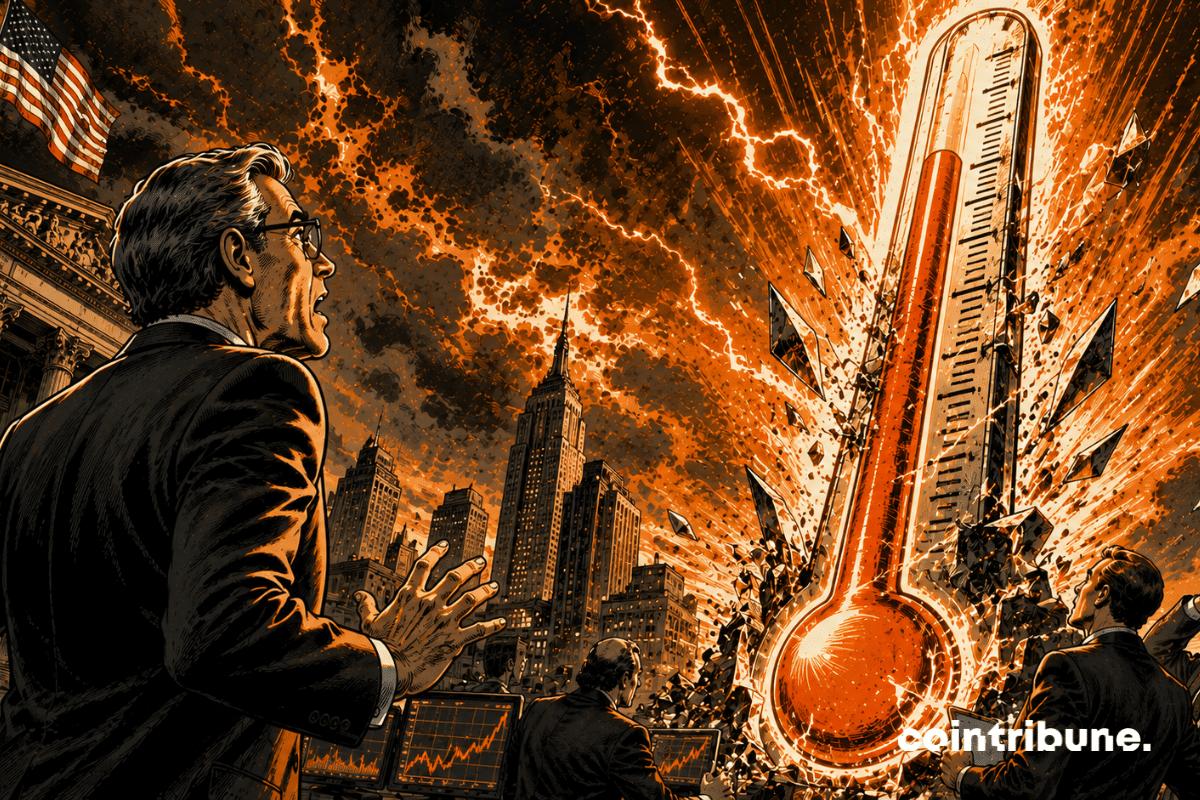
The financial markets beat to the rhythm of an indicator whose slightest variation can upset investors' forecasts. While many observers were counting on a continued decline in American inflation in 2026, the latest data published in the United States suggests the opposite. The return of a significant increase in prices calls into question several economic scenarios which still seemed credible a few weeks ago.
In brief
- US inflation reached 4.2% in May, its highest level since 2023, marking a sharp acceleration in price pressures.
- Energy costs played a central role in this increase, accounting for more than 60% of the monthly increase in the CPI.
- Tensions between the United States and Iran continue to fuel fears about global oil supplies and the evolution of energy prices.
- The publication of this data caused a decline in the S&P 500 and the Dow Jones, a sign of investor concerns.
US inflation hits record high since 2023
The figures published for the month of May break with the dynamics of recent months. American inflation, considered more worrying by the Cleveland Fed, is now at 4.2%, its highest level since 2023. This development seems very significant in view of a rate of 2.4% reported for February 2026. In just a few months, inflationary pressures have sharply intensified in the American economy.
The detailed analysis of the report reveals several sectoral developments:
- Food prices rose 0.2%;
- Coffee prices continue to rise;
- Cheese prices have fallen;
- Hospital services climbed 0.7%;
- Automobile insurance shows a decrease of 1.7%;
- Energy prices increased by 3.9%;
- More than 60% of the monthly increase in the CPI comes from energy.
These data illustrate the heterogeneous nature of inflationary pressures currently at work in the United States. Thus, certain categories of spending continue to accelerate while others experience a slowdown, which makes the interpretation of the phenomenon more complex than a simple generalized increase in prices.
Energy and the Middle East reignite price tensions
If the general rise in prices was the result of the growth of several components of the CPI, energy appears to be the main catalyst for this acceleration. The figures published, using on-chain data, show that more than 60% of the increase recorded month-on-month between April and May is a direct result of rising energy costs. Over the period, the overall index evolved mainly under the effect of energy prices (+ 3.9%).
This dynamic was also pointed out by Atsi Sheth, director of credit at Moody's Ratings. He estimated that “the inflation figures published today support our forecasts: the rise in energy prices, and its cascading effects on the cost of transport and food, largely contributed to the increase in the CPI in May”. This statement shows how energy spreads its effect throughout the economy. When the cost of energy increases, this phenomenon also has repercussions on transport prices, then on supply chains, and then on the prices charged to consumers.
The geopolitical context is at the heart of this evolution. Indeed, the recent rise in energy prices can be explained in particular by tensions between the United States and Iran. Unrest in the Strait of Hormuz, a key location for global oil trade, is triggering fears over international energy supplies. This situation allows sustained pressure to be maintained on the oil markets and increases uncertainty about the future evolution of inflation.
Markets are already reassessing the Fed's monetary scenario
More than just an increase in prices, investors are now trying to assess the effects of such a release on American monetary policy. For several months, markets have been scrutinizing economic indicators to try to guess the Federal Reserve's next decisions. A lasting return of inflation necessarily makes this exercise more difficult.
The financial markets reacted immediately. The S&P 500 and the Dow Jones fell slightly after the release of the CPI figures. This fall reflects investors' fears of a scenario in which the Fed would have to maintain a restrictive monetary policy for longer than expected. Inflation of 4.2% only puts the American economy further away from the price stability objective normally set at a rate close to 2%.
This idea is also mentioned by Moody's. According to Atsi Sheth, “As long as geopolitical uncertainties persist in the Middle East, energy prices should continue to push inflation upwards”. Such a situation reduces the visibility of American central bank officials on the future trajectory of prices and complicates monetary arbitrage.
The next few months therefore promise to be decisive for all financial markets. If inflation remains persistently high, this would strengthen the argument for maintaining current interest rates for a longer period of time. In the other direction, a geopolitical appeasement which could bring down energy prices would be more permissive for the Fed. This new inflationary surge reminds investors, especially in the crypto world where liquidity is a key parameter, that macroeconomic factors remain one of the main drivers of global markets.
Maximize your Tremplin.io experience with our 'Read to Earn' program! For every article you read, earn points and access exclusive rewards. Sign up now and start earning benefits.