
Despite a 28% decline since January, Ethereum retains market attention. The decline in price occurs while accumulators are still following on-chain signals. In this context, DeFi, stablecoins, tokenization and staking show sustained activity. This situation gives a broader reading than just price performance.

In brief
- Ethereum has fallen 28% since January, but its on-chain activity remains strong.
- The network maintains a major place in DeFi, stablecoins and tokenized assets.
- Accumulators continue to follow staking, with nearly 39.1 million ETH locked up.
- Analysts are still monitoring a historic accumulation zone ahead of a possible new cycle.
Ethereum remains dominant in DeFi and tokenized assets
Since January, the drop in the price of ether has placed the network under pressure, without erasing its weight in on-chain activity. It retains an important place in decentralized finance, stablecoins and tokenized assets.
Here are four key figures which summarize this situation:
- Around $43 billion in liquidity remains housed in DeFi;
- More than $165 billion in stablecoins are still circulating on the network;
- Nearly 55% of tokenized assets tracked on public blockchains are linked to Ethereum;
- Tokenized ETFs exceed $400 million in capitalization, with 76.9% market share for the network.
For accumulators, this data provides a benchmark for the actual use of the protocol. Indeed, the drop in price is not enough to summarize the state of the ecosystem. Cash, stablecoins, tokenized ETFs and tokenization still report significant activity, despite a fragile context.
Accumulators monitor staking and queues
Staking is also progressing, despite the decline observed this year. THE data of the network show that nearly 39.1 million ETH are staked, or approximately 32% of the total supply. This reserve is distributed among more than 896,000 active validators.
Furthermore, the demand for entry as a validator remains high. There are over 3.49 million ETH waiting in the queue, meaning over 60 days of waiting. Conversely, exit supply remains limited, with 7,424 ETH reported.
This contrast helps accumulators read the long-term trend around Ethereum, as large volumes remain locked in despite Ether's price decline. These accumulators therefore seem to favor duration, even if the market remains under pressure since January.
Analysts follow a historical price zone
Flows to addresses dedicated to accumulation reinforce this observation. On May 20, inflows reached 248,400 ETH, the highest daily inflow since January 6 according to CryptoQuant data. These portfolios show little selling, which often associates them with long-term holders.
On the charts, Ethereum remains depicted in an accumulation phase between $1,000 and $5,000. CryptoBullet sees this period as gradual position building ahead of a larger trend. He evoked also a possible capitulation zone of $1,000 to $1,300.
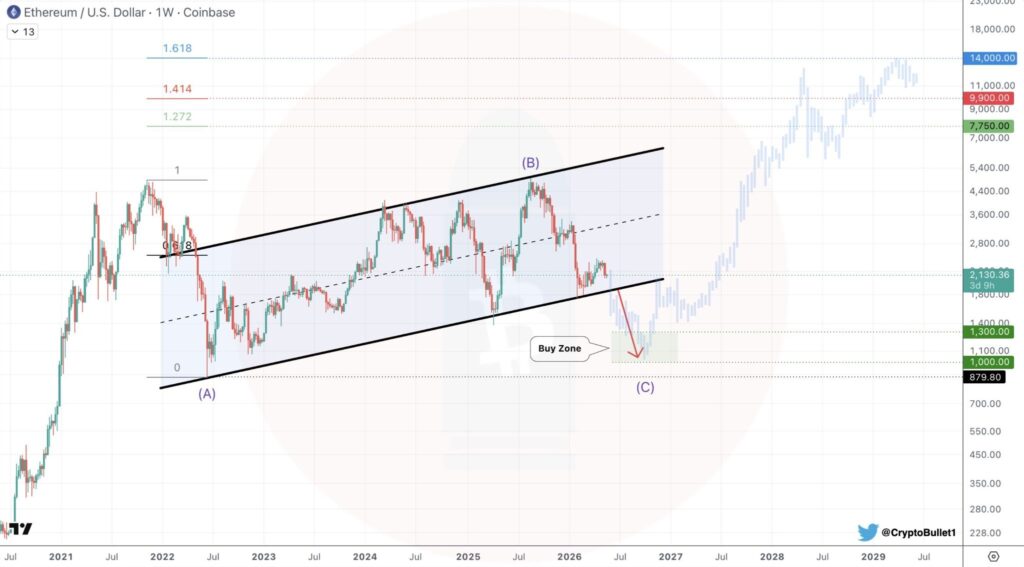
Furthermore, CryptoBullet estimates that Ethereum could target, in the long term, a zone between $7,700 and $14,000 over the period 2027-2029. For his part, Onchain's Rei follows a model based on the two-year simple moving average. According to this model, Ethereum has fallen below the x1 band, often considered a fair value zone. For accumulators, this zone can serve as a benchmark in a cyclical reading of the market.
What happens next will depend above all on the resistance of on-chain activity and the evolution of the price compared to historical areas. If inflows, staking and DeFi remain strong, ETH could continue to be treated as an accumulation phase asset. However, a continuation of the pullback would keep open the hypothesis of a test lower before any expansion cycle.
Maximize your Tremplin.io experience with our 'Read to Earn' program! For every article you read, earn points and access exclusive rewards. Sign up now and start earning benefits.