
For the first time in months, the Bitcoin hashrate fell below the symbolic bar of 1 zettahash per second. A trend which reveals an unexpected competition between cryptocurrency and artificial intelligence. Why are miners abandoning bitcoin for AI? What are the challenges for the crypto network and its stakeholders?
In brief
- The Bitcoin hashrate fell below 1 ZH/s, a first in months, due to the migration of miners to AI services.
- Economic difficulties and falling income are pushing mining players to reallocate their resources towards AI.
- This fall weakens the Bitcoin network, but also opens up opportunities for innovation for the remaining miners.
AI, the new promised land for Bitcoin miners?
Bitcoin's hashrate, a key indicator of the network's computing power, has fallen below 1 zettahash per second (ZH/s). A historic decline, attributed to the reallocation of resources from miners to AI services. Faced with a difficult economic environment, marked by falling revenues and increasing costs, mining players are looking for more lucrative alternatives.
Leon Lyu, CEO of StandardHash, explains this phenomenon by the search for higher profit margins. Indeed, the infrastructures of mining farms equipped with energy and cooling lend themselves perfectly to the needs of AI. In 2025, TheMinerMag was already calling the year the most difficult environment ever for Bitcoin miners, pushing them to diversify their activities.
This migration raises questions about the future of traditional mining. Miners, formerly dedicated to Bitcoin, are now turning to sectors where profitability is immediate and less volatile. A trend that could worsen if economic conditions do not improve.
Bitcoin in danger? The consequences of a falling hashrate
The fall of the Bitcoin hashrate has direct repercussions on network security and decentralization. Indeed, less computing power means increased vulnerability to potential attacks, such as 51% attacks. This situation worries blockchain purists, for whom the robustness of the network is a top priority.
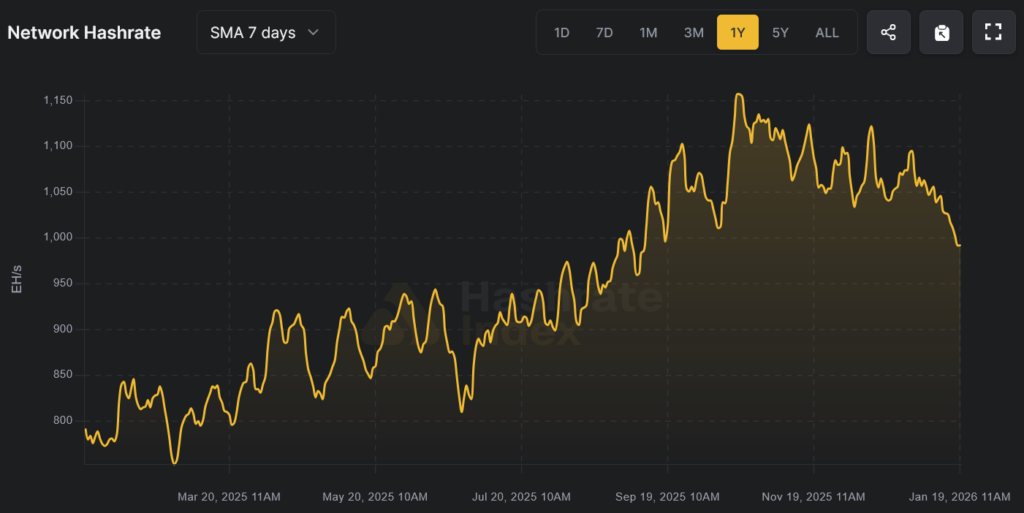
Paradoxically, the drop in hashrate is accompanied by a reduction in mining difficulty. Since November 2025, this difficulty has dropped from 156 to 146.5 trillion, making bitcoin mining more accessible. A boon for the remaining miners, but which does not compensate for the loss of overall network power.
The price of bitcoin, slightly increasing ($40 per petahash/day), is not enough to reverse the trend. As a result, miners, faced with high energy costs, prefer to invest in sectors like AI, where returns on investment are more predictable. A dynamic that could permanently weaken the Bitcoin ecosystem.
Towards coexistence between BTC and AI?
The future of Bitcoin mining will depend on its ability to adapt to this new competition. Players in the sector are already exploring ways to optimize their energy costs and diversify their activities. Some are even considering a hybridization between crypto mining and AI services, in order to maximize the use of their infrastructures.
In addition, regulators and states could play a key role in this transition. Favorable energy policies and tax incentives could help miners remain competitive. However, is this competition between bitcoin and AI a threat or an opportunity? Where some see it as a catalyst for innovation, others fear a gradual marginalization of BTC in the face of the irresistible rise of AI.
The fall in the Bitcoin hashrate is not an isolated phenomenon, but a symptom of a broader transformation in the sector. AI, in search of computing power, is redefining the rules of the game. To survive, bitcoin players will have to innovate and adapt. One thing is certain, this competition is only just beginning. And you, do you think that BTC can coexist with AI, or is it condemned to becoming a secondary player?
Maximize your Tremplin.io experience with our 'Read to Earn' program! For every article you read, earn points and access exclusive rewards. Sign up now and start earning benefits.


