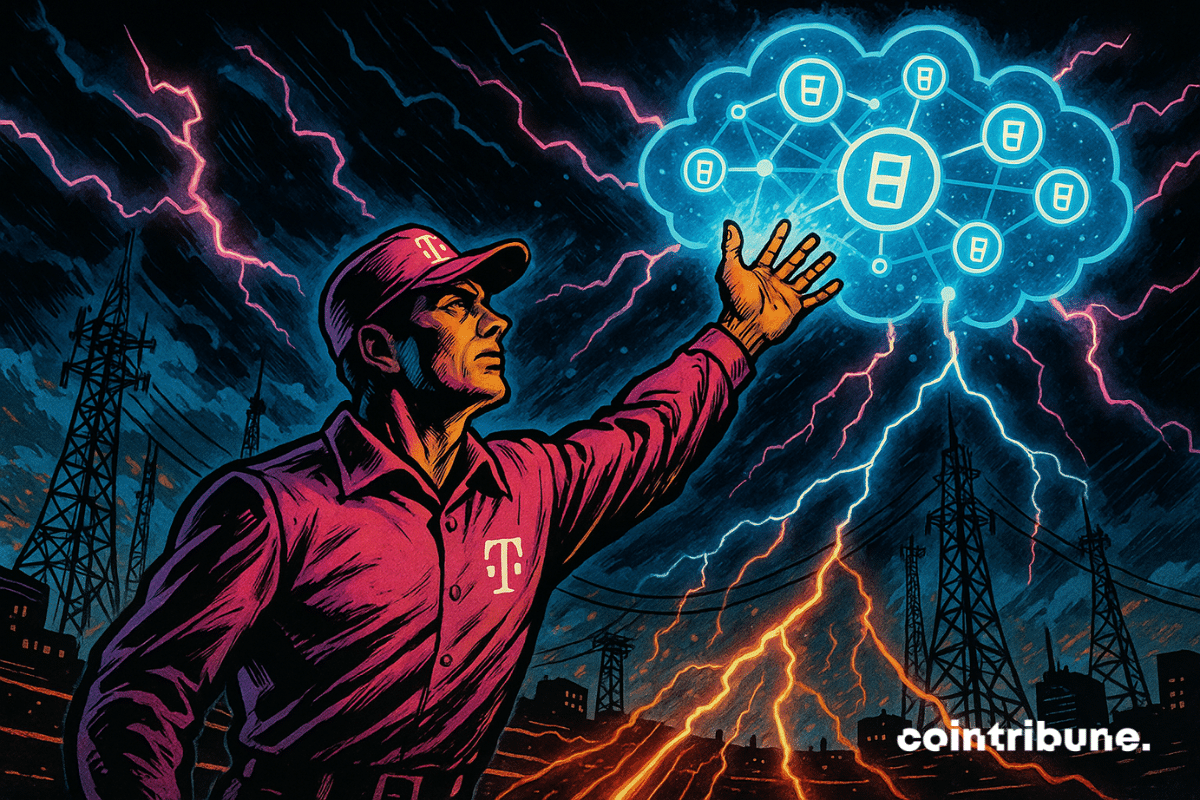
German company Deutsche Telekom has joined Theta Network as an enterprise validator, marking a major expansion of its involvement in blockchain and decentralized computing. By assuming this role, the telecom leader becomes part of Theta's growing group of corporate validators.
In brief
- Deutsche Telekom becomes the first telecommunications company to validate transactions on Theta's layer 1 blockchain network.
- The company will stake THETA tokens and receive TFUEL rewards while contributing to the security of Theta's decentralized ecosystem.
- Theta EdgeCloud connects edge nodes with cloud providers for efficient GPU-driven decentralized computing.
- The partnership strengthens Deutsche Telekom's Web3 strategy and expands its role in blockchain-based digital infrastructure.
This partnership marks a key step in the merger between blockchain and traditional telecoms
Theta Network announced this partnership, highlighting that Deutsche Telekom is the first telecommunications company to act as a validator on its blockchain. As part of this, the company will verify transactions and contribute to layer 1 network security via a public validator address. This advancement represents an important milestone for Theta's business ecosystem as well as Deutsche Telekom's involvement in blockchain technology.
As a validator, Deutsche Telekom will stake Theta's native THETA token and in return receive rewards in TFUEL, the operational token that powers transactions and payments within the Theta ecosystem. TFUEL also powers Theta EdgeCloud, the network's decentralized hybrid cloud platform designed to provide distributed GPU computing power.
Theta EdgeCloud connects community edge nodes with professional cloud providers to deliver computing resources more efficiently. By distributing workloads to edge nodes, the platform helps reduce latency and operating costs compared to traditional centralized (centralized) systems. It supports applications such as 3D modeling, real-time data processing and large-scale machine learning.
Deutsche Telekom's participation strengthens Theta's work in the decentralized cloud, particularly as demand increases for high-performance, scalable infrastructure. According to the company, joining Theta Network is a natural extension of its digital infrastructure strategy into blockchain-based environments.
Academic use cases demonstrate the technical potential of Theta
Dirk Roeder, head of Web3 infrastructure and solutions at Telekom MMS, said the decision was influenced by Theta's performance in demanding computing environments. He emphasized that Deutsche Telekom was attracted by the strong performance and security of Theta EdgeCloud.
The Telekom manager highlighted academic contexts where large AI models are developed and deployed as close as possible to the user. Theta's decentralized structure, he added, aligns with Deutsche Telekom's focus on secure and reliable digital infrastructure.
We have been impressed by Theta EdgeCloud's recent use cases focused on reliability, performance and security, particularly in academia, where large AI models are trained and deployed at close quarters. Theta's decentralized architecture aligns with our priority of reliable and secure infrastructure.
Dirk Roeder
Roeder explained that this collaboration supports Deutsche Telekom's broader digital strategy, which aims to explore emerging technologies and open up new growth opportunities.
Theta Network CEO and co-founder Mitch Liu welcomed Deutsche Telekom's involvement, describing it as a major milestone for decentralized cloud services serving the media and IT industries. Liu highlighted that Deutsche Telekom's long experience with blockchain makes it a key contributor to its Theta validator network.
Theta Network establishes itself at the heart of decentralized cloud growth
At the heart of this partnership is Theta EdgeCloud, a system designed to improve the efficiency and accessibility of computing for developers and businesses. Its architecture offers several key advantages:
- Hybrid structure: Combines community edge nodes with cloud partners for increased flexibility and balanced resource distribution.
- Decentralized Computing: Reduces dependence on centralized data centers, improves scalability and lowers costs.
- Performance-Oriented Design: Provides GPU-based processing for applications requiring fast rendering and analysis.
- Cost Efficiency: Utilizes idle IT resources to deliver affordable cloud capacity.
- Broad integration: Supports academic, industrial and media projects, allowing access to high-performance computing.
With these features, Theta EdgeCloud provides a flexible foundation for real-time, data-intensive tasks. Its network already supports partners such as the Houston Rockets and research institutions at Stanford University, Seoul National University and Singapore's NTU.
Deutsche Telekom's participation is expected to expand Theta's presence in enterprise computing markets, including those focused on AI-related workloads.
Deutsche Telekom's involvement with Theta Network adds to its growing Web3 portfolio, managed by its subsidiary Deutsche Telekom MMS. In recent years, the telecom provider has operated infrastructure and validator services for Ethereum, Chainlink and Polkadot, coloring the constant progress in blockchain integration.
Last year, Deutsche Telekom also collaborated with Bankhaus Metzler on a bitcoin mining pilot project powered by excess renewable energy. Carried out at Rival GmbH Engineering in Backnang, this project used excess energy that would have otherwise been lost due to grid limitations.
Maximize your Tremplin.io experience with our 'Read to Earn' program! For every article you read, earn points and access exclusive rewards. Sign up now and start earning benefits.