
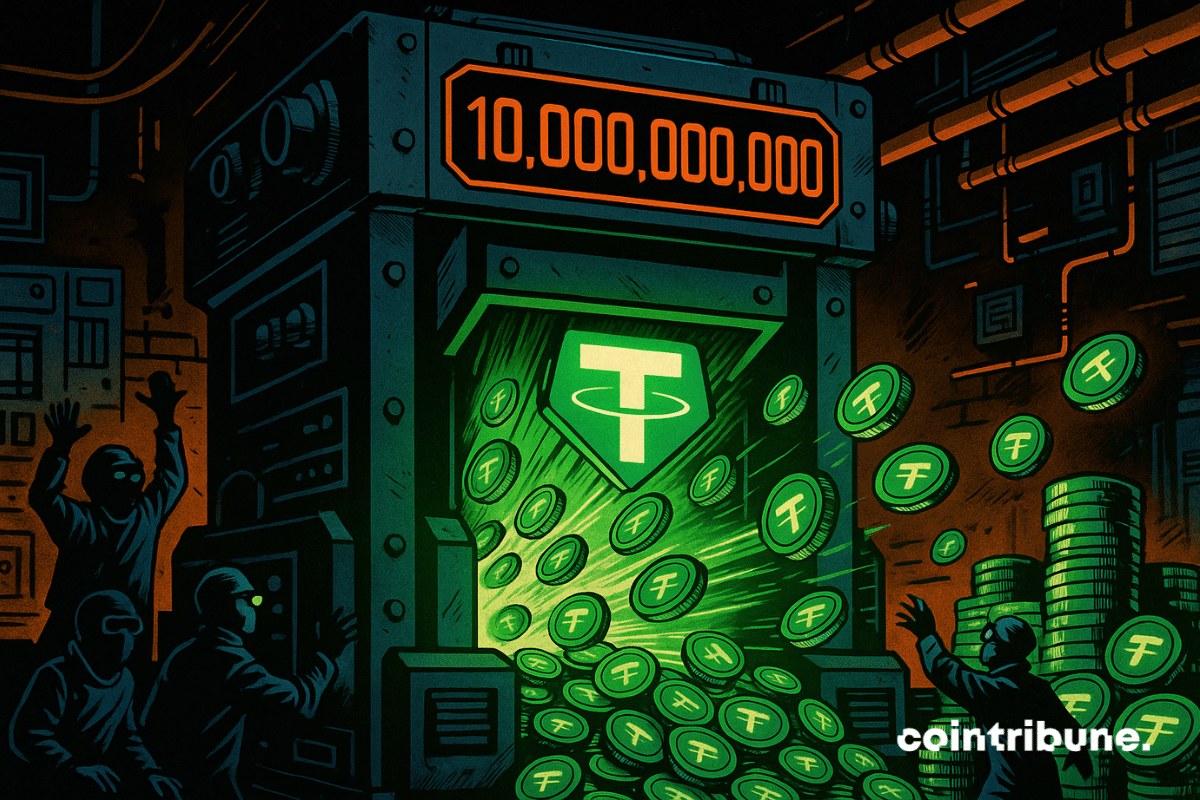
Tether has just crossed a dizzying threshold: more than $10 billion in profits in just nine months. Behind this extraordinary figure lies the rise of a player who has become essential in the crypto ecosystem. Issuer of USDT, the most used stablecoin in the world, Tether impresses as much as it questions. This record profitability, revealed in its latest attestation report, triggers as much enthusiasm as concerns, particularly in the area of transparency and regulation.
In brief
- Tether generated more than $10 billion in profits in nine months, an unprecedented performance in the crypto sector.
- This exceptional profitability is based on massive exposure to US Treasury bonds, estimated at $135 billion.
- The company also holds nearly $13 billion in precious metals and $10 billion in Bitcoin, illustrating a diversified investment strategy.
- Despite these results, Tether remains criticized for its lack of transparency, only publishing certifications instead of real financial reports.
Tether: A record quarter driven by US Treasury bonds
In the third quarter, Tether issued an additional $17 billion worth of USDT, cementing its status as the world's leading stablecoin issuer.
As Tether forecasts record profit of $15 billion in 2025, company says it has reached a symbolic milestone in its statement published last Friday and certified by the BDO firm: more than 10 billion dollars in cumulative profits during this year.
In July, Tether announced $5.7 billion in profits for the first two quarters. This implies that the third quarter alone generated at least $4.3 billion. “ Third Quarter 2025 Results Reflect Continued Confidence and Strength Around Tether, Even in a Challenging Global Macro Environment “, has asserted Paolo Ardoino, CEO of Tether.
This spectacular growth is mainly based on the performance of its reserves. Here is what we know, according to official information:
- $135 billion in exposure to US Treasury bonds, a significant increase, which ensures stable profitability thanks to the Fed's current monetary policy;
- $12.8 billion in investments in precious metals, a diversification that strengthens the strength of reserves;
- $10 billion held in bitcoin, signaling a hybrid strategy between stable assets and cryptos;
- Strongly expanding USDT distribution, with $17 billion in additional issuance in the third quarter, reflecting continued demand.
These figures confirm that Tether is today a central player in stablecoins, but also in digital capital markets.
Persistent opacity and divergent market signals
Despite the impressive figures, the very structure of Tether is challenging. As a private company registered in El Salvador, Tether does not publish full financial reports, but quarterly certificates prepared by the firm BDO.
This lack of standardized accounting transparency prevents any independent verification of the details of its income or the precise management of its reserves. Furthermore, if USDT remains the most used stablecoin, certain indicators show that Tether's dominance could be called into question. A recent analysis from JPMorgan highlights that Circle's USDC stablecoin is now growing faster in terms of on-chain activity and capitalization.
This contrast is significant. While Tether announced that it had exceeded 500 million users in October, Bloomberg revealed in September that the company was in talks with investors to raise up to $20 billion, based on an estimated valuation of $500 billion. A colossal ambition, which fuels both admiration and concern.
The lack of regulatory oversight, coupled with massive reserves concentrated in US sovereign assets, is fueling debate over the role Tether now plays in the“shadow banking”crypto.
It is therefore the limits of the Tether model that are of concern. Its current profitability is largely based on a favorable monetary environment, notably the Fed's high rates, but what will happen if these conditions turn around? Additionally, as Tether moves closer to a near-systemic role in the crypto market, expectations for governance, regulation, and transparency will only grow.
With more than $10 billion in profits, Tether, issuer of the USDT stablecoin, confirms its strategic weight in the crypto ecosystem. However, this success is accompanied by gray areas. Transparency, regulation and governance will be the key issues of the coming months for a player that has become essential… and is now under increased surveillance.
Maximize your Tremplin.io experience with our 'Read to Earn' program! For every article you read, earn points and access exclusive rewards. Sign up now and start earning benefits.


