Traditional investment benchmarks are faltering. Faced with market volatility and the erosion of confidence in traditional portfolios, more and more American investors are turning away from stocks and bonds to explore assets deemed more dynamic: crypto, gold, oil, private equity. This movement reflects a profound questioning of established models, driven as much by distrust as by the quest for efficiency and freedom. A structural change confirmed by the latest figures from the Charles Schwab survey.
In brief
- A Charles Schwab survey reveals that 45% of American investors are interested in alternative assets like crypto, gold or oil.
- Two thirds of respondents believe that stocks and bonds are no longer enough to build a solid portfolio.
- The rise of alternative ETFs allows simplified access to these assets, with more than $1,000 billion injected in 2025 in the United States.
- Recent regulatory developments make it easier to integrate alternative assets into savings and retirement plans in the United States.
The massive appeal of alternative assets
While Trump's tariffs have wreaked havoc on the crypto market, a recent study published by Charles Schwab reveals a major shift in investment behavior in the United States.
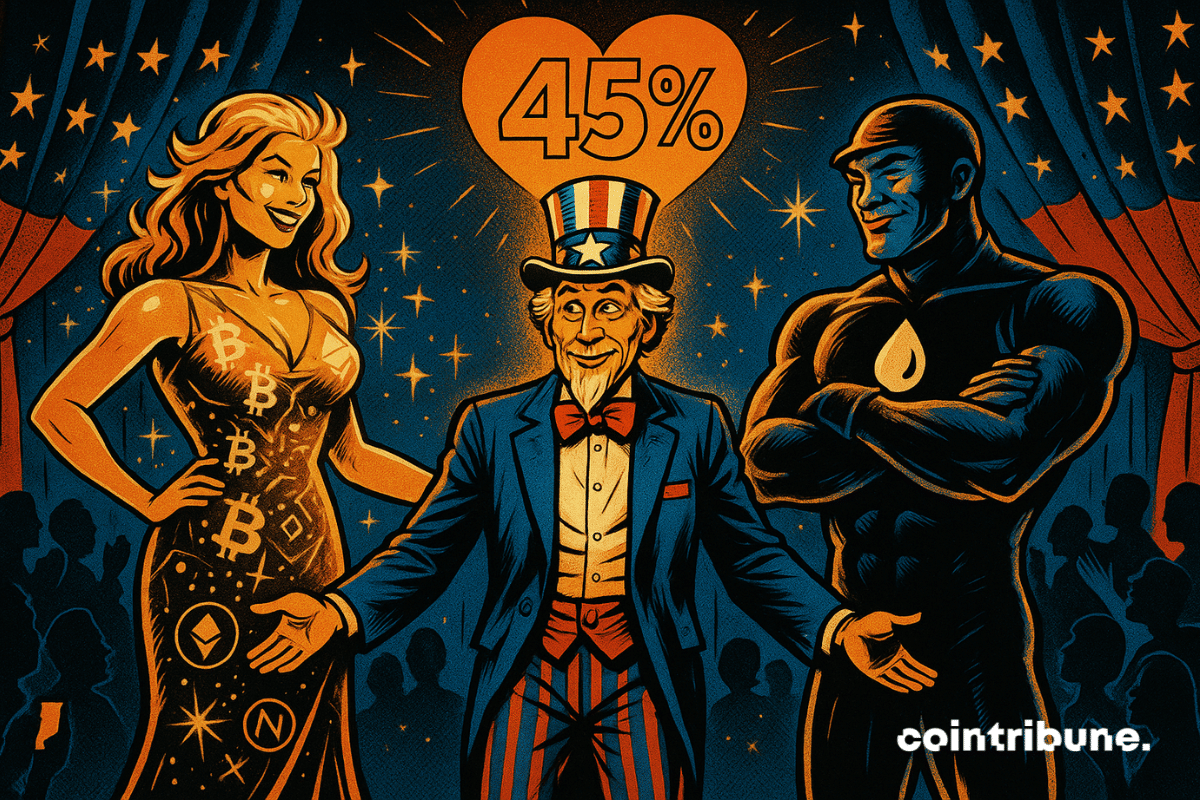
Indeed, 45% of investors surveyed say they want to place their money in non-traditional assets, a category that includes cryptos, commodities such as gold or oil, unlisted real estate, private equity and even hedge funds.
This desire for diversification is also supported by a rejection of the conventional portfolio. “Two thirds of those surveyed believe that limiting themselves to stocks and bonds is no longer sufficient”, asserts the report. An explicit loss of confidence in traditional strategies which, according to analysts, reflects a generational and structural turning point in wealth management.
In this context, ETFs (exchange-traded funds) play a central role. They allow investors to access these complex assets without being subject to the traditional constraints of private placements. According to State Street Investment Management, more than $1 trillion has been pumped into ETFs in the United States this year, a significant portion having gone to ETFs linked to gold and cryptosaccording to CNBC. Several reasons explain this enthusiasm:
- Accessibility: ETFs can be bought and sold at any time, including outside market hours, unlike many private funds;
- Liquidity: investors are no longer subject to lock-up periods or restricted exit windows;
- Administrative simplification: they avoid the complex formalities often associated with unlisted alternative products;
- Controlled exposure: they allow a measured and progressive approach towards more volatile asset classes.
“These private investments often have lock-up periods of several years and restricted redemption windows”recalls Cathy Curtis, director of Curtis Financial Planning. For her, ETFs are an interesting entry point, but not without limits: “for small portfolios, alternatives must be limited to 5%. Larger portfolios can go up to 10–15% ».
A change driven by youth and favored by crypto regulation
Beyond the figures, the survey reveals an important generational phenomenon. Young investors, particularly Millennials and Generation Z, are among the most likely to abandon traditional savings models in favor of solutions perceived as more daring.
Charles Schwab included 200 Gen Z investors as well as 200 crypto investors in its panel, in order to better capture this trend. The observation is clear: a large part of the young people surveyed reject traditional recommendations in favor of what some analysts already call a form of “financial nihilism”where we prefer to explore new asset classes, even if it means assuming more volatility.
This shift is not only carried by individuals. It is also facilitated by the regulatory environment. The Trump administration signed an executive order in August to make alternative assets more easily integrated into workplace retirement plans, a move that could open access to these products to millions of American workers.
At the same time, the SEC has relaxed certain rules, notably those governing the launch of spot crypto ETFs, making their arrival on the market faster and more fluid. These two measures combined could transform investing in alternative products, expanding their adoption well beyond sophisticated investor circles.
As the appetite for alternative assets gains ground as evidenced by the strong rebound in Bitcoin and Ethereum ETFs, a redefinition of investment models appears to be underway. Between regulatory openness and financial innovations, traditional boundaries are gradually disappearing, revealing a new heritage architecture, more diversified, but also more demanding.
Maximize your Tremplin.io experience with our 'Read to Earn' program! For every article you read, earn points and access exclusive rewards. Sign up now and start earning benefits.