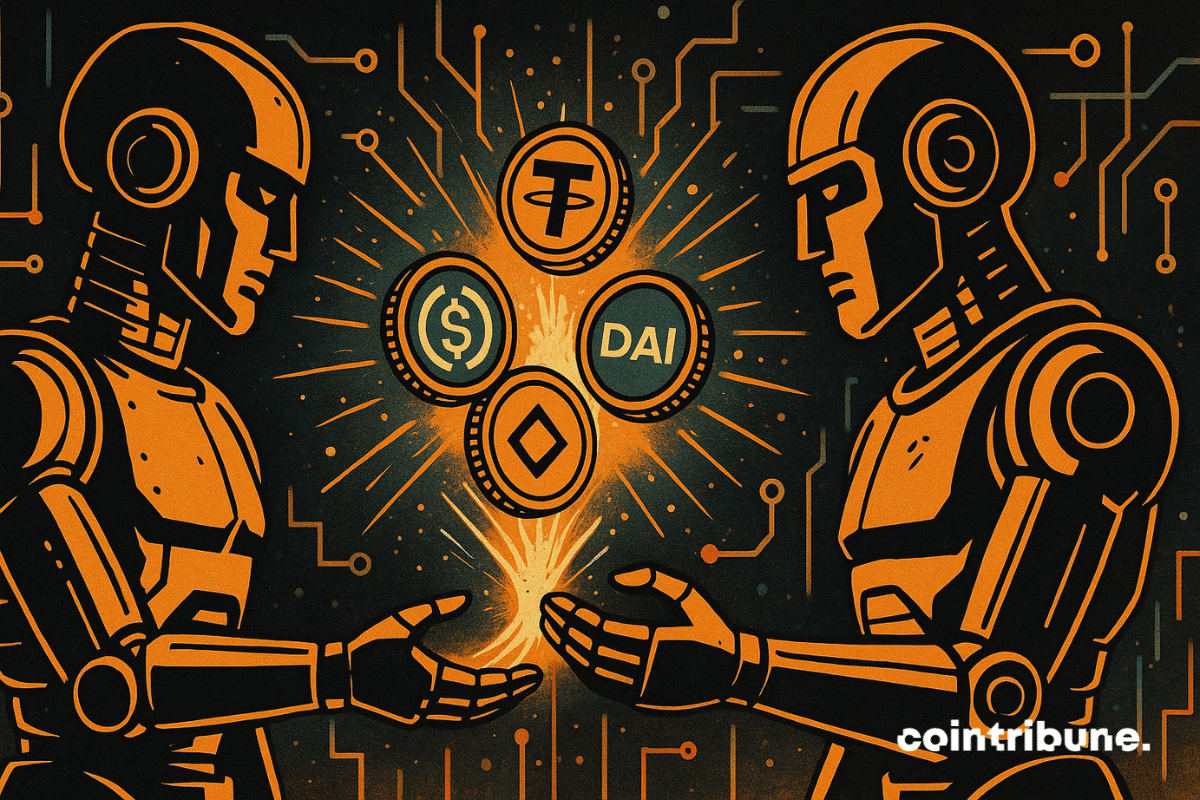
What if your software soon took charge of your payments, without you? Google takes one more step towards this reality by launching an unprecedented protocol: its intelligent agents can now exchange money between them, via bank cards and stablecoins backed by the dollar. This project, supported by Coinbase and other companies, opens the way to an automated economy, where AI are no longer content to assist you … but act for you.
In short
- Google launches an open-source payment protocol allowing its IA agents to exchange money between them.
- This system supports both traditional bank cards and stablecoins indexed to the dollar.
- he Protocol is part of the agent-to-agent project (A2A), aimed at standardizing interactions between smart software.
- Coinbase, Salesforce, American Express and more than 60 companies have participated in its development.
Google launches an inter-agent payment protocol with Stablecoin support
This Tuesday, Google unveiled an open-source payment protocol allowing IA agents to exchange value between them via classic bank card rails and stablecoins backed by the dollar, after the launch a few months ago from Gemini 2.0.
This announcement marks a significant extension of the framework “Agent-to-Attent” (A2A), presented last April by Google, which aimed to standardize interactions between smart software. From now on, this framework incorporates mechanisms for verifying user consent, securing transactions and automated payment, whether via blockchain or traditional payment networks.
This infrastructure could transform AI agents into “Buyers, intermediaries and automated management agents”capable of acting and paying independently.
The protocol was co-developed with Coinbase, and developed in consultation with more than 60 partner companies, including Salesforce, American Express and Etsy. Here is key elements Protocol:
- Agent-to-agent interoperability: AI agents can now communicate, but also transfer value to each other;
- Multi-rail support: Payments can pass through conventional bank cards or stablecoins backed by the dollar;
- Integrated security: verification of user consent and implementation of transactional safeguards;
- Traceability and auditability: Each transaction is designed to be verifiable and integrable into business systems.
It is therefore not a marginal experimentation, but a robust protocol, designed to fit into production environments, with an architecture intended for the automation of financial flows in a professional context.
A global blockchains integration strategy by Google Cloud
Beyond the launch of the protocol itself, this initiative fits into a general Google Cloud strategy, which has been looking for several months to build programmable financial infrastructure for institutions.
This ambition had already resulted in the Universal Ledger project, a pilot aimed at creating a settlement infrastructure compatible with both traditional financial systems and blockchains.
In a statement, James Tromans, web3 director at Google Cloud, clarified that the new payment protocol has been designed “Designed from the outset to take care of both traditional infrastructure and stablecoins”emphasizing the objective of systemic interoperability between web2 and web3.
For example, Ethereum Foundation also announced the creation of a team dedicated to decentralized artificial intelligence, called DAI, in order to position Ethereum as a confidence base for the ECC economy.
This growing competition between centralized and decentralized actors reveals that the automated web3 race is now fully engaged, each camp focusing on its assets: the scale and integration on one side, resilience and transparency on the other.
Maximize your Cointribne experience with our 'Read to Earn' program! For each article you read, earn points and access exclusive rewards. Sign up now and start accumulating advantages.