
The advent of Stablecoins questions. Are they a simple payment innovation or an existential threat to traditional banks? Their market continues to grow, already exceeding the two dollars of transactions in 2024. In this context, Coinbase advances a clear response: the idea that stablecoins empty the banking chests would be a myth. But the battle of narratives between banks and crypto actors has only just begun.
In short
- Coinbase denounces the “myth” according to which the stablecoins empty the deposits of American banks.
- Half of the stablecoins transactions in 2024 took place outside the United States.
- Banks collect $ 187 billion each year thanks to the costs linked to card payments.
- $ 3.3 billions of bank deposits sleep at the Fed, generating $ 176 billion in interest.
When the banks agitate the scarecrow of siphoned deposits
American banks speak of a systemic risk: according to them, the stablecoins, the market of which is estimated at $ 301 billion, would aspire the deposits and weaken the credit. A Treasury Borrowing Advisory Committee report even talks about up to 6 trillions of dollars in flight. Coinbase dismantles this calculation, recalling that the same report anticipates only 2 billions of capitalization for stablecoins in 2028. The equation does not hold.
For Exchange, stablecoins are not savings accounts, but payment tools. Paying an Asian supplier in Stablecoins is not a withdrawal of savings is just to avoid a slow and expensive transfer. The majority of transactions take place outside the United States: out of the two Billions treated in 2024, a trillion circulated in Asia, Latin America and Africa.
In his reportCoinbase insists:
Stablecoins do not threaten credit – they offer a competitive alternative to $ 187 billion in annual banks related to card costs. Institutions that brandish today the spectrum of “ Systemic risk ”are the same ones who pocket tens of billions thanks to the processing costs of the cards, which the stablecoins could bypass fully.
Crypto, stablecoins and banks: a fight for $ 187 billion
Behind the varnish of the debate, it is a trade war. US banks collect around $ 187 billion in card costs each year. However, stablecoins allow fast payments, 24/7, without going through these circuits. No wonder Wall Street is sounding the alarm.
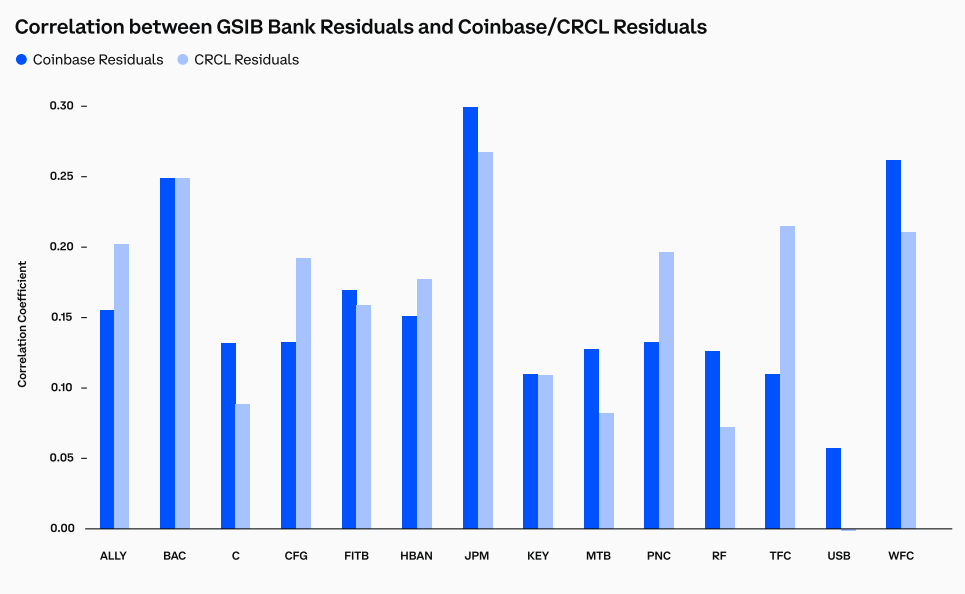
Coinbase also underlines the contradictions of the banking sector. If the deposits were missing, the remunerative rates would climb. However, banks prefer park 3.3 $ trillion at the Fed, earning $ 176 billion in interest in 2024, rather than lending more. The real subject is not credit, but the defense of juicy margins.
Some figures that change the look
- 2 billions $ of stable -coin transactions in 2024;
- 1 Billion $ treated outside the United States. ;
- $ 3.3 billions of dormant bank deposits at the Fed;
- $ 187 billion in annual fees generated by bank cards;
- $ 176 billion in interest collected by banks thanks to the reserves.
This frontal opposition illustrates a shock of models: crypto innovation open against protected banking rent. Crypto industry associations call on congress to support competition, via the Genius Act, rather than ratifying the domination of historical actors.
The future of global payments could be played on this battle: to protect banking profits or strengthen the role of stablecoins. If the United States chooses a permissive route, Europe seems to take the opposite direction. Faced with the rise of foreign stable currencies, Christine Lagarde recently promised to harden the tone so that the old continent takes over.
Maximize your Cointribne experience with our 'Read to Earn' program! For each article you read, earn points and access exclusive rewards. Sign up now and start accumulating advantages.


