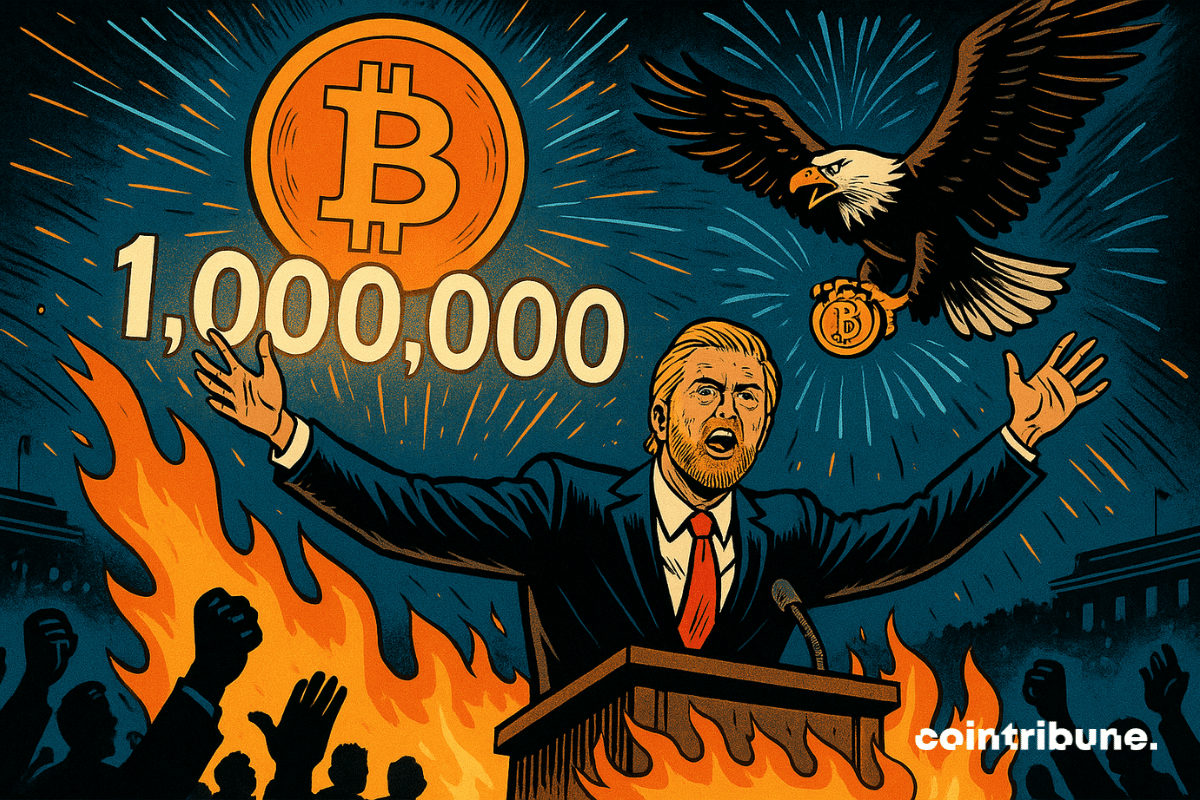
While cryptos are essential in the global political and financial agenda, some statements resonate with a particular intensity. In Hong Kong, during Bitcoin Asia Conference, Eric Trump said Bitcoin would reach a million dollars. Much more than an announcement effect, this prediction reflects a strategic vision: that of a rapidly changing market, torn between regulation, institutional adoption and geopolitical ambitions, where Asia now plays a central role.
In short
- Eric Trump caused the Bitcoin Asia conference, saying Bitcoin will once reach a million dollars.
- This declaration, far from being a simple provocation, is part of a positioning strategy on an evolving market.
- The overall context of cryptos is marked by an acceleration of regulations, technical innovations and the massive arrival of institutional actors.
- The release of Eric Trump sparked contrasting reactions in the crypto ecosystem, between skepticism, enthusiasm and opportunism.
An industrial and financial vision of Bitcoin
During his intervention at the Bitcoin Asia conference in Hong Kong, Eric Trump surprised the audience by the firmness of his convictions, while his family is more involved in mining.
“There is no doubt that Bitcoin will reach a million dollars,” he said, triggering an enthusiastic reaction. He has qualified assets of “the largest reserve of value ever created” and “the greatest active in the world”highlighting its long -term potential as a value reserve.
To illustrate this vision, he revealed to be directly involved in the mining industry with American Bitcoin, a company he co -founded and whose ambition he clarified: an upcoming entry into the Nasdaq.
In this same speaking, Eric Trump detailed Several factual elements who underlie his confidence in the evolution of the BTC price:
- American Bitcoin would currently produce around 3 % of the world's BTC, according to its declarations;
- The cost of producing a bitcoin within its structure would be around $ 37,000;
- Institutional adoption widens via conventional channels such as childcare services, retirement plans or investment funds;
- Major actors (sovereign funds, high net value families, fortunes of fortune 500) would actively discuss the integration of the BTC into their portfolios;
- The enthusiasm of individuals would remain, according to him, strongly fueled by the easy access to bitcoin via traditional platforms.
This constructed discourse aims to present Bitcoin no longer as a speculative asset, but as a serious financial infrastructure, endowed with solid technical and economic fundamentals, and ready to seduce large institutions.
China and the United States, rival powers in the crypto arena
Beyond the economic aspects, Eric Trump gave a geopolitical reading of the development of Bitcoin, saying that the United States and China clearly lead the crypto race.
An observation that may surprise, given the drastic restrictions imposed by Beijing. Indeed, China officially prohibits trading and Cryptos mining, although, paradoxically, it still controls 16.61 % of the world hashrate, compared to almost 50 % before 2020.
Eric Trump praised China's technological power in the crypto ecosystem, declaring: “There is no doubt that China is a sacred power in the activity around Bitcoin”.
The role of China goes beyond a residual mining activity. The country is also ahead of the development of digital central bank currencies (CBDC), with a digital yuan which is among the most advanced projects in the world.
Some actors also mention a possible detention of 190,000 BTC by China, an estimate that several analysts on-chain consider overestimated. Despite the regulatory hostility of Beijing, the country's technological and strategic imprint in the crypto remains undeniable.
As a perspective, Trump spoke of Bitcoin as a potential diplomatic tool capable of connecting cultures and having its place in bilateral discussions between the United States and China, even if it concedes that other priorities will probably dominate the agenda. This geopolitical positioning poses a fundamental question: could Bitcoin become a lever of soft power, as evidenced by a controversial dinner with Trump, even a strategic issue in international relations? If this hypothesis is still speculative, it reflects a conviction shared by an increasing part of the elite.
Maximize your Cointribne experience with our 'Read to Earn' program! For each article you read, earn points and access exclusive rewards. Sign up now and start accumulating advantages.