
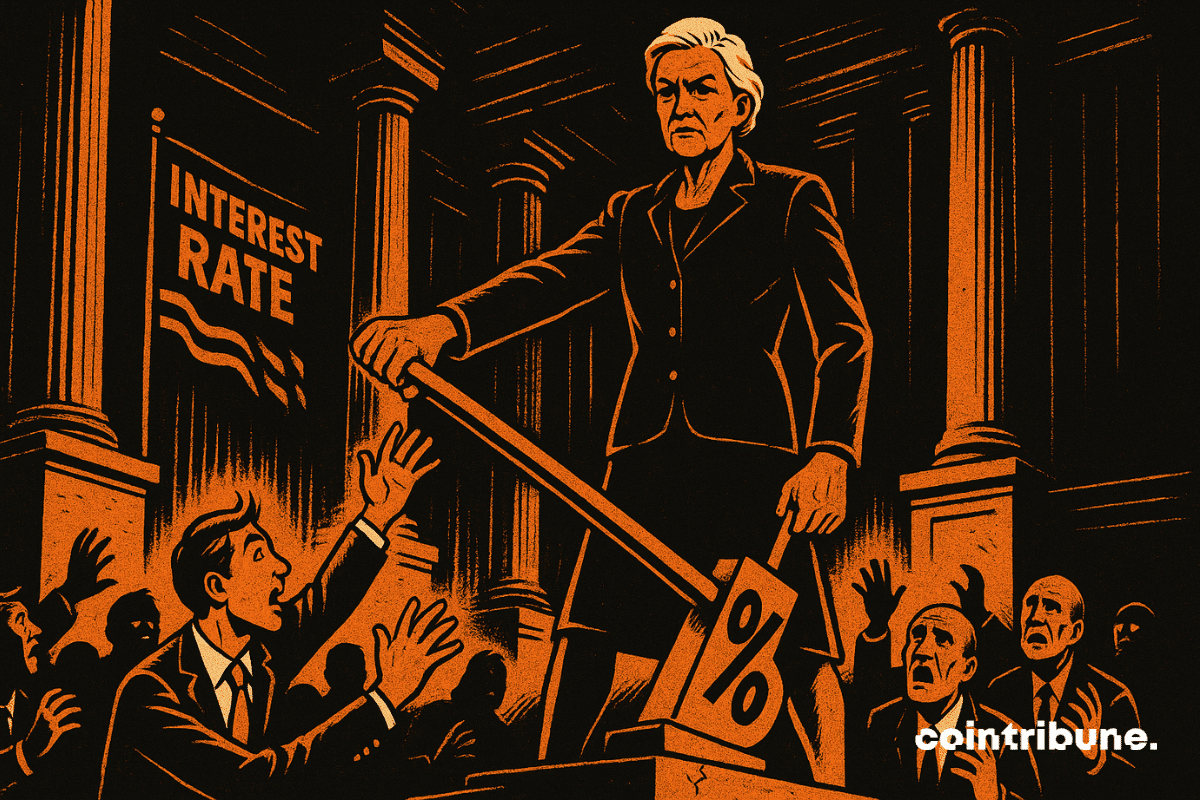
While the majority anticipated a drop in Fed rates in September, a key indicator is sowing doubt. The publication of the last production price index (PPI) revives inflationary fears and cools the hopes of monetary easing. This subtle reversal, but heavy with meaning rebatses the cards in a context where the Fed policy dictates the tempo of risky assets, and more than ever, that of the Crypto market.
In short
- The financial markets, which largely anticipated a drop in Fed rates in September, begin to doubt.
- The publication of the last production price index (PPI) revives tensions around inflation more persistent than expected.
- Prediction platforms like CME, Kalshi and Polymarket show a subtle but real shift in investor anticipations.
- The probability of a decrease of 25 base points remains the majority, but the scenario of a status quo wins the field.
The dynamics of a monetary pivot questioned
Until recently, the drop in rates in September seemed almost acquired, as anticipated Goldman Sachs. The CME (Chicago Mercantile Exchange) market, via its Fedwatch tool, still attributed a 96 % probability of a reduction in the key rate to 4.00–4.25 %.
However the wind turned. Following the publication of the PPI of July, This probability has slipped at 92.8 %. A modest correction in appearance, but revealing a change of perception. The market is starting to doubt. And these doubts also extend to other prediction platforms.
On Kalshi, A decrease of 25 basic points in September There remains the most envisaged scenario with 76 %, but the rate of status quo increases to 21 %, signaling growing prudence.
Market platforms reflect this anticipation shift in an encrypted and unambiguous way:
- CME Fedwatch Tool: 92.8 % probability of a drop to 4.00–4.25 % (compared to 96 % before) and 7.2 % probability of the rate maintenance;
- Kalshi: 76 % of bettors anticipate a drop of 25 basic points, 21 % envisage a status quo, and 4 % bet on a higher drop (> 25 BPS);
- Polymarket: 72 % probability of a decrease of 25 basic points, 23 % for a status quo, 5 % for a drop of 50 bps, and 1 % for an increase.
These differences, although tenuous, reflect a slow, but tangible reconfiguration of anticipations. The publication of the PPI has reminded that inflation is not under control, which complicates the argument of a rapid monetary pivot.
Even if the majority of the market is still leaning for a softening, operators adopt a more measured tone, reflecting an increased consciousness of latent macroeconomic risks.
Inflation reappears and blurs the perspectives
The inflection observed on polymarket illustrates the magnitude of the situation. Indeed, the probability of a monetary status quo in September now reaches 23 %, a significantly higher level than at the beginning of the month.
At the same time, the scenario of a drop of 25 base points loses a few points and falls to 72 %, when that of a more marked reduction (50 base points) remains marginal to 5 %. If the Fed adopts an approach based on economic data, as it has repeated for several months, the issue becomes clear: each macroeconomic indicator, inflation, employment, growth, is now likely to redistribute cards.
This nervousness results from an indicator, the PPI, which, although less publicized than the ICC, is scrutinized for its advanced signals on inflationary pressures. An unexpected increase at this level feeds the scenario of more rooted than expected inflation.
It places the Fed in a delicate posture: maintain the unchanged rates despite the risk of slowing down, or lower them by running the risk of stirring a new wave of prices. No scenario is simple, and it is precisely this complexity that is reflected in the current volatility of monetary expectations.
In this pending monetary environment, Bitcoin is no exception to turbulence. Long considered a refuge value in the face of inflation, the asset has gradually adjusted to the rate of rate policies. The more declining anticipations retreat, the more the flows towards cryptos slow down.
The current uncertainty on the Fed trajectory thus fuels latent volatility on the crypto market, slowing down the bull -up impulses observed in recent weeks. The operators remain on the lookout for a clear monetary signal before repositioning their strategies.
In the longer term, this uncertainty could have wider consequences on the markets, especially those of cryptos. A hesitant Fed, perceived as less predictable, could strengthen volatility on bitcoin and altcoins, already sensitive to rate movements. The next CPI publications, employment figures and speeches of FOMC members will therefore be decisive.
Maximize your Cointribne experience with our 'Read to Earn' program! For each article you read, earn points and access exclusive rewards. Sign up now and start accumulating advantages.


