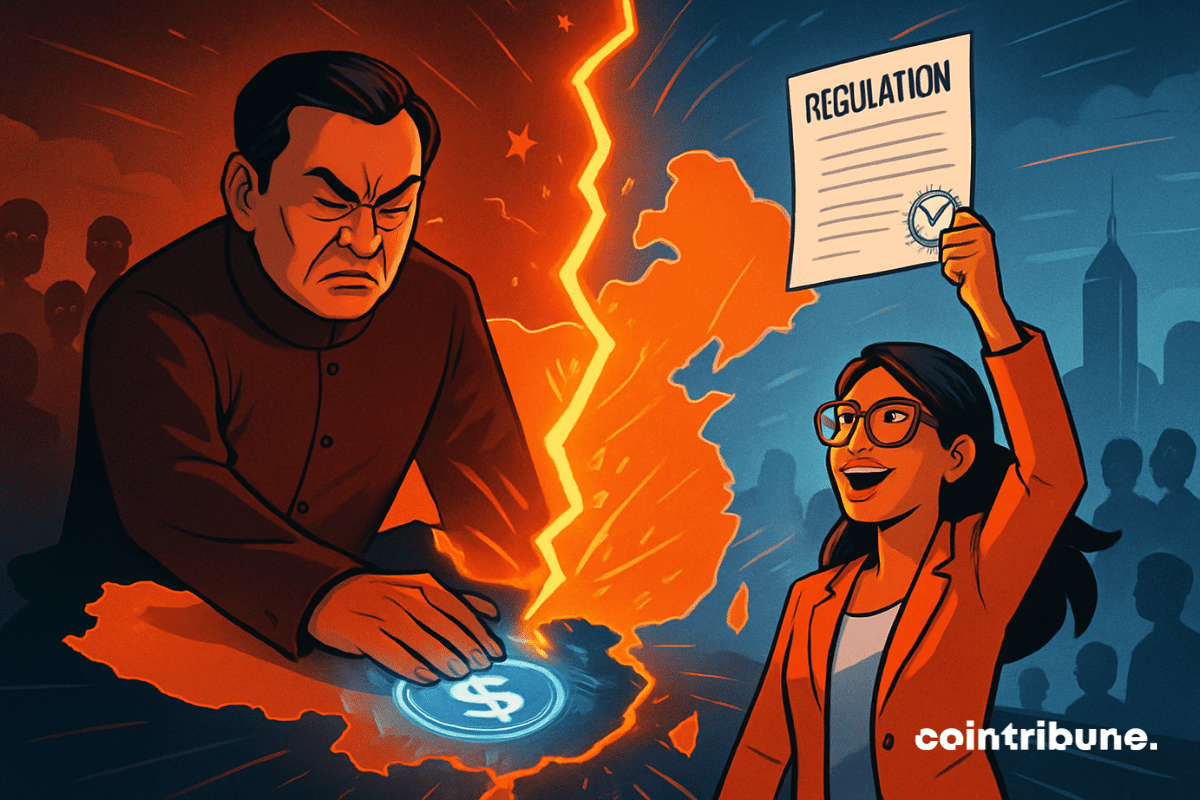
Beijing tightens its grip on the activity of Stablecoins, by ordering the main financial institutions to cease any promotion of this class of digital assets. To curb the growing craze and limit speculative risks, regulators demanded brokers, think tanks and research teams that they cancel seminars devoted to stablecoins and stop publishing linked content.
In short
- Beijing intensifies the repression of stablecoins to slow down fraud and speculative risks.
- Hong Kong adopts the regulation of stablecoins, positioning itself as a hub of digital finance.
- China promotes the expansion of the digital yuan while the United States pushes the regulated stablecoins backed by the dollar.
Repression in full rise in interest in stablecoins
Published at the end of last month, the directive is a new sign of prudence from China to cryptocurrency, in particular tokens backed by the US dollar. It reflects a growing concern in the face of fraud, illegal capital lifting and the investment frenzy of individuals.
Shenzhen authorities have recently warned of scams disguised in stable placements, one example among others of the national concerns around these assets.
As Bloomberg reported, continental China officially prohibits transactions in cryptocurrencies, but Owl exchanges (OTC) remain active. According to Chainalysis, OTC flows could reach $ 75 billion by the end of the first half of 2024.
Beyond the risks of fraud, regulators also fear mass behavior from private investors. Fear: that a speculative wave does not cause large -scale financial instability, in a context where the majority of consumers have only superficial knowledge of digital assets. The government therefore acts preventively to limit exposure before the situation degenerates.
Hong Kong traces his own way
While continental China hardens the tone, Hong Kong adopts an opposite approach. The City recently established a regulatory framework to supervise stablecoins issuers, attracting the attention of companies on the continent.
Thanks to the principle “a country, two systems”, Hong Kong retains an autonomy allowing it to build its own regulation. The city is thus positioned as an experimentation field for innovation in digital finance in the region.
This regulatory divergence is far from harmless: she suggests that Beijing sees Hong Kong both as a laboratory to test digital assets and as a rampart against risks. At the same time, the Banque Populaire de China (PBOC) continues the development of its digital central bank currency. It recently inaugurated in Shanghai an international operations center intended to promote the cross -border use of the Digital Yuan.
Global prospects are taking shape
While China is advancing with caution, the United States has opted for official supervision. The Genius law, recently adopted, establishes a legal framework for stablecoins backed by the dollar. This comparison highlights the Chinese strategy: promoting an exploration supervised via official channels while sanctioning unauthorized practices.
Maximize your Cointribne experience with our 'Read to Earn' program! For each article you read, earn points and access exclusive rewards. Sign up now and start accumulating advantages.