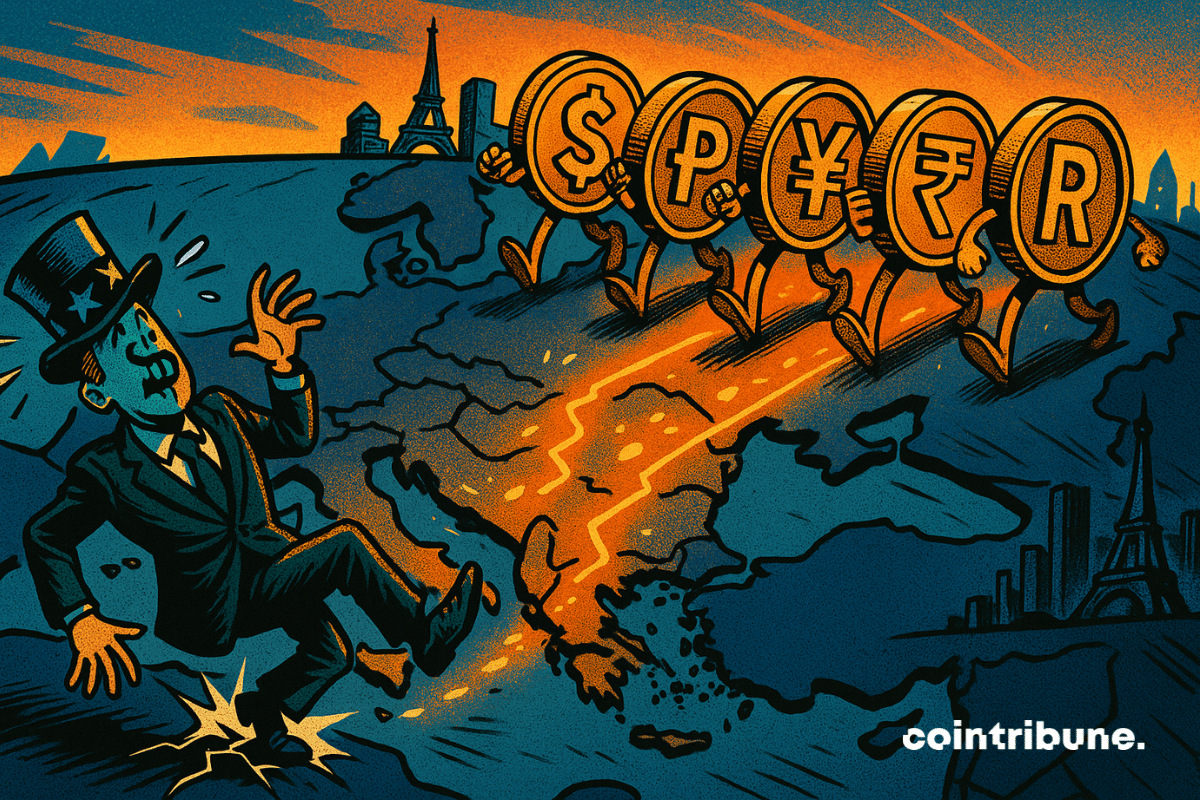
With the knowledge of the general public, a monetary rocking takes place in Europe. The US dollar loses ground there. Since the beginning of the year, companies and foreign funds have required regulations in local currency, revealing a strategic fracture at the heart of continental finance. This movement, far from being anecdotal, is aligned with the ambitions of the BRICS, determined to erode the hegemony of the greenback. Discreetly, it is the very architecture of international exchanges that vacillates, under the leadership of an emerging alliance in search of economic sovereignty.
In short
- The US dollar loses field in Europe, where companies are now requiring transactions in local currencies.
- European banks and financial institutions receive more and more requests to bypass the dollar in the regulations.
- This development is part of the BRICS strategy to promote local currencies on the world scene.
- Financial technology and increase in liquidity today facilitate direct regulations between non -American currencies.
A new deal on European exchange offices
Requests from European customers to make local currencies transactions rather than dollars are increasing.
According to Revelations of Luxembourg Timesseveral European banks, brokers and financial entities have faced a unique development for a few months in the way their international customers wish to carry out their transactions.
For the first time, foreign institutional funds expressly ask to avoid the US dollar in the regulations. European financial institutions receive requests for transactions, including covers (Hedges), which bypass the US dollar.
These requests relate to the direct use of local currencies such as the Chinese Yuan, the Dirham Emirati, the Hong Kong dollar or even the euro. The phenomenon, although discreet, is described as a significant inflection by the actors concerned.
This questioning of the pivotal role of the dollar in international flows is observed concretely in several operational cases. For example, when a Japanese company transferred money to a fund based in the Philippines via a European bank, the classic scheme first involved a conversion to dollars before a new change to the Peso Philippin.
Now customers demand that this intermediate step be deleted. Requests relate in particular to:
- The abandonment of the dollar as a currency in international transfers;
- Direct treatment in local currencies even in transcontinental operations;
- Tax and regulatory optimization thanks to the simplification of monetary circuits;
- An ideological response aligned with the objectives of the BRICS Alliance, which aims to assert regional economic sovereignties in the face of the hegemony of the greenback.
This shift is clearly integrated into the strategic line promoted by the countries of the BRICS, which have been calling for several years in a reconfiguration of the global monetary system.
The fact that these requests today reach European compliance firms demonstrates that this ideology goes beyond diplomatic speeches. It begins to transform the concrete practice of global payments.
A change favored by technology and market conditions
If the geopolitical ideology of the BRICS promotes this dynamic, the technical springs that make it possible are just as decisive.
Gene Ma, Chinese research director at the Institute of International Finance (IIF), identifies the two main levers: “The increase in transactions between non -American currencies is mainly due to technological development and the increase in liquidity”.
In other words, it is not only a rejection of the dollar that motivates the actors, but also the growing perception that direct regulations between local currencies are technically viable, faster and not necessarily more expensive.
The currency derivative market illustrates this trend. Also according to reported information, requests for derivative products to cover yourself against fluctuations in local currencies, without using the dollar, are on sharp rise.
These tools were previously little used outside the Dollar circuit, but the rise in Endtech infrastructure and the diversification of liquidity pools make these strategies more accessible.
The inheritance of trade tensions between the United States and several regional blocks, initiated by Donald Trump, also weighs on the confidence of investors in the role of monetary pivot of the greenback. Even if the American tariff measures are now on a break, the climate of uncertainty persists.
Maximize your Cointribne experience with our 'Read to Earn' program! For each article you read, earn points and access exclusive rewards. Sign up now and start accumulating advantages.