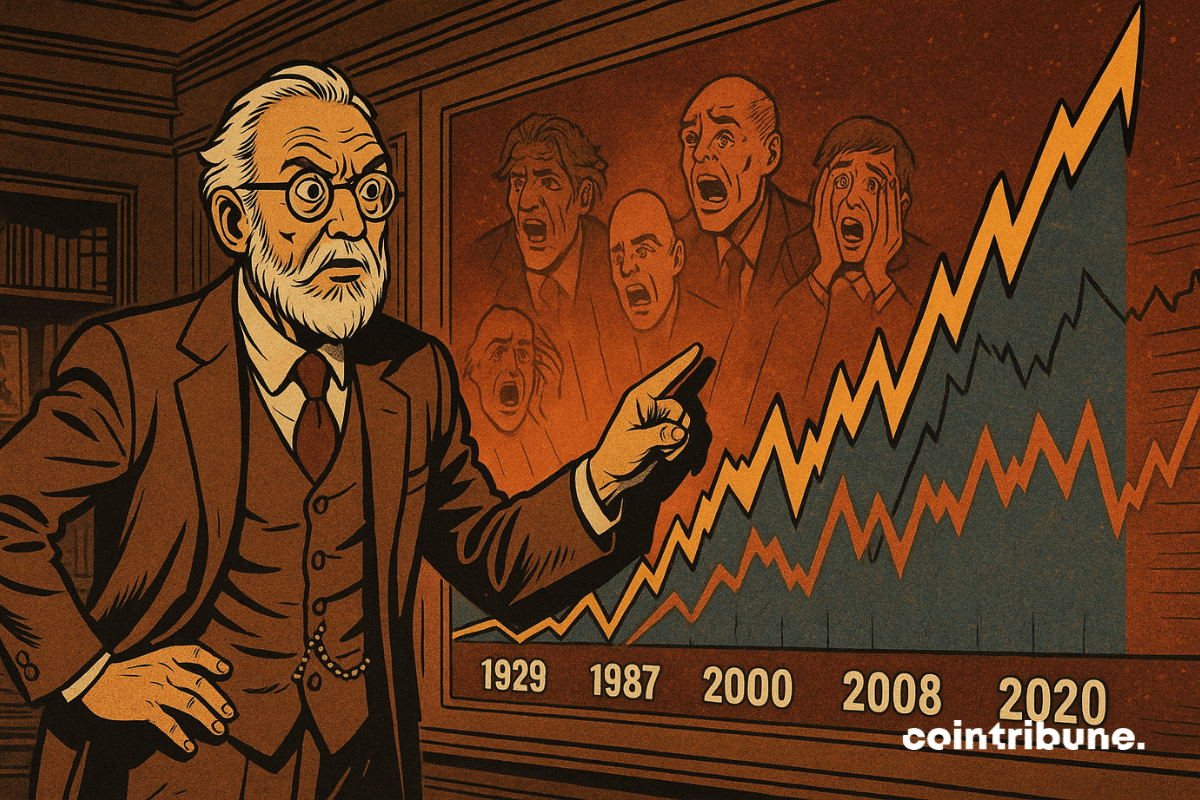
What if the markets followed a tempo that escapes economic logic? While American GDP is back, the S&P 500 bounces after a flash fall of almost 20 %. This unexpected turnaround, nourished by contradictory signals, intrigues even in market rooms. Indeed, in BNP Paribas, the strategists wonder: does this dazzling correction are inserted in a global tradition? To understand this, they plunge back into a century of history of stock market crash.
In short
- The S&P 500 experienced a brutal fall of almost 20 % between February and April 2024, baptized the “Tariff Crash”.
- BNP Paribas analysts compare this decrease to other historic krachs that occurred without recession.
- Their study, based on 100 years of data, shows that some violent crash can be temporary and quickly corrected.
- Several positive economic signals, including solid job creations and a rebound in clues, have supported the resumption of the market.
A Krach without recession?
Between February 19 and April 8, 2024, the S&P 500 index lost almost 20 %, and increased from 6,144.15 to 4,982.77 points. This downward sequence, which BNP Paribas analysts have baptized the “Tariff crash”drew their attention because of its magnitude, but also its context.
Greg Boutle, Bénédicte Lowe and Aurélie Dubost write In a note published this Friday:
The recent behavior of the actions is consistent with the previous Krachs not linked to a recession.
They add: “Krachs that occur without marked economic slowdown can be significant and volatile, but tend to be relatively short”. Retranging market movements until the 1920s from data from the Dow Jones, the authors show that significant falls can occur even in the absence of major macroeconomic shock.
Several cyclical elements came to confirm this interpretation and supported the rebound observed at the end of the period studied:
- The three main American stock market indices recorded weekly gains close to 3 %, only two days after the announcement of a GDP contraction in the first quarter (-0.3 %);
- The yields of treasury bills have jumped, investors having suddenly reversed their bets on a slowdown;
- The April employment report posted 177,000 job creations, a figure greater than expectations, while the unemployment rate remained stable at 4.2 %;
- Beijing studied the possibility of relaunching trade discussions with the United States, which attenuated tensions linked to customs duties;
- The behavior of the markets in the middle of the week, including a spectacular bullish reversal of the Dow and the S&P 500, underlined the resilience of the actions despite a degraded macroeconomic environment.
A fragile rebound and persistent uncertainties
If the historical analysis of BNP Paribas tends to put the violence of the “Tariff crash”the strategists do not evaluate the structural weaknesses which could plunge the markets back into turmoil.
In the same note, they alert on an alternative scenario: “Actions could retest their annual lowest if a combination of revisions downwards and compression of multiple is materialized”.
The compression of the multiple, which designates a drop in stock market valuations in connection with the prospects for profits, could indeed call into question the current rebound, in particular if growth deteriorates more. A return to grace of the market is therefore based on an unstable balance between hopes of commercial de -escalation, cyclical and dynamic resilience of business results.
In addition, the authors recall that economic expectations, even supported by long -term analyzes, can prove to be shifted in the face of reality. “In 2022, our model projected a S&P 500 close to 3,000 and a VIX reaching 40 in mid-2023”they note, before emphasizing that these levels have never been reached.
This observation encourages caution regarding current predictions. Especially since other signals, such as the high rise in bond yields observed at the end of last week, indicate that the market continues to oscillate between fear of a brutal slowdown and hope of a gentle landing. Thus, any bad macroeconomic surprise or a return of trade tensions could suddenly reverse the current trend.
Ultimately, if the rebound in the S&P 500 seems to validate the hypothesis of a Krach without recession, the balance remains precarious. The precedent of 2022 recalls that the best built scenarios can be contradicted by the facts. For investors, the lesson is clear: the resilience of the market cannot be interpreted as a white-seing. Between encouraging signs and persistent uncertainties, the coming weeks will be decisive to decide between simple technical correction and deeper economic reversal.
Maximize your Cointribne experience with our 'Read to Earn' program! For each article you read, earn points and access exclusive rewards. Sign up now and start accumulating advantages.