
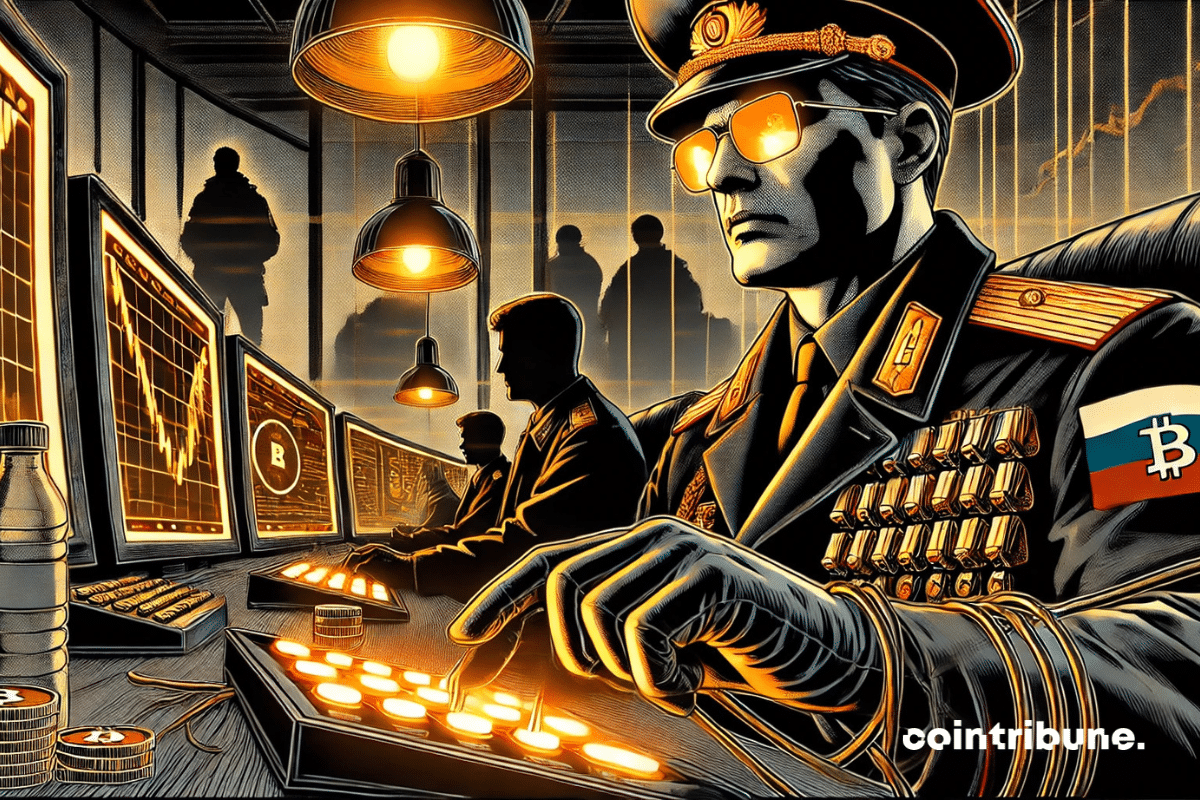
While the world of cryptos shattered between regulation and anarchy, Russia plays an unprecedented partition. Far from the shots of a refractory state, Moscow orchestrates a subtle maneuver: a state -based state schpto, reserved for a financial elite. A paradox? Rather a calculated strategy, mixing absolute control and muffled opening.
In short
- Russia is launching a state crypto scholarship, reserved for super qualified investors.
- This hybrid model reflects a geopolitical strategy: bypass the sanctions, without shaking the traditional financial system.
- A risky experimentation where innovation rhymes with cozy authoritarianism-Moscow tests a Russian crypto-realism.
Crypto-elitism: When Moscow reinvents access to digital assets
The Central Bank and the Russian Ministry of Finance have unveiled a daring project: a crypto exchange platform reserved for super qualified investors. A very closed club.
To enter, you have to hold at least 100 million rubles ($ 1.2 million) or display an annual income of 50 million rubles ($ 602,000). A threshold that excludes 99 % of the population, but concentrates power in the hands of a handful of actors.
Why such exclusion? Anton SiluanovMinister of Finance, hammered it: it is a question of legalizing the cryptoactives while maintaining them in a closely monitored framework.
As Vugar Usi Zade points out, COO at Bitget:
By limiting participation in super-qualified entities, probably institutional actors and companies affiliated with the State, the Kremlin creates a controlled sandbox.
Clearly, the state wants to capture flows, avoid capital leaks, and above all, keep their hands on a sector perceived as a threat. A logic of control, typically Russian, where innovation complies with geopolitical imperatives.
However, the selection criteria remain vague. Osman Kabaloevsenior ministry official, admits that the thresholds could be adjusted. An artistic vagueness? No doubt.
Moscow tests reactions, both internal and international. Because behind this three -year experiment hides a larger lens: normalizing cryptos … without shaking the traditional financial system.
Between shadow and light, Russia sails in a mutation crypto landscape
If the project seems rigorous, it also reveals a little -known reality: Russia cannot ignore cryptos. Western sanctions, bypass the dollar, and energy exchanges with China or India in BTC and USDT forces it to adapt its strategy.
In April 2023, the gel of the portfolios linked to Guarantx and Tether by the United States rang the alarm. Russian response? Kabaloev evokes the creation of a sovereign stablecoin. A digital currency anchored on real assets, controlled by the Kremlin. A risky bet, but consistent with the objective: to reduce dependence on Western infrastructure.
At the same time, Evgeny Masharovmember of the Civic Chamber, offers a crypto fund fed by the assets entered during criminal procedures. An idea that echoes the future legislation recognizing cryptos as seizable goods. Double benefit: legalize an opaque market and recover resources for the State.
“This project reflects a global trend: the torn nations between the adoption of the economic potential of the blockchain and the attenuation of its risks”USi Zade analysis.
This reflects the first model of exchange under license in Singapore, but with a distinct geopolitical turn: facilitate trade with the allies of the BRICS in the midst of the sanctions.
But the real revolution is elsewhere. By integrating cryptos into its international exchanges – especially oil, Russia defies the hegemony of the dollar. Bitcoin and USDT become tools for bypassing sanctions, an economic war currency.
The state scholarship is then only a link in a larger chain: regain control of a sector while instrumentalizing it.
A fragile balance between innovation and authoritarianism
Russia does not convert to cryptocurrencies; She tames them. Its state scholarship, reserved for an elite, symbolizes this ambivalence. On the one hand, a pragmatic opening to survive the sanctions. On the other, an authoritarian locking to avoid any risk of destabilization.
But can this hybrid model hold? Usi Zade warns:
Without participation of individuals, the Russian scholarship could find it difficult to compete with offshore platforms such as the major centralized scholarships.
And the external pressure could intensify:
If the EU or the United States qualifies this initiative to escape sanctions, the partners concerned with compliance with the rules may avoid it.
The fact remains that for the global markets, this experiment could initiate a larger trend:
“An evolution towards greater institutional involvement and the legitimization of digital assets in international trade”concludes Usi Zade.
By focusing on super qualified, Moscow marginalizes the consumer use of cryptos, but offers a discreet laboratory. A risky bet, where each transaction is a step towards the unknown. In this geopolitical game, Russia relies on crypto-realism-a third way between ban and liberalization. And Bitcoin gains legitimacy.
Maximize your Cointribne experience with our 'Read to Earn' program! For each article you read, earn points and access exclusive rewards. Sign up now and start accumulating advantages.


