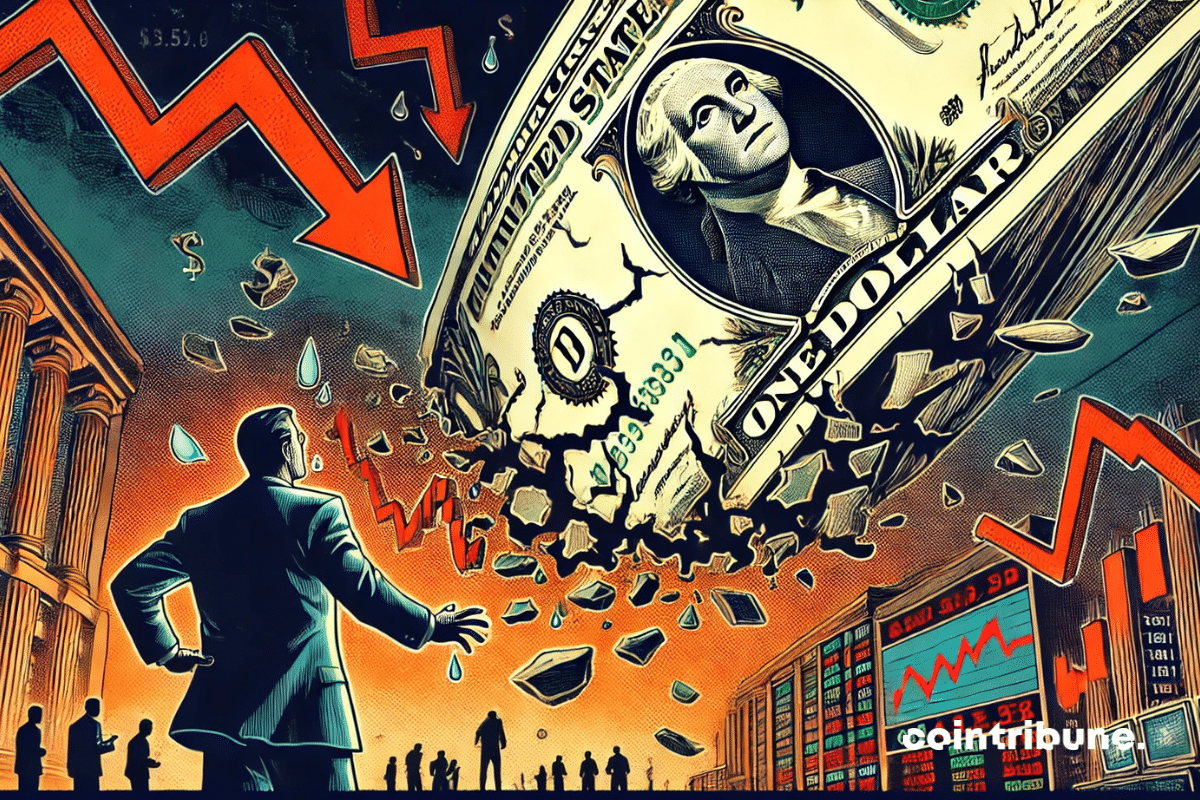
The domination of the US dollar on international trade and world reserves has never been so questioned. Indeed, Deutsche Bank sounds alarm on a growing phenomenon: dedollarization among the allies of the United States. Faced with geopolitical tensions and financial sanctions, several nations seek to reduce their dependence on the greenback. If this trend accelerates, the impact could be considerable, which would upset the global monetary balance and redefined power relations within the international financial system.
Increasing tensions around the greenback
The Deutsche Bank warns against a phenomenon that accelerates. Many allied countries in the United States reduce their dollar dependence for its commercial transactions and exchange reserves.
According to the bank, this dynamic is notably fueled by the rise in economic and geopolitical tensions. “The pressures exerted by American sanctions and uncertainties on monetary policy encourage many countries to seek alternatives to the dollar”, explain A report by the financial institution.
Major actors of international trade, such as China, Russia and certain Gulf countries, have already started a turn to other currencies, including the Yuan and the Euro.
Recent tensions with Washington and the fear of using the dollar as a diplomatic pressure tool accelerate this transition. Some countries seek to secure their exchanges and sign payment agreements in local currencies, in order to reduce their dependence on the fluctuations in the greenback.
Progressive erosion of the role of the dollar
Historically, the dollar has dominated the global financial system thanks to several advantages:
- Its stability: despite economic fluctuations, the dollar has long been perceived as a refuge value;
- Its role in world trade: oil transactions and many raw materials are still denominated in dollars;
- The influence of American financial institutions: the power of the American banking network has strengthened the domination of the greenback.
However, several clues show that this hegemony is weakened. The IMF has reported a gradual drop in the dollar share in world reserves, which has reached its lowest level for several decades. In parallel, international transactions in dollars decrease, for the benefit of bilateral agreements in alternative currencies.
This tilting does not take place overnight, but the signs of monetary rebalancing are multiplying. For the financial markets, such an evolution could cause greater volatility of exchange rates and a questioning of the historical advantages which the dollar benefited in international funding.
Alternatives emerge against the dollar: towards a new world monetary balance?
With the rise of uncertainties linked to the greenback, several initiatives aim to build a more multipolar financial system. China actively pushes the internationalization of the Yuan, in particular through trade agreements with emerging countries.
Russia, for its part, turned to transactions in rubles and yuan for its exports of raw materials.
Other countries, especially in Asia and Latin America, strengthen their exchanges in local currencies, in order to avoid going through the dollar for their transactions.
This development is also observed in the raw material sector, where certain oil contracts are now labeled in Yuan. The objective is clear: limit exposure to fluctuations in the greenback and reduce the stranglehold of the American financial system on the global economy.
In this context of monetary recomposition, cryptos could take over the game. Bitcoin, often considered as an alternative value reserve, benefits from increasing distrust of traditional fiduciary currencies. Some nations also explore the potential of digital currencies of central banks (CBDC) as a tool for bypassing the dollar.
However, the rise of cryptos in this new environment will depend on several factors: institutional adoption, regulation and confidence of investors.
If dedollarization continues, it could strengthen the role of cryptos as a decentralized global exchange solution, in competition with traditional currencies.
The warning of Deutsche Bank provides information on a phenomenon that could redraw the contours of the international monetary system. If dedollarization accelerates, the world could switch to a more fragmented model, where several currencies would share global economic domination. In this context, financial market players and investors must anticipate the repercussions of a world where the dollar would no longer be the undisputed king.
Maximize your Cointribne experience with our 'Read to Earn' program! For each article you read, earn points and access exclusive rewards. Sign up now and start accumulating advantages.