At the intersection of cutting-edge technology and economic fluctuations, the world of cryptocurrencies never ceases to surprise us. This week we have witnessed a series of events that are redefining not only the value and function of digital currencies, but also their impact on our society and our global economy. From the depths of the Mt. Gox affair to the heights reached by Solana, to the looming challenges of Bitcoin and Ethereum, to the intrigues surrounding SHIB, each story is a breadcrumb trail in the complex labyrinth of crypto. Follow us on this weekly journey where we untangle these threads to bring you a clear and precise understanding of the latest developments in this fascinating universe.
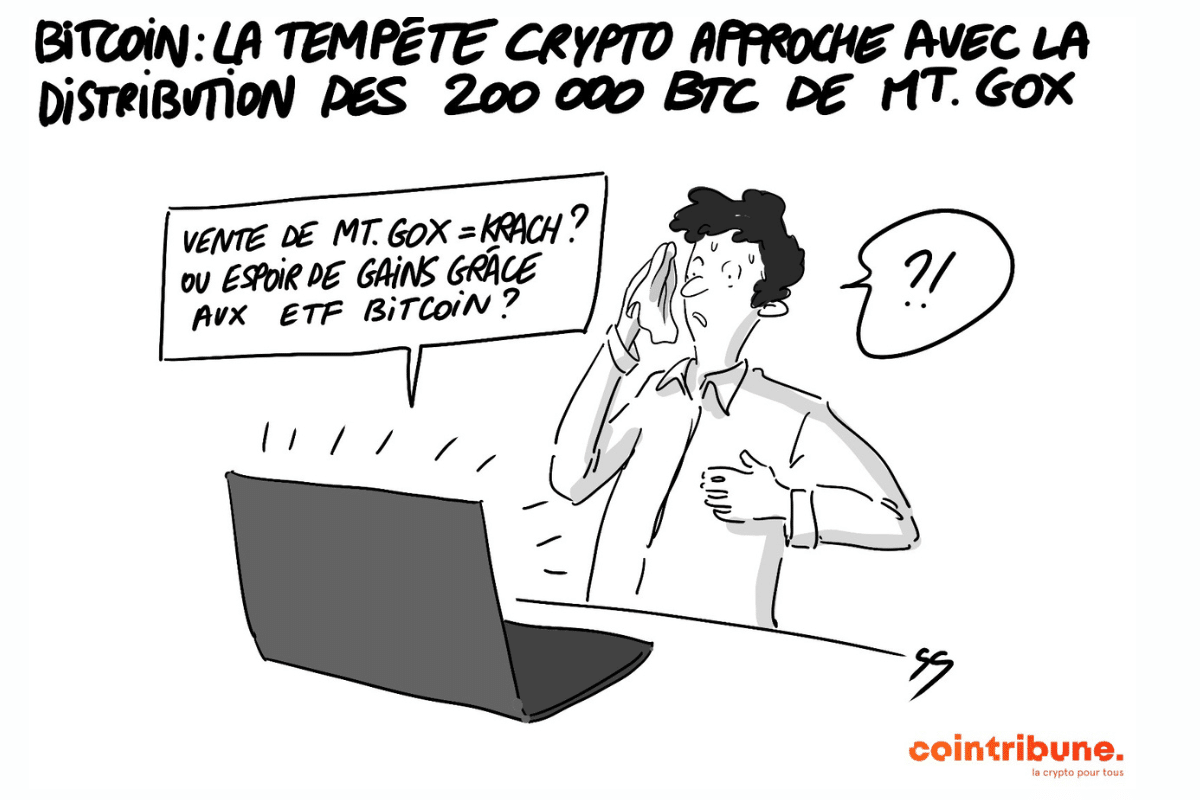
Bitcoin: The storm approaches with the distribution of 200,000 BTC from Mt. Gox
In 2014, the Bitcoin world was shaken by the hack of Mt. Gox, one of the largest exchanges at the time. Today, after a decade of twists and turns, Mt. Gox is preparing to repay its creditors, marking a major turning point. This process will result in the release of 200,000 BTC into the crypto ecosystem. Recently, the mtgoxinsolvency subreddit became lively following the receipt of emails requesting confirmation of identity and account details.
The announcement of the distribution by Mt. Gox comes in a context where Bitcoin, already below $43,000, seems to be walking a tightrope. On the one hand, the threat of a crash induced by the massive sale of recovered BTC looms. On the other hand, a wind of optimism is blowing thanks to the successful introduction of a Bitcoin ETF by BlackRock, indicating a new influx of capital. Investors remain suspended between hopes of gains and fears of losses, making the Mt. Gox distribution a potentially landmark event in recent Bitcoin history.
Halving Bitcoin 2024: Miners soon to go bankrupt?
The Bitcoin halving planned for March 2024 will halve the reward for miners, a situation which could be catastrophic for many mining players if it is not offset by an increase in the price. In 2024, Bitcoin mining requires colossal technological resources, with professional miners investing heavily in high-performance computing hardware and spending huge sums on electricity to power their mining farms. According to Cantor Fitzgerald, the average cost to produce a single bitcoin is currently around $8,500.
Until now, the bitcoin reward awarded for each validated block allowed many miners to partially compensate for these deficits. But after the halving of 2024, this reward will be halved, potentially falling to 3,125 BTC. Such a brutal reduction in revenues, without an equivalent increase in prices, could spell the end for most mining companies. Only those benefiting from the most aggressive production costs could hope to continue creating value. Cantor Fitzgerald’s report warns that without a substantial rise in the price of bitcoin, halving could trigger a “cryptowinter” and cascading bankruptcies, making mining economically unviable and threatening the decentralized integrity of the Bitcoin network.
Solana launches token extensions: A major revolution!
Solana recently announced the introduction of token expansions, marking the dawn of a new era in the crypto space. These extensions are not simple additions, but pillars of a structure aimed at revolutionizing the SPL Token standard. They promise to turn security, compliance and ease of use into tangible realities for businesses in the crypto sphere. Solana’s token extensions introduce innovations such as transfer hooks, adjustable transfer fees, and confidential transfers, providing secure and compliant navigation in the crypto space.
Anatoly Yakovenko, the visionary behind Solana Labs, sees these extensions as the epitome of what makes Solana unique. Their potential for mass adoption is particularly exciting, and the Solana Foundation envisions a future where crypto companies dive into Web3 with confidence. Furthermore, despite recent volatility, SOL crypto is showing signs of impressive underlying strength.
Ethereum developers announce major update
Ethereum developers have announced the deployment schedule for Dencun, a crucial update aimed at improving performance and reducing transaction fees. This update will first be activated on the Sepolia and Holesky testnets, on January 30 and February 7 respectively, before its deployment on the mainnet. These activations on testnets are essential to ensure a smooth transition to this new version of Ethereum. Tim Beiko, one of the main developers, emphasizes the importance of these tests to validate the solidity of Dencun and prepare for its official launch.
Dencun continues the revolutionary work started by Shappella in 2023, integrating the “EIP-4844” update, better known as “Protodanksharding”. This advancement is expected to result in a dramatic drop in transaction fees for Ethereum-based layer 2 solutions, with an estimated reduction of 90% for protocols like Optimism or Arbitrum. This radical reduction in costs promises to increase the accessibility and use of the Ethereum blockchain, thus stimulating the emergence of new layer 2 innovations.
Mysterious transfer of 420 billion SHIB: The hype is starting again?
A massive transfer of 420 billion Shiba Inu (SHIB) tokens, worth $3.87 million, has crypto investors intrigued recently. On January 21, an anonymous investor transferred this astronomical sum of SHIB between two unidentified Ethereum addresses. The origin of the tokens, initially stored in a wallet associated with the Coinbase Prime Custody institutional custody solution, suggests possible involvement of professional investors. This transfer, of rare magnitude, adds to the confusion and speculation surrounding the transaction.
This major move in SHIB comes shortly after a similar transaction was identified by Arkham Intelligence, involving massive purchases of Shiba Inu by Robinhood. The SHIB price, which recently fell to its lowest level since early December 2023, is showing signs of redemption, suggesting a possible trend reversal. If the price of SHIB manages to consolidate around its current level, some analysts believe that a lasting crossing of the $0.00001 threshold would be possible, adding a potential bullish element to this scenario.
Only 5 exchanges control 98% of the euro crypto market
A recent study by Kaiko reveals that just five exchanges control 98% of the total euro crypto trading volume. Among more than a dozen exchanges offering euro transaction services, Bitvavo, Kraken, Coinbase, Bitstamp and Binance largely dominate the market. This high concentration highlights the disparity in the distribution of market shares within crypto exchanges.
European traders have shown a strong preference for Bitcoin (BTC) in 2023, with trading volumes exceeding €37 billion. In comparison, Ethereum’s Ether (ETH) and Ripple’s XRP recorded volumes of €15 billion and €9.5 billion, respectively. This dynamic highlights Bitcoin’s status as a preeminent crypto.
Bitcoin windfall: Uncle Sam prepares a mega-sale of Silk Road’s crypto treasure
The US government is preparing to make a sensational sale of $130 million in bitcoins, seized as part of the famous Silk Road scandal. Silk Road, a virtual black market specializing in money laundering and drug trafficking, was taken down in 2013, but confiscated bitcoins continue to haunt the auctions. This sale undoubtedly represents a unique opportunity for bidders.
The seizure of 69,000 BTC linked to the Silk Road affair by the United States and the announcement of their imminent sale raises questions about the possibility of laundering a criminal past through government auctions. This situation highlights the moral dilemma surrounding the sale of seized property from illegal activities.
This is the main thing to remember for this week. But if you want a more detailed recap and in-depth analysis straight to your inbox, feel free to subscribe to our weekly newsletter.
Maximize your Tremplin.io experience with our ‘Read to Earn’ program! For every article you read, earn points and access exclusive rewards. Sign up now and start earning benefits.