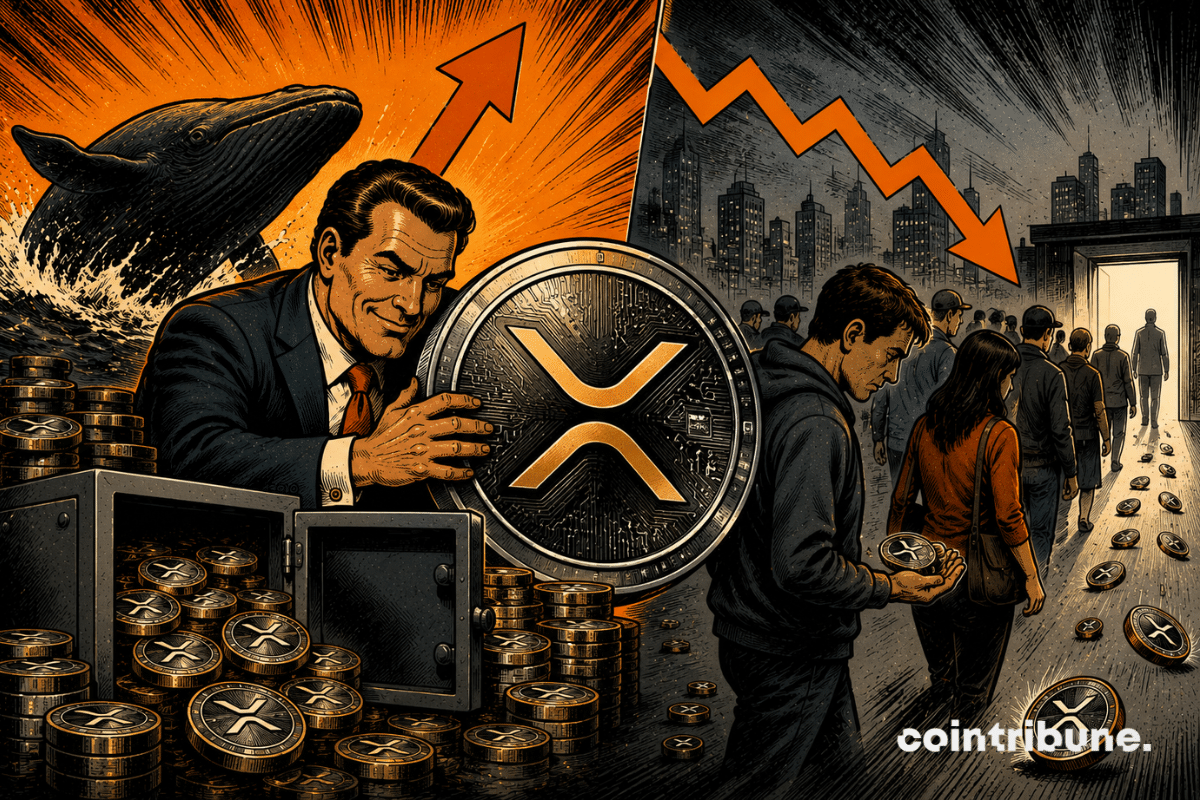
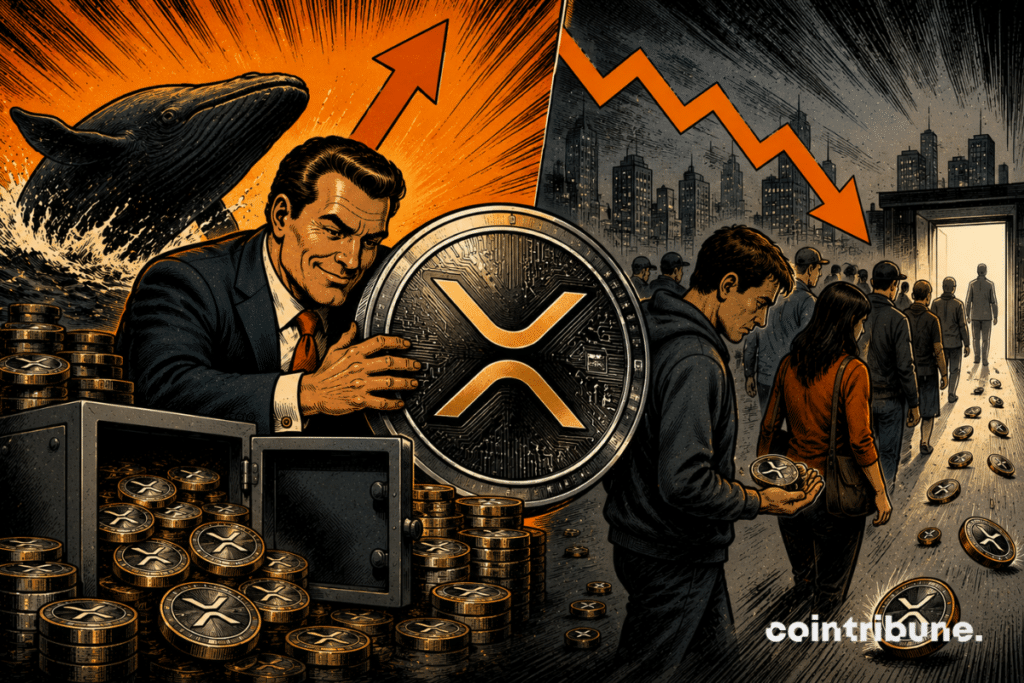
Small holders abandon XRP, whales buy back without hesitation. This unprecedented divide within the Ripple ecosystem reveals a massive transfer of tokens between investors with opposing strategies. On-chain data shows that small portfolios capitulate under the effect of volatility, while the largest fortunes methodically strengthen their positions. This shift comes as XRP rebounded by more than 8% in five weeks and returned to $1.16. Such a signal could say much more about market dynamics than just the evolution of its price.
In brief
- XRP climbs more than 8% in five weeks and crosses the $1.16 mark.
- Small portfolios reduce their reserves by 5.2%, yielding to selling pressure.
- Large holders (100k to 100M XRP) increase their positions by 2.8% over the same period.
- This transfer from “weak hands” to “strong hands” historically anticipates a price recovery.
A massive purge of small carriers
The behavior of individual investors on the XRP network demonstrates a marked loss of steam in the face of recent market uncertainties. The data published by the on-chain analysis platform Santiment highlight several important factual elements regarding this capitulation:
- The abandonment of small holders: the smallest portfolios reduced their overall positions by 5.2% over a period of five weeks;
- A liquidation under pressure: this massive disengagement materializes a classic phase of capitulation of individual investors, characterized by the sale of assets by players discouraged by volatility;
- Losses of conviction: the selling pressure orchestrated by individuals shows a desire to exit the market to limit losses or join assets perceived as less risky.
The analysis of this desertion among small investors reveals the fragility of individual investors in the face of uncertainty and consolidation movements. By selling 5.2% of their overall reserves in just over a month, they released a significant volume of tokens on the secondary market. This net purge phenomenon cleans up the registers by eliminating short-term speculators and the least resilient investors. This dynamic of capitulation of the smallest portfolios constitutes a major behavioral indicator. It reflects the realization of a generalized pessimism among individual investors, a state of mind which historically precedes the redistributions of tokens towards better-endowed financial players.
The whale counter-offensive: a strategic accumulation of XRP
Unlike small holders, institutional investors and large token holders have stepped up their purchases. Santiment data reveal that wallets holding between 100,000 and 100 million XRP increased their balances by 2.8% over the past five weeks. This phase of accumulation supported by these whales directly influenced the rise in price, allowing XRP to go from 1 dollar at the end of June to more than 1.16 dollars. This aggressive purchasing behavior on the part of the best capitalized portfolios demonstrates that major market players are taking advantage of the liquidity offered by the capitulation of individuals to strategically strengthen themselves at these price levels.
From a structural point of view, this absorption of the selling offer by large holders validates the existence of an upward bias supported by specialists in on-chain analysis. As the Santiment team pointed out in a post on X: “Historically, the price of XRP has tended to move more in correlation with key stakeholders and away from smaller wallets, so this large gap supports the bullish thesis behind the rebound”. Additionally, this transfer of ownership from weak to strong hands alters the distribution of circulating supply, consolidating price above previous support levels through increased institutional presence.
A favorable fundamental alignment
This behavioral divergence does not occur in a speculative vacuum, but is backed by a fundamental context in full change for the Ripple ecosystem. The Santiment firm also specifies that the timetable for this accumulation coincides with several favorable developments, notably “improved institutional access through possible ETF products and continued use of the XRP Ledger for payments, tokenization and the RLUSD stablecoin”.
The integration of these financial infrastructures reinforces the thesis of a long-term positioning on the part of the whales, who anticipate a growing structural demand for the native token of the network.
If the capitulation of small holders may have colored the market with pessimism in the short term, the taking over by the large players offers a promising signal of maturity for XRP. The implications going forward, however, will depend on the network’s ability to deliver on these core promises, whether it be the final approval of ETFs or the actual adoption of the RLUSD stablecoin in international trade. In a constantly evolving crypto landscape, monitoring this large gap between individuals and institutional investors will remain one of the best barometers for anticipating future market cycles.
Maximize your Tremplin.io experience with our ‘Read to Earn’ program! For every article you read, earn points and access exclusive rewards. Sign up now and start earning benefits.