DAOs are currently at the heart of technology and management discussions. But what exactly are we talking about? Can you imagine a world where companies operate without bosses, where the rules are written in computer codes and where everyone can have a say? Well, this is the world of DAOs. In this article, let’s try to get to know this new organization better. How do they actually work? Could they one day take the place of the companies we know?
What is CAD?
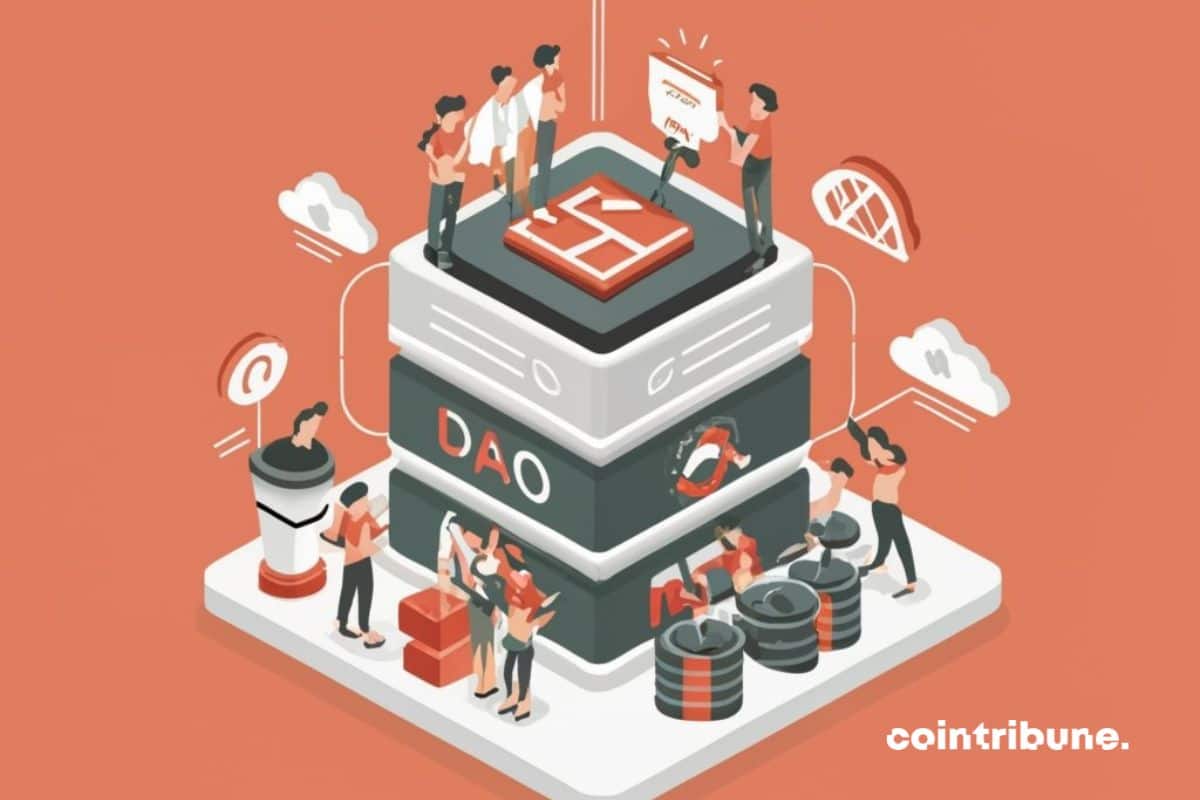
A DAO (or decentralized autonomous organization) is a bit like a business. But as its name indicates, it differs from the latter by the fact that it is autonomous and decentralized.
Concretely, the concept is as follows: instead of having managers and bosses who make all the decisions, a DAO works with rules programmed into a computer. It’s like computers and people working together to run a business.
The rules are written in what is called “smart contracts”. These are self-executing computer programs stored on the blockchain. They define the processes, decisions and interactions within the organization.
Important clarification: These digital contracts cannot be changed once they are in place. This means that everyone knows what the rules are and no one can break them.
How DAOs Work ?
A DAO is an autonomous, decentralized and self-executing entity. It works based on a set of rules previously programmed in smart contracts. Once deployed on a blockchain, these contracts are:
- visible to all members of the DAO,
- verifiable,
- immutable.
Instead of being based on a central authority, DAOs are therefore managed by the community of participants who hold tokens or shares in the organization. Each token holder can contribute to decisions and proposals.
Decryption: When a decision (like how to spend money or what direction to take) needs to be made in a DAO, members vote using tokens. These tokens are a bit like digital voting tickets. The more tokens the member has, the more their vote counts. This means that everyone can participate in decisions (not just bosses or bosses).
Once the vote is completed, computers automatically execute the decision. To do this, they rely on the rules programmed in smart contracts. Also, each vote is recorded on the blockchain. Enough to guarantee transparency. The DAO thus creates a democratic environment where choices are made by consensus rather than by a small group of decision-makers.
What is the current use of DAOs?
Currently, DAOs are used in different fields. For example, we create certain DAOs to invest money in projects. Other DAOs are used to create and share media content (including articles and videos). There are even DAOs that manage computer programs and protocols.
What are the advantages of DAOs?
DAOs offer significant advantages. Their first asset: greater transparency thanks to the auditability of smart contracts. Also, DAOs do not need intermediaries or trusted third parties. This significantly reduces costs.
Decisions made by DAOs are based on predefined rules. They are therefore not not influenced by personal interests. Additionally, the decentralized nature of DAOs makes them resistant to censorship and manipulation.
What are the limits of DAOs?
Despite its many advantages, a DAP has limitations. For example, its autonomy sometimes generates unexpected or unwanted decisions. This happens when the code base is not strong enough. Ambiguous regulation can also be problematic as DAOs operate in a relatively unregulated space.
Will DAOs replace businesses?
DAOs offer many advantages. They are transparent, which means everyone can see what is happening. They eliminate the need to trust a single person, because everything is based on clear rules. However, they are unlikely to completely replace businesses.
The reason is simple: Companies havelegal rules and complex structures which can be difficult to reproduce in a DAO. Additionally, businesses have employees who need to be paid and regulations to follow.
In conclusion, DAOs offer a fascinating new approach to governance and management. But the fact that they can completely replace businesses seems unlikely. Both models have their advantages and limitations. However, they could change the way they work. DAOs show that technology can help us collaborate and govern in a different way, where everyone has a say and the rules are transparent and immutable.
Maximize your Tremplin.io experience with our ‘Read to Earn’ program! For every article you read, earn points and access exclusive rewards. Sign up now and start earning benefits.