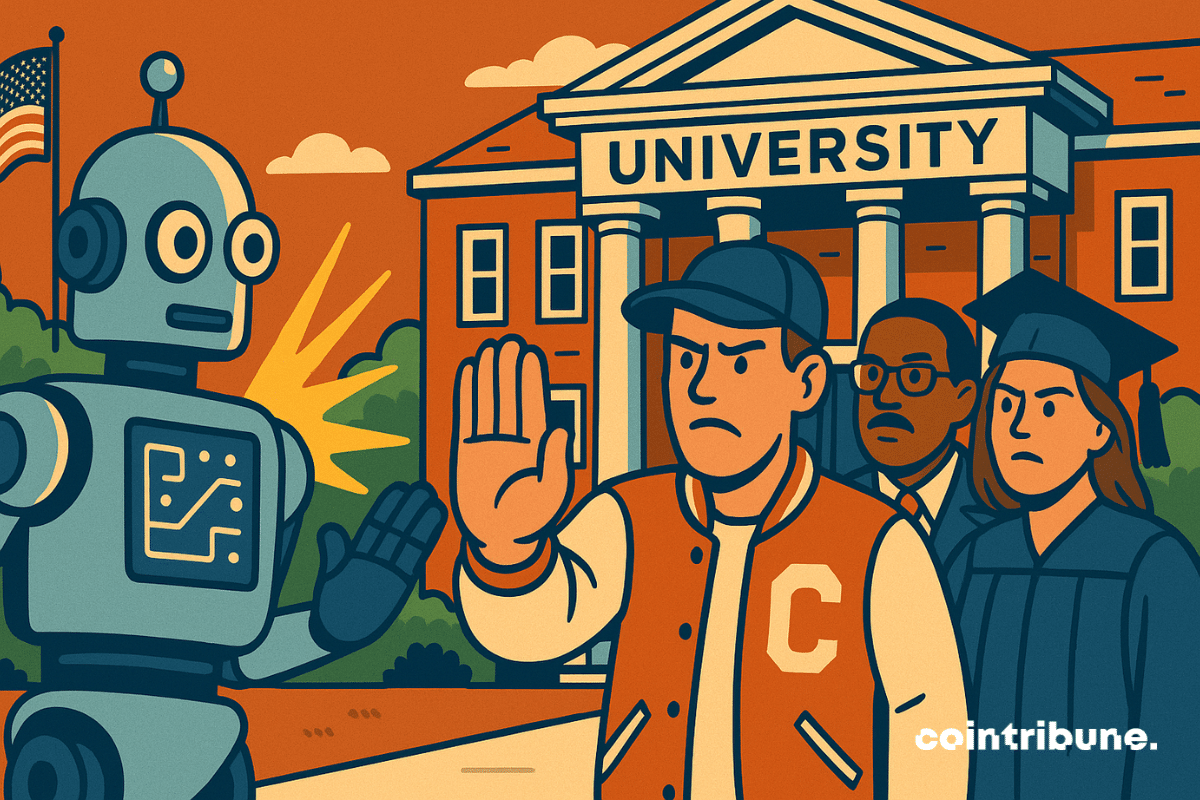
While American universities are in great investing in artificial intelligence, from the University of Georgia to that of Michigan, a national survey reveals a surprising reality. American citizens, far from kissing this revolution, show an increasing distrust of the integration of AI on campuses.
In short
- More than half of Americans judge the AI negative for learning students.
- 46 % think that its use by teachers weakens academic support.
- Even generation Z, however familiar with AI, remains skeptical.
- 40 % believe that AI devalues university degrees.
AI divides opinion into American universities
Since 2023, American universities have multiplied initiatives around AI. The University of Georgia has paved the way with Microsoft Copilot generalized to the whole campus and a prize rewarding educational innovation in AI.
Michigan followed by creating its own tools, while Arizona State has allied directly with Openai.
However, despite these advances, public opinion remains cautious. According to theVarying degrees 2024 study53 % of Americans believe that the use of AI by students harms their learning.
Only 27 % consider that it could have a positive effect, and almost a fifth see any notable impact. On the teachers' side, the observation is similar: 46 % of respondents believe that AI weakens the quality of the support offered to students.
This skepticism is not surprising. Indeed, some teachers continue to sanction, sometimes wrongly, work suspected of being generated by AI.
In parallel, part of the students tends to excessively rely on tools like Chatgpt or Grammarly, which blurs the line between reasoned use and technological dependence.
Generation Z, more skeptical than expected
One might think that generation Z, born with smartphones and social networks, would spontaneously adopt artificial intelligence. However, the figures tell another story. Indeed, only 19 % of 17–18 year olds believe that AI improves university learning, eight points less than the national average.
Even more striking, 54 % consider its use negative By teachers, more marked skepticism than their elders.
In addition, this prudence reflects a deeper concern: the value of diplomas. Admittedly, 73 % of Americans continue to believe that higher education offers a good return on investment.
However, 40 % fear that AI devalues diplomas, in particular because numerous “white passes”, financial analysts, consultants or assistants, could be directly competed by algorithms.
Behind this statistic hides a fundamental question: does AI threaten the human dimension of education? A recent study by Northwestern University, in collaboration with the Hertie Institute for AI applied to health, strengthens these doubts.
In 2024, almost 13.5 % of biomedical publications already carried the traces of chatgpt or similar tools, raising doubts about transparency and academic integrity.
Artificial intelligence attracts as much as it worries. On American campuses, its establishment is progressing fast, but confidence is slow to follow. The challenge is not limited to technology: it relates to culture, politics and the very credibility of knowledge. Will higher education be able to transform AI into an educational ally, or will it remain a threat perceived for the academic future?
Maximize your Cointribne experience with our 'Read to Earn' program! For each article you read, earn points and access exclusive rewards. Sign up now and start accumulating advantages.