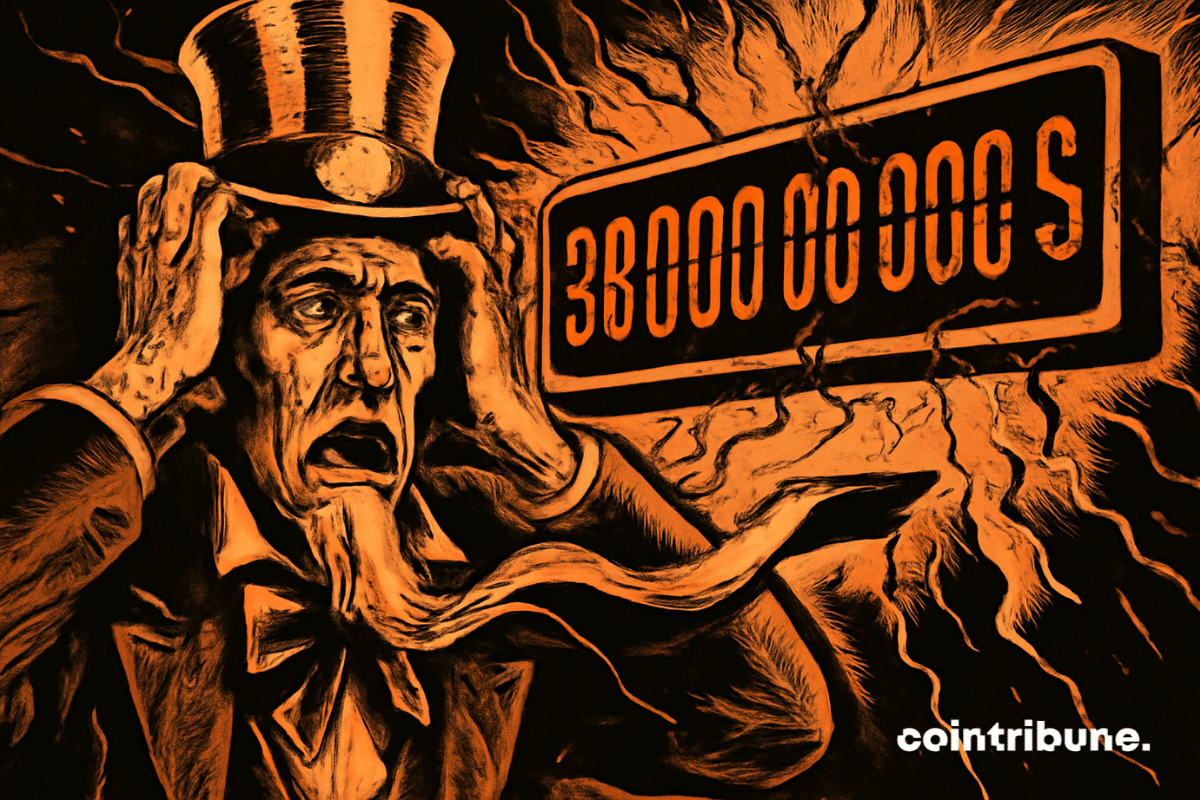
In the midst of a budgetary paralysis, the American public debt has reached 38,000 billion dollars, a historic record. This threshold, revealed by the Treasury, raises questions about the budgetary trajectory of the United States, while monetary policy remains under tension and the regulation of cryptos remains unclear.

In brief
- The United States hits a historic record with $38 trillion in public debt, in the midst of a partial government shutdown.
- The debt has increased by $1,000 billion in less than two months, an unprecedented acceleration outside of the pandemic period.
- Experts warn of the consequences: increased inflation, rising borrowing costs and an explosion in future interest charges.
- The administration claims to have reduced the deficit to $468 billion, thanks to a policy of budgetary austerity.
American debt reaches historic milestone
The gross debt of the United States exceeded the threshold of 38,000 billion dollars this week, a dazzling increase which marks 'Fastest accumulation of a trillion dollars outside of the pandemic'according to the Treasury report.
The country reached 37 trillion last August, meaning another trillion was added in less than two months. This dizzying rise comes at a time when the federal administration is undergoing a shutdown, due to a political blockage on the budget. The Joint Economic Committee of Congress has calculated that the debt is currently increasing at a rate of $69,713.82 per second.
The economic consequences of this dynamic are widely documented by experts:
- Increased inflation and falling purchasing power: “this additional inflation accumulates and erodes consumers’ purchasing power”, explain Kent Smetters of the University of Pennsylvania, discussing the impact on the ability of younger generations to access homeownership;
- Rising Borrowing Costs for Households: Government Accountability Office alert on the mechanical effect of high debt on the rates applied to real estate and automobile loans;
- A reduction in private and public investments: an increasing share of available resources is absorbed by debt, to the detriment of the real economy;
- The explosion of interest charges to come: “We spent $4 trillion in interest over the last decade, but we will spend $14 trillion over the next ten years”says Michael Peterson of the Peterson Foundation.
Trump, Bessent and the promise of a fiscal shift to the right
In this highly flammable budgetary context, Scott Bessent, Treasury Secretary and former hedge fund boss, said on Wednesday that the American deficit had been reduced to $468 billion between April and September 2025, “the lowest level since 2019”.
The White House, through its spokesperson Kush Desai, maintains that this improvement would be the result of a policy combining “reduction of expenses and increase of revenue”and promises to continue this strategy with “robust economic growth, lower inflation, increased customs revenue, lower borrowing costs and a fight against waste and fraud”.
Contrary to the alert launched by several economists, the Trump administration presents these results as signs of rigorous management. However, this reading calls into question the real sustainability of the long-term budgetary strategy, particularly if interest rates remain high.
The choice of Scott Bessent, a personality from speculative finance, could also signal a desire for reinforced deregulation, likely to influence financial regulation, and therefore the crypto environment. Although no direct statements on cryptos specifically bitcoin have been made at this point, this more liberal economic focus could affect investors' perception of risk, as well as the dollar's role as a global reserve currency.
In the medium term, this fiscal positioning could cause tensions with the Federal Reserve, or restart a standoff over the debt ceiling, with systemic consequences on global markets. In this context of uncertainty, some players in the sector are already seeing bitcoin or other assets as fallback options in the event of a shock to US sovereign debt.
Maximize your Tremplin.io experience with our 'Read to Earn' program! For every article you read, earn points and access exclusive rewards. Sign up now and start earning benefits.