
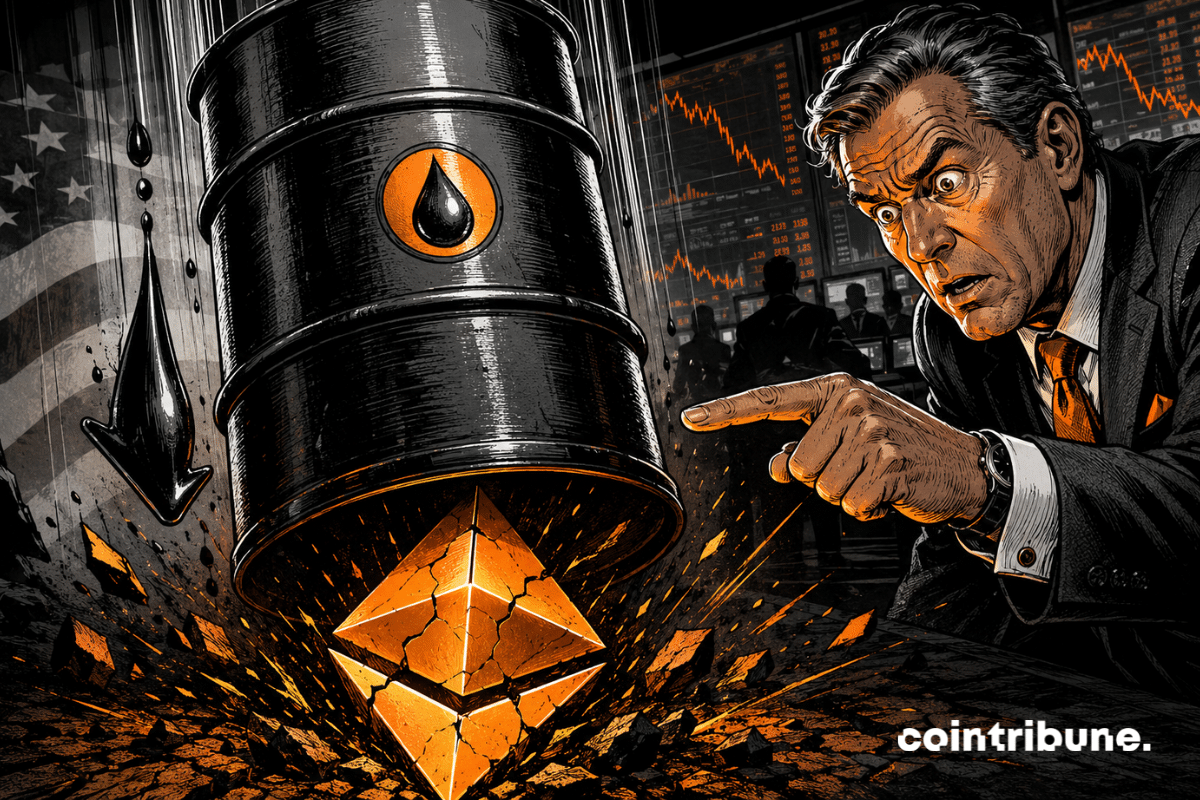
Ethereum is under unusual pressure, and Tom Lee points to a very concrete culprit: oil. For the co-founder of Fundstrat, the surge in crude oil is clouding risk appetite, reinforcing inflationary fears and directly weighing on ETH.
In brief
- Ethereum is suffering from the oil surge and the return of macro risk.
- Tom Lee believes that a decline in crude could revive ETH.
- The current pressure seems tactical, but the market remains very selective.
Ethereum caught in the oil shock
Ethereum is not only falling because of factors internal to the crypto market. Tom Lee's reading is broader. According to him, the surge in oil acts as a macroeconomic brake. It pushes investors to reduce their exposure to risky assets, including ETH. This movement recalls a recent episode where bitcoin had already retreated while oil soared.
Crude oil rose to around $110, in a very tense geopolitical context. WTI reached $108, while Brent neared $111. This increase feeds the idea of a more nervous, less liquid, and more selective market. In this setting, Ethereum becomes a second-tier victim. The network remains strong. Its uses are progressing. But its token reacts like an asset sensitive to rates, the dollar, oil and fear.
Tom Lee claims that the inverse correlation between Ether and oil has reached an all-time high. Clearly, when crude rises violently, ETH tends to stall. It is not a permanent law. But in the current context, the signal is strong enough to attract attention.
Since the start of the Israeli-American conflict against Iran, the price of oil has jumped by around 66%. It would have gone from 65 dollars to more than 100 dollars per barrel. This increase changes the temperature of the market. It puts inflation back at the center of discussions.
And when inflation comes back into the picture, Ethereum loses some of its immediate charm. Investors are less likely to anticipate a rate cut. They become more cautious. They sell first what seems most fragile in the short term.
ETH also faces its own headwinds
Reducing Ethereum's decline to oil would, however, be too simple. Other factors are already weighing on the market. Capital outflows from certain ETFs, reserves on exchanges and underperformance against bitcoin are also fueling selling pressure.
This fragility is seen in institutional flows. Investors are not completely exiting crypto, but they are sorting more. Some ETH-related products have already shown signs of weakness, as seen when Bitcoin and Ether ETFs slipped back into the red after a brief rebound.
ETH therefore finds itself stuck between two narratives. On the one hand, its infrastructure attracts traditional finance. On the other hand, its price remains vulnerable to macro shocks. This discrepancy creates frustration. The bottom line remains promising, but the chart tells a harsher story.
A tactical setback, not necessarily a lasting break
Tom Lee calls it “short-term tactical noise.” This formula counts. It means that the current pressure does not necessarily call into question the long-term thesis on Ethereum. If oil turns around, ETH could find some air again.
The structural enablers remain there. The tokenization of real assets is progressing. Stablecoins continue to massively use public blockchains. The idea of autonomous AI using crypto payments also reinforces the potential role of Ethereum in future digital infrastructures.
This is where the case becomes more interesting. Ethereum doesn't just depend on trading. It carries some of the ambitions of tokenized finance. JPMorgan, BlackRock and other institutional players are already exploring this terrain. This is why the institutional dynamic around tokenization on Ethereum remains a key element despite the low price.
Maximize your Tremplin.io experience with our 'Read to Earn' program! For every article you read, earn points and access exclusive rewards. Sign up now and start earning benefits.


