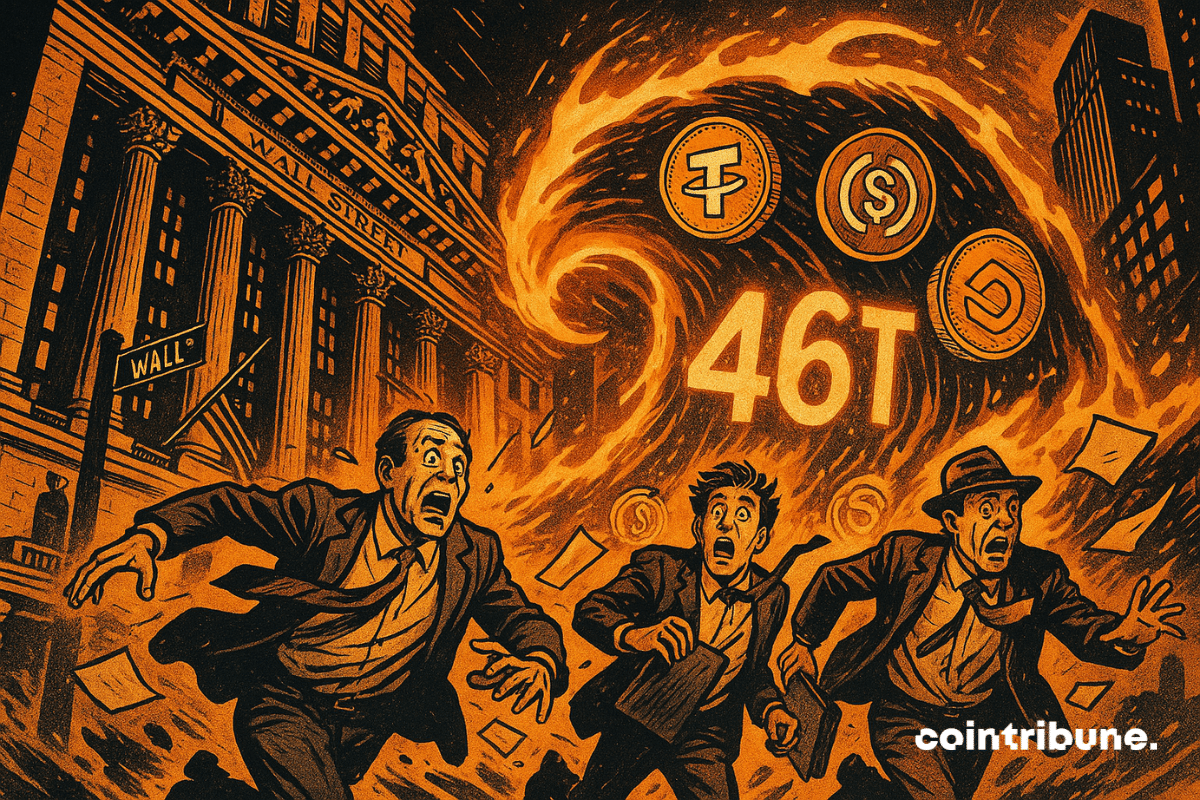
Global finance is changing. Slowly but surely, a new paradigm is taking hold. And guess what technology is infiltrating everywhere, at high speed? It's neither AI nor neobanks. It's crypto. And more precisely: stablecoins, these digital tokens backed by the dollar. They were marginal tools of traders; today they are at the heart of major financial maneuvers. And while some are cheering, others on Wall Street are starting to worry.
In brief
- Stablecoins processed $46 trillion in transactions in a single year.
- Visa, Fidelity and JPMorgan are now investing in stablecoin-related products and services.
- Blockchain speed reaches 3,400 transactions per second, making crypto more accessible than ever.
- USDT and USDC hold 87% of the stablecoin market, with $300 billion in circulation.
Stablecoins: from the crypto niche to the nerve of global finance
Stablecoins, originally simple alternatives to transfers between crypto platforms, have become economic colossi. In 2025, they processed $46 trillion in transactions. For comparison, that's almost three times Visa's volume over the same period. Even adjusted to remove artificial effects, this figure remains astronomical: $9 trillion, far more than PayPal.
According to the State of Crypto 2025 report posted by a16z:
In the past, stablecoins were mainly used to settle speculative crypto transactions; in recent years, they have become the fastest, cheapest, and most universal way to send a dollar — in less than a second, for less than a penny, almost anywhere in the world.
And this is just the beginning. The number of active crypto users varies between 40 and 70 million, and the growth comes mainly from emerging countries like Argentina or Nigeria. Where banking systems falter, stablecoins emerge as a safe haven, as a more reliable means of exchange than the local currency. At this rate, the tokenized dollar becomes the real dollar of global markets.
Wall Street wants its piece of the stablecoin pie
Financial giants no longer look down on crypto. They invest in them, integrate them, distribute them. Visa, JPMorgan, Fidelity, BlackRock, Mastercard, Citi, Morgan Stanley: all are now in the loop. Some already offer the purchase of stablecoins from their platforms. Others are developing blockchains or integrating stablecoins into their customer services.
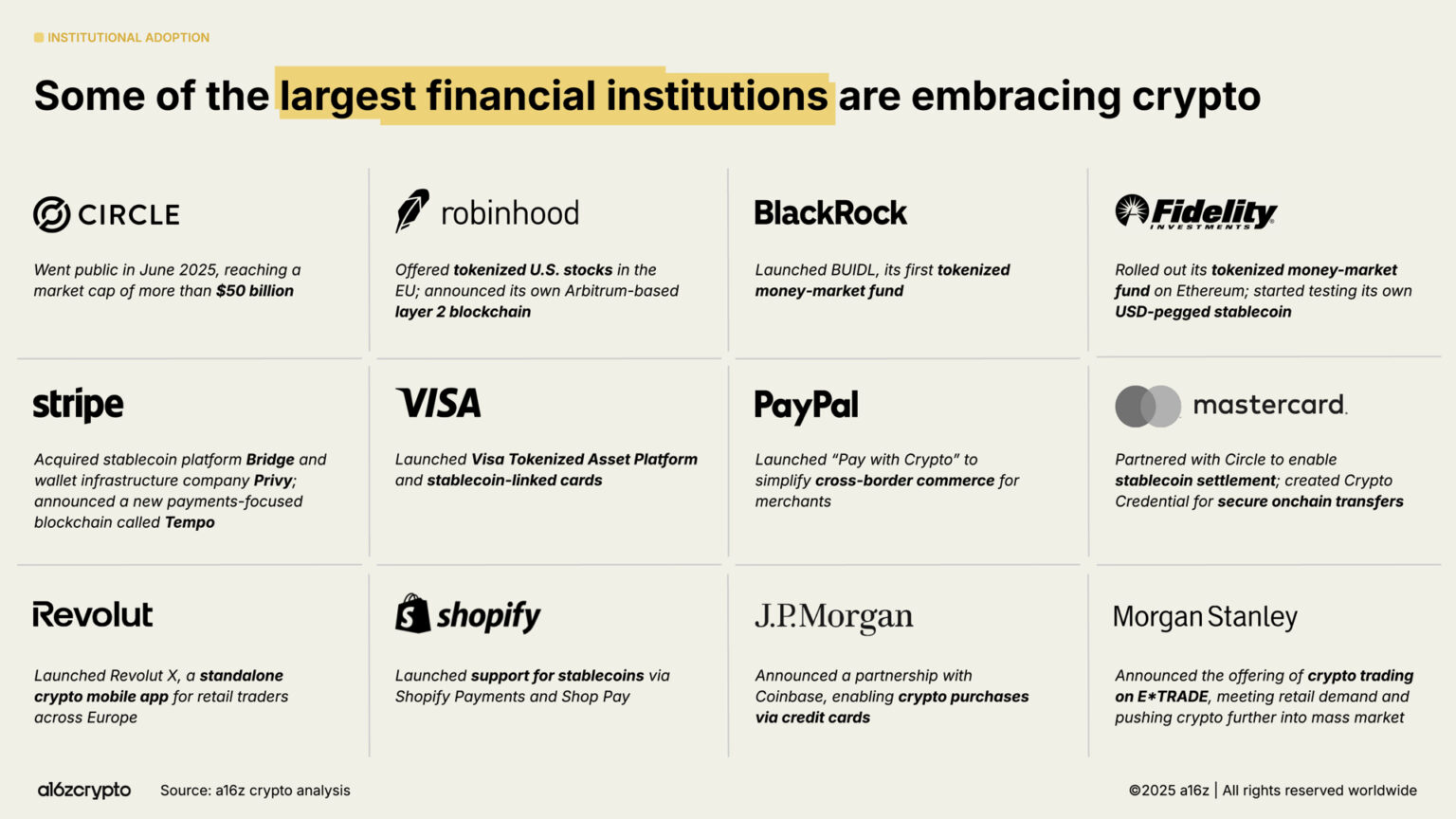
Circle, the issuer of USDC, even went public. And crypto exchange-traded funds (ETPs) exceed $175 billion in assets under management. The BlackRock Bitcoin Trust has become one of the most successful launches in history.
As a16z summarizes:
These companies have immense distribution reach. If development continues, crypto could become deeply integrated into the financial services we use every day.
Stablecoins continue to grow: more than $300 billion in circulation, 87% of which are held by Tether (USDT) and USDC. They also hold $150 billion in US Treasury bonds, making them the 17th largest holder of US debt in the world. Some analysts see it as a lever of stability for the dollar; others, an unprecedented dependence of the Treasury on private actors.
Crypto, AI, finance: the convergence that is rebuilding the system
As markets heat up, crypto technology is entering a new era. Blockchains, once slow and expensive, now reach processing speeds of 3,400 transactions per second. Solana and Ethereum dominate. L2s like Arbitrum or Optimism reduce fees to less than a cent. On the user side, the watchword is simple: crypto is ready for mass use.
And AI is never far away. Decentralized protocols explore solutions for autonomous agent payments, digital identity management, privacy. Giants like Stripe are investing heavily in stablecoin infrastructure. The forecasts? 10x growth by 2030, to reach $3,000 billion in capitalization.
The numbers that speak loudly:
- $46 trillion stablecoin transactions in 2025;
- 87% of the market held by USDT and USDC;
- $150 billion in Treasury bonds held by stablecoins;
- 3,400 TPS: blockchain performance multiplied by 100 in 5 years.
But not everyone is celebrating this rise in power. US Senator Elizabeth Warren has publicly criticized the GENIUS Act, which she considers too favorable to private interests. For her, stablecoins represent a systemic risk if they escape strict control. If finance changes its face, it will not emerge unscathed. And the political battle has only just begun.
Maximize your Tremplin.io experience with our 'Read to Earn' program! For every article you read, earn points and access exclusive rewards. Sign up now and start earning benefits.