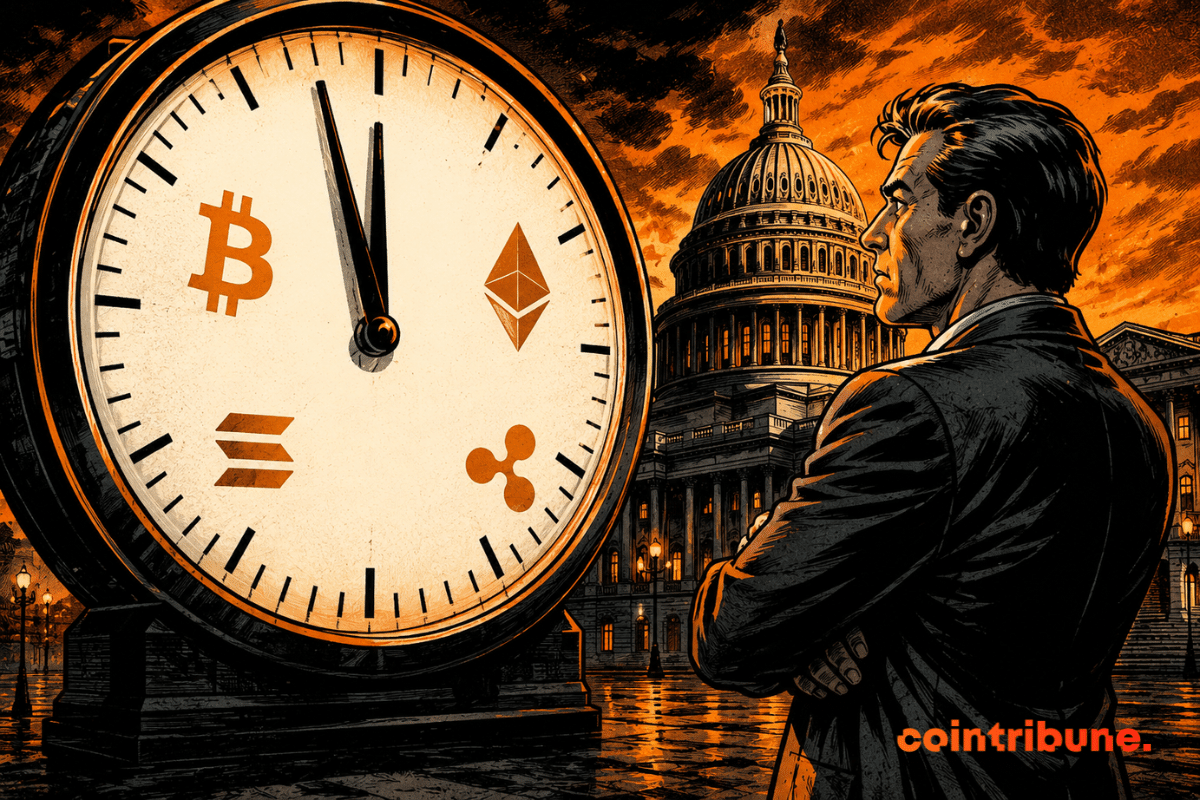
While Brussels methodically locks its digital corridors like a bureaucratic antivirus bunker, the United States is once again turning on the crypto reactors. Europe filters, frames, cuts and then sews the blockchain together with almost clinical caution. Opposite, however, Washington is preparing a new, particularly risky regulatory leap. The American crypto-sphere now resembles an immense cyberpunk laboratory where senators, exchanges and lobbyists test a financial architecture that is still smoking under phosphorescent screens and nervous graphics.
In brief
- The CLARITY Act finally clarifies the respective roles between SEC and American CFTC in the long term.
- Coinbase, Kraken and Gemini are contesting several restrictions currently targeting certain small American tokens deemed potentially manipulatable.
- Institutional investors are above all waiting for regulatory stability before massive deployment of compliant American crypto infrastructures.
- Several blockchain companies had recently left the United States for Singapore and other previously welcoming jurisdictions.
Washington finally brings the big crypto patch out of the regulatory freezer
The CLARITY Act will officially go before the Senate Banking Committee on May 14. This step appears administrative, yet it acts as a central operating room for the entire American crypto industry. In fact, it allows the text to be amended, modified and then finalized before a much broader vote in the Senate.
For several months, crypto companies in the United States have been waiting for this sequence like traders observing a final boss before a technical breakout.
The text mainly seeks to clarify the respective roles of the SEC and the CFTC. Digital assets considered as commodities would fall under CFTC control, while securities would remain monitored by the SEC.
Coinbase is already celebrating this sudden return of the crypto issue to the American political calendar. Paul Grewal, the exchange's legal director, posted a particularly nervous message on X:
It's launched like in Donkey Kong.
Source: X / @iampaulgrewal
Under the Biden administration and then under Gary Gensler, several blockchain companies left the United States for Singapore or other much more welcoming jurisdictions. Washington is now trying to recover part of this industry before a new technological hemorrhage.
The United States is now assembling a legal motherboard for all digital finance
The CLARITY Act now acts like a gigantic surgical intervention on the American crypto market. The text notably introduces a decentralization test intended to classify several categories of digital tokens. Behind this regulatory mechanism lies a much broader objective: to reassure institutional investors before a massive entry into regulated crypto products.
Faryar Shirzad, head of policy at Coinbase, summed up this battle in a message published after the official announcement:
Clear rules on market structure are essential to protect consumers, support innovation, and ensure that this technology grows in the United States rather than abroad.
Source: X / @faryarshirzad
However, several tensions still remain explosive. Coinbase had withdrawn its initial support for the text due to DeFi rules, open source developers and the performance of stablecoins. Now, Coinbase, Kraken and Gemini are still trying to relax certain restrictions targeting small tokens deemed “easily manipulated”.
Behind this technical battle, crypto exchanges above all fear a gradual asphyxiation of American liquidity.
The US crypto market is now playing a game of high-voltage regulatory poker
The US crypto market is now waiting for much more than just legal clarification. Institutional investors are above all demanding regulatory security that is sufficiently robust to deploy crypto funds, digital derivatives and tokenized infrastructures on a large scale.
Several leaders even consider the CLARITY Act as the future legal “firmware” capable of powering the entire American blockchain.
However, tensions remain visible in the comments published under political tweets. Some users are already accusing American banks of wanting to discreetly neutralize the text. Others are calling for tax exemptions for bitcoin, Ethereum, Solana or XRP.
This agitation reminds us that American crypto regulation resembles a poker table under red light more than a perfectly stabilized transition.
The numbers that are currently electrifying Washington
- The CLARITY Act will officially pass the Senate markup on May 14;
- The text must obtain at least sixty votes to then move forward sustainably;
- Polymarket currently estimates a 71% chance of adoption before the year 2026;
- Coinbase, Kraken and Gemini are still pushing several sensitive changes quietly at the moment;
- The United States wants to slow the blockchain exodus to Singapore and other jurisdictions.
The United States is moving forward quickly, sometimes brutally, yet the political landscape remains much more fragile than it appears under the spotlight. Republicans could yet see their regulatory castle collapse after the upcoming US midterm elections. In this ultra-political crypto industry, a change of majority can transform a legislative bull run into a gigantic brutal institutional blue screen.
Maximize your Tremplin.io experience with our 'Read to Earn' program! For every article you read, earn points and access exclusive rewards. Sign up now and start earning benefits.