At the intersection of technology and finance, digital assets and blockchain are emerging as compelling forces shaping our future. Indeed, from one sector to another, these technologies are finding more relevant and innovative applications than ever, promising a freer and more personalized future. But given current trends, what should we expect from the blockchain and crypto industry in 3 years? We have studied the question for you.
Crypto in 2025: Towards global dominance or coexistence with fiat?
This is a fact. In a few years, paper money will be just an old memory forgotten in the books of economics. We will no longer just talk about the dematerialization of fiduciary money, since cryptocurrency is already establishing itself as an alternative to fiat. There is even reason to say that it could soon become the new version of the currency.
In the USA alone, for example, we expect to see “tens of millions of crypto users by 2025”, as CoinsPaid CEO Max Krupyshev asserts in a recent interview. But Max doesn’t believe the exponential growth in cryptocurrency usage will only happen in the United States.
He also believes that when it comes to crypto adoption, Asia has more potential than the US in the long term. At the same time, he notes that the African crypto market is growing so much that we should expect a massive increase in adoption on this continent too by then.
However, already, crypto and blockchain have already changed the game in the sector of international payments and transfers.
Cryptos and international transfers and payments
In one of his recent interviews, Marketing Director at DeFi Unizen, Brandon Dallman, shed light on the growing importance of cryptocurrencies in international transfers and payments.
He believes, in fact, that cryptocurrencies have considerably changed the mapping of the ecosystem of payments and cross-border funds transfers which was mainly controlled by Western Union, Stripe and PayPal, which now has its own stablecoin.
This thesis on the influence of crypto is confirmed in the Web3 Barometer 2023, a survey conducted by Deloitte SAS in January 2023. The survey consisted of online questioning about a hundred companies located in France, employing between less than 10 and more than 5,000 people and operating in a dozen traditional business sectors.
30% of companies surveyed said they have turned to cryptocurrencies to make international transfers and payments due to the relatively high cost of such foreign currency transactions. The most used cryptocurrencies include ETH, stablecoins, BTC, with stablecoins being preferred for transfers and ETH for payments.
Enforcement of MiCA regulations: a new boost for crypto
The lack of crypto regulation has always been considered one of the barriers to crypto adoption around the world. If in the US, things are struggling to take off, this is far from being the case in Europe. Indeed, on April 20, 2023, the European Parliament adopted the MiCa regulation (Markets in Crypto-Assets), the European regulation on crypto-asset markets.
The adoption of the MiCA (Markets in Crypto-Assets) regulation by the European Parliament marked a decisive turning point in the regulatory landscape of cryptocurrencies in Europe. Designed to oversee the entire crypto-asset market, MiCA aims to create a safe and transparent environment for investors and consumers.
The main objective of this regulation is threefold: to protect investors against potential risks, to guarantee fair competition between players in the crypto-asset market and to ensure the financial stability of the European Union. By setting clear standards for crypto-asset issuers and service providers, MiCA seeks to eliminate the gray areas that have long surrounded the industry.
Since the adoption of MiCA, other regulatory initiatives have emerged to complement this framework. These new guidelines address specific challenges such as the rise of DeFi (decentralized finance) platforms and the constant evolution of NFTs (non-fungible tokens).
MiCA’s impact is not limited to investor protection. By providing a clear legal framework, Europe hopes to attract more crypto-asset innovators and entrepreneurs. The establishment of EU-wide harmonized regulation also facilitates cross-border operations and strengthens Europe’s position as a major hub for blockchain innovation.
With the expected implementation of MiCA at the end of 2024, the European crypto industry is about to experience a major transformation. The renewed confidence of businesses, institutions and individuals in cryptocurrencies is expected to drive exponential growth in the European cryptoasset market in the coming years.*
Recognize the advantages of blockchain and cryptocurrencies
Today, there are countless use cases for the blockchain in the world of finance, health, supply chain, agriculture, etc. There are many possibilities: issuance of financial securities, transfers of digital currency or other digital property titles, programming and deployment of smart contracts, etc.
Cryptocurrencies and the blockchain have therefore simply deconstructed the myth of the supremacy of the traditional financial sector. Unbanked or poorly banked populations, unsecured startups, companies unable to meet the conditions to benefit from traditional banking facilities, financial products and financial services, etc. can now bypass obstacles in the system.
Thus, several startups are now managing to raise huge amounts of funding through ICOs, which are new, innovative and unconventional forms of financing, without having to resort to banks. In addition, its ability to collect, organize and secure information by the principle of cryptography, has enabled blockchain technology to offer a society and marketplaces without trusted third parties.
NFTS and Metaverse: The Convergence of Reality and Digital
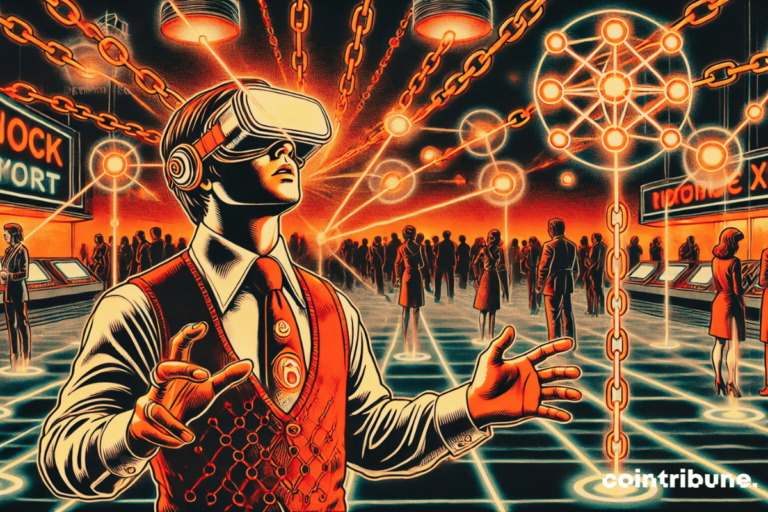
The concept of the metaverse, a parallel digital universe, is redefining the way we interact with the digital world. More than just a virtual space, it is seen as an extension of our reality, where the boundaries between physical and digital are blurring.
NFTs (non-fungible tokens) play a crucial role in this evolution. As unique digital assets, they help authenticate and monetize virtual objects, artworks, land, and even identities within the metaverse. These tokens guarantee the authenticity, ownership and rarity of the items they represent, thus providing tangible value in a virtual space.
A concrete example of this merger is the initiative of Lacoste, which launched a virtual store, combining the traditional shopping experience with the exclusivity of NFTs for members of their loyalty program.
But the metaverse goes far beyond transactions and commerce. It offers unprecedented opportunities for education, entertainment, collaboration and socialization. Imagine attending a virtual concert, training in a digital classroom, or even exploring worlds created by other users. The possibilities are almost endless.
Large technology companies, aware of the potential of the metaverse, are investing heavily in its development. These investments aim not only to create robust and immersive platforms, but also to establish standards and protocols to guarantee an optimal user experience. As this virtual space of a different kind continues to evolve, it is clear that it will play a central role in our digital future by 2025, and will provide us with enriched experiences by redefining the way we interact with the world. digital.
Conclusion
As we stand at the dawn of a new digital age, blockchain and cryptocurrencies are no longer mere technical terms, but pillars of our socio-economic future. Advances in technology, coupled with appropriate regulation, are paving the way for mass adoption, redefining our relationship to money, ownership, and how we interact in virtual spaces like the metaverse. By 2025, we may well see these technologies move from “novelty” to “standard”.
Receive a digest of news in the world of cryptocurrencies by subscribing to our new service of daily and weekly so you don’t miss any of the essential Tremplin.io!