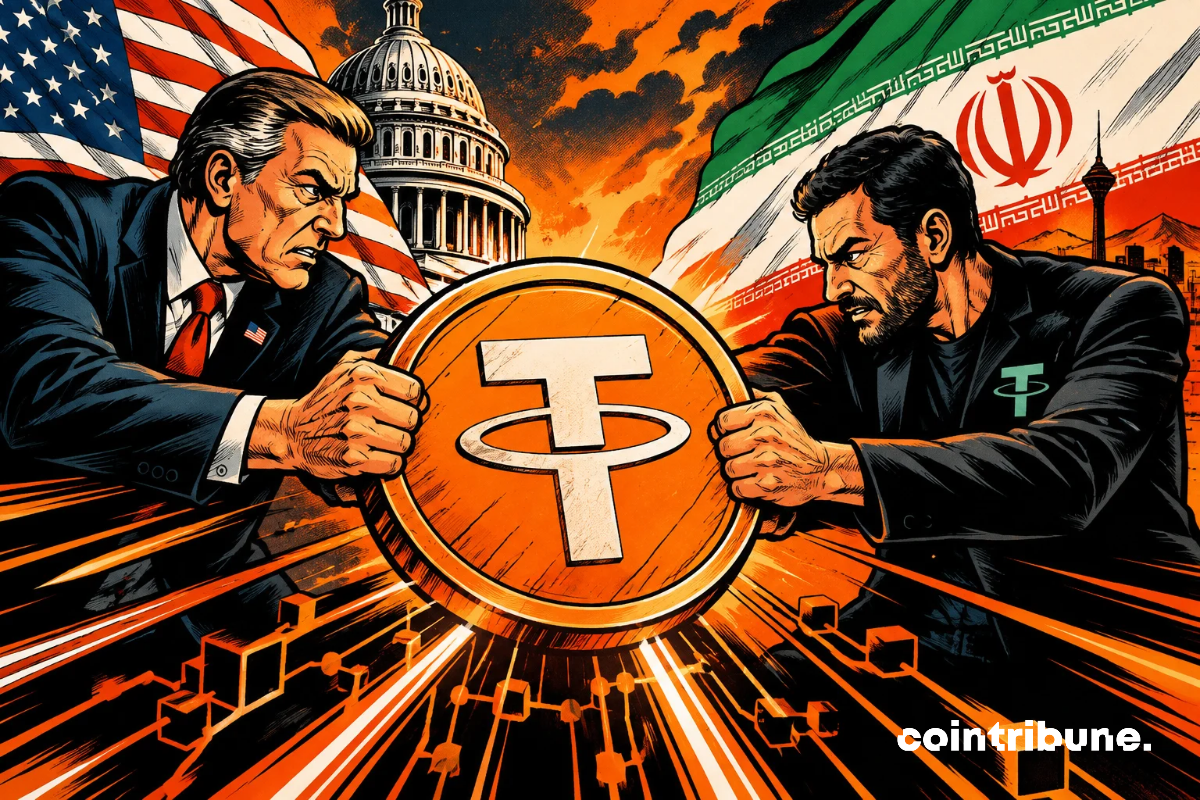
A report from Democratic senators accuses USDT of facilitating Iran’s financial operations despite US sanctions. Tether disputes these accusations and highlights nearly $550 million in tokens frozen in 2026. A disagreement which puts the question of the responsibility of stablecoin issuers back on the table.
In brief
- The Democratic report analyzed 846 sanctioned addresses linked to Iran: 84% operate almost exclusively in USDT.
- Tether claims nearly $550 million worth of USDT frozen in 2026, including $344 million in April.
- According to the report, Tether had not responded to the June Senate inquiry letter.
Senate report damns USDT on Iranian networks
In September, Iran opened its foreign trade to USDT and bitcoin. A month later, US Senate Democrats responded with “ Tethered to Terrorism », a 24-page document published Monday by the Permanent Subcommittee on Investigations. It dissects 846 addresses sanctioned since 2021 by Washington and Israel for their links with Iran and its relays: 84% operated exclusively, or almost, in USDT, far ahead of bitcoin.
The text is based on the designations of the American OFAC and the Israeli NBCTF. He cites $603 million collected in four years by two sanctioned oil traffickers, almost entirely in USDT, and $34.6 million which circulated after the designation of the wallets. At the national level, the use of cryptos to circumvent sanctions jumped by 694% in 2025, for at least 2 billion illicit transactions.
For the authors, Tether would have become a “leading illicit international payment system” for Tehran, and its “repeated failure” to freeze certain wallets would have created a “permissive environment”. The company did not respond to the subcommittee’s June inquiry letter.
Tether’s response, half a billion frozen in 2026
The response came the same day. In a press release released Monday, Tether claims nearly $550 million in USDT frozen in 2026 on wallets that Washington links to Iran’s Central Bank and the country’s sanctions networks. Two highlights: 344 million in April, more than 130 million in July.
Tether also recalls its results: more than 2,800 investigations facilitated in 67 countries and 4.9 billion dollars frozen in total. The company already claimed $4.2 billion in illicit tokens frozen over three years at the start of the year.
USDT is not a safe haven for sanctioned actors, terrorist organizations, or criminal networks.
Paolo Ardoino
Behind the duel, the freezing power of the transmitters
The crux of the matter lies in a particularity of stablecoins: their issuers can block funds. Tether blacklists an address in the contract of its token: the funds remain visible, but nothing comes out. The senators judge this power exercised too laxly; the issuer replies that it is acting on a report from the authorities. The report notes that USDC, a direct competitor, barely appears there.
The political dimension also emerges: the text is signed by the Democratic minority of the subcommittee, and criticizes the indulgence it lends to the Trump administration towards crypto companies. Another episode in Tether news, between record freezes and recurring accusations.
The report is preliminary: no sanctions have been announced. The pressure is also mounting: this summer, Washington massively tightened its secondary sanctions against Tehran. Each new freeze, or each silence, will tell if the report changes the situation.
Maximize your Tremplin.io experience with our ‘Read to Earn’ program! For every article you read, earn points and access exclusive rewards. Sign up now and start earning benefits.