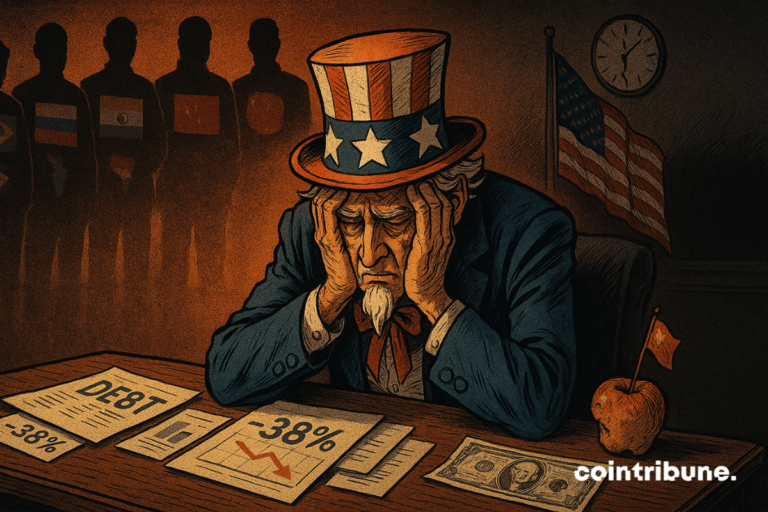
Israeli strikes against Iran upset the calculations of the American Federal Reserve (Fed). While Donald Trump multiplies pressures to obtain a monetary relaxation, central bankers must now deal with a new factor of uncertainty: geopolitical climbing that ignites oil prices.

In short
- Israeli attacks against Iran cause the world's oil prices.
- The Fed already hesitates on rate drops in the face of uncertainties linked to Trump policies.
- Geopolitical tensions add a new inflationary risk factor in the United States.
- The American labor market remains solid, giving time to the central bank.
The inflationary equation becomes more complex for Jerome Powell
The Israeli bombings led Friday against Iranian nuclear and military sites mark a major turning point in the conflict in the Middle East.
This unprecedented escalation caused an immediate flambée in oil prices on international markets, reviving fears of an inflationary thrust worldwide. For the American federal reserve, this new geopolitical deal comes complexify an already delicate monetary equation.
Robert Sockin, senior economist at Citigroup, alert On this dynamic:
If the situation was to get worse and if the prices of oil remained permanently high, that would only make the challenges that the Fed already face.
Monetary officials must now integrate this geopolitical shock into their forecasts, even though they are already struggling to adapt to the uncertainties linked to the commercial reforms driven by Donald Trump.
This energy price thrust could quickly spread throughout the American economy. Households would first suffer the effects with the pump, then in their heating and electricity bills.
On the business side, the cost of transport and production costs would multiply, fueling generalized inflationary tensions.
In such a context, a premature decrease in interest rates would risk triggering a dangerous prices-side spiral, which the Fed is precisely seeking to avoid.
The convergence of geopolitical and commercial tensions Place Jerome Powell in a strategic impasse.
On the one hand, Donald Trump intensifies the pressure to obtain a monetary relaxation. On the other, instability in the Middle East threatens to compromise the disinflationary trajectory of the United States, thus weakening the normalization strategy initiated by the Central Bank.
A Fed forced to patience despite political pressures
John Velis, strategist at Bny Mellon, perfectly sums up the challenge:
Monetary policy is not well suited to meet geopolitical shocks, but all of this means that the Fed will be even more prudent.
This prudence is explained by the unpredictable nature of geopolitical conflicts and their potential impact on global supply chains.
Paradoxically, the current solidity of the American labor market gives the Fed a room for maneuver.
In May, 139,000 jobs were created, a figure greater than expectations, while the unemployment rate remains stable at 4.2 %. This resilience offers monetary managers the possibility of delaying and observing the evolution of the situation before deciding.
But this lull may only be temporary. Jay Bryson, chief economist at Wells Fargo, anticipates a breathlessness: ” By the end of summer, you will probably see lower employment growth “, He warned, notably pointing to the massive departures of federal officials.
If the labor market was to be flexed, the Fed could be forced to intervene, even in a high energy price context.
The financial markets have already integrated this new calendar. Under -term contracts are now counting on a first drop in rates in October, pushing hopes for monetary relaxation.
In short, the conflagration of the Middle East only adds to the ambient uncertainty. Between the pressures of Donald Trump, the persistent trade tensions and the oil shock, Jerome Powell finds himself facing an unprecedented puzzle. Will the next monetary policy meeting be decisive: will the Fed maintain its wait-and-see cap, or will it give in against this conjunction of economic and geopolitical threats?
Maximize your Cointribne experience with our 'Read to Earn' program! For each article you read, earn points and access exclusive rewards. Sign up now and start accumulating advantages.