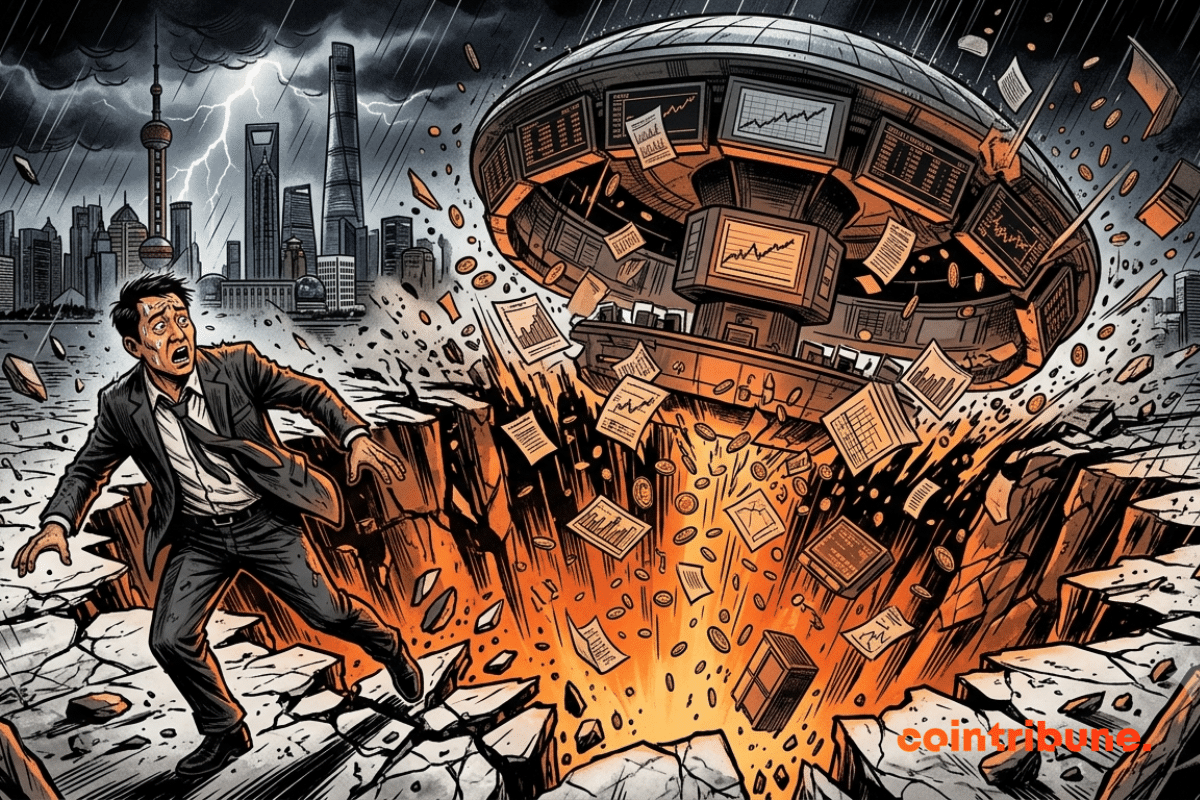
This Monday, July 13, 2026, a flash crash pulverized 2.5 trillion yuan in 15 minutes on the Shanghai Stock Exchange, pushing Beijing to sell off its American Treasury bonds to save the yuan. Triggered by the American strikes in Iran, this stock market crisis exposes the systemic vulnerability of traditional markets to energy shocks.
In brief
- A flash crash wipes out 2.5 trillion yuan of market capitalization in just 15 minutes.
- The Shanghai and Shenzhen stock markets closed sharply lower, weighed down by the collapse of the energy sector.
- US military strikes in Iran are driving up oil prices and threatening China’s energy security.
- To save its currency, China is massively liquidating its American Treasury bonds, spreading panic to Western markets.
The collapse of Chinese stock markets
This major stock market crash occurred this Monday morning, striking fear into investors around the world, as Kiyosaki believes that gold, silver, oil and bitcoin will withstand the market fall. At the close of the session, official figures confirmed the extent of this spectacular fall through key indicators :
- Instantaneous losses: more than 2,500 billion yuan of market capitalization completely evaporated from the Middle Kingdom’s markets in the space of just fifteen minutes;
- The Shanghai Composite: the benchmark index lost 2.06% to settle at 3,913.79 points at the end of the day;
- The Shenzhen Component: The situation proved even more critical in Shenzhen, where the index recorded a massive fall of 3.48%, ending the session at 14,522.9 points.
To understand the nature of this crash, it is necessary to look at the sectoral origin of the losses on the stock market, which reveals a crisis deeply correlated with the vital infrastructure of the second largest economy in the world. Energy companies suffered staggering losses throughout the day. The case of Datang International Power Generation, one of the country’s main electricity producers, is particularly emblematic in this respect since the stock recorded one of the most severe declines on the market with a violent drop of 9.94%.
The sudden decline in this specific compartment directly and immediately reflects investors’ concerns regarding the country’s future hydrocarbon supply. This sudden paralysis also occurs in a delicate domestic context, marked by a Chinese economy already weakened by years of slow growth and major difficulties in its real estate sector.
Beijing’s response
Faced with the situation, the central government activated its contingency plan by ordering its large national refiners to maintain maximum fuel production to preserve its security of supply. This strict directive implies heavy financial sacrifices for manufacturers, forced to operate at full capacity despite reduced margins, with the sole aim of building up strategic stocks.
The origin of this sudden destabilization finds its roots thousands of kilometers from Shanghai, more precisely in the Middle East. American military strikes against targets in Iran have in fact caused an explosion in world markets, raising the specter of a prolonged blockage of the Strait of Hormuz, a strategic maritime route through which approximately a fifth of the world’s oil passes. For China, which imports more than 70% of its crude oil, this situation represented a direct threat to its energy security, causing an immediate rise in world prices.
The liquidation of Treasuries and international contagion
To support the yuan at the heart of the general investor panic, Beijing immediately deployed its major monetary resources by initiating a massive liquidation of its American Treasury bonds. On-chain data indicates that Chinese authorities are actively mobilizing their dollar foreign exchange reserves to stabilize their financial markets in the face of capital flight.
The decision to sell U.S. sovereign debt adds an explosive geopolitical dimension to the crisis, as the action is likely to drive up U.S. interest rates and complicate the Federal Reserve’s monetary policy. Also, Western stock markets opened in the red under the effect of this contagion.
This major crisis invites nuanced reflection on the prospects for global financial markets and alternative assets. On the one hand, traditional investors are bearing the brunt of the critical dependence of state economies on energy flows from the Gulf, transforming each geopolitical escalation into an immediate liquidity risk. On the other hand, this massive sale of US Treasuries by Beijing could shake confidence in traditional reserve currencies and government bonds.
In this context of forced monetary reconfiguration, the trajectory of the price of bitcoin and gold will be scrutinized with the greatest attention in the days to come. If the panic initially pushes operators to liquidate all their assets to obtain liquidity, the decentralized, rare and independent nature of bitcoin could in the medium term attract capital seeking protection against the volatility of fiat currencies and the arbitrary decisions of central banks.
Maximize your Tremplin.io experience with our ‘Read to Earn’ program! For every article you read, earn points and access exclusive rewards. Sign up now and start earning benefits.