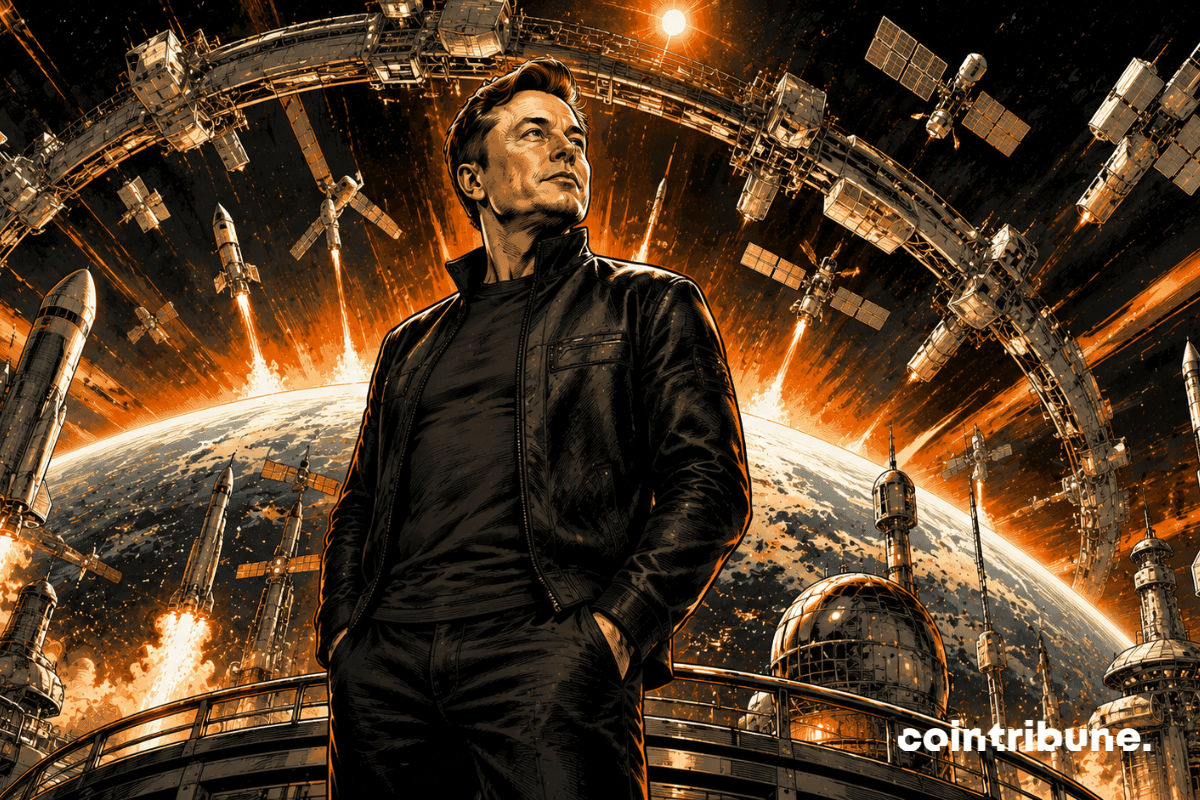
With the historic IPO of SpaceX, Elon Musk became the first individual to exceed $1,000 billion in personal wealth, an unprecedented threshold that redefines the limits of wealth creation in the technological era. This affair is much more than a stock market success. It traces the meteoric rise of a company that shook up the global space industry and reveals the markets' enthusiasm for new technological infrastructures.
In brief
- SpaceX makes history with a record $75 billion IPO, bringing its valuation to approximately $2.1 trillion.
- The operation propels Elon Musk beyond $1,000 billion in personal fortune, a world first in modern economic history.
- Investors are banking on the potential of Starlink and the dominant position of SpaceX in the space industry to justify this exceptional valuation.
- The IPO also creates a significant wealth effect, with several thousand employees and former employees likely to become millionaires.
A stock market debut that shatters all records
SpaceX had the largest IPO of all time. Elon Musk's company raised $75 billion when it entered the American financial market. Thus, the company's shares were offered at $135 per unit, an increase of nearly 19%, before their first session closed at $160.95.
This surge immediately brought the group's market value to some $2.1 trillion. On this historic day, Elon Musk declared : “a small company born in a warehouse now becomes the largest IPO in history”.
Here is the key figures of the operation:
- $75 billion raised in IPO;
- $135 per share at IPO price;
- $160.95 at the close of the first session;
- Nearly 19% increase from day one;
- Around $2.1 trillion in market valuation.
The operation also revealed the company's financial results. SpaceX would have made between $18.7 billion and $19 billion in revenue in 2025, according to figures provided to investors. The company is still recording operating losses estimated between $4.3 and $4.9 billion despite this sustained growth. Demand for shares far exceeded available supply, making this IPO a global financial event.
Why are investors betting heavily on SpaceX?
This valuation of $2.1 trillion may seem spectacular for a company that is still making a loss. Investors, however, no longer see SpaceX as a simple rocket builder. Indeed, the company is today considered a global technological infrastructure, whose activities touch several strategic sectors. This vision is largely based on the Starlink network. From now on, thanks to its thousands of satellites placed in low orbit, it offers Internet access in many regions of the world and constitutes, for the financial markets, a particularly attractive source of recurring income.
Investors are also banking on the dominant position acquired by SpaceX in space. The company is responsible for many of the world's commercial launches and designs technologies that have the potential to lastingly change the space economy. This combination of telecommunications, space and critical infrastructure explains why the markets place such a high value on the group.
For many fund managers, SpaceX is not just a space company: it is a technology platform that can play a strategic role in global communications networks, defense, government services and future space-related economic activities.
Elon Musk becomes the first trillionaire in history
SpaceX's IPO had an immediate effect for its first shareholder. The company allows Elon Musk to officially become the first trillionaire in modern history. This symbolic threshold now puts the leader in a category of his own. According to Matt Durot, analyst at Forbes Wealth, the scope of the phenomenon is summarized as follows: “the second richest person in the world is around $300 billion, less than a third of what Musk may be worth today”. This difference shows how quickly some technology companies can generate wealth when markets massively embrace their long-term vision.
The operation also benefits its founder. According to estimates reported by the international press, more than 4,400 employees and former employees of SpaceX could become millionaires thanks to the IPO. This massive wealth effect is one of the largest ever seen in the technology sector.
At the same time, this unusual concentration of capital is reigniting debates about economic inequality and the increasing power of large technology companies. Several economists point out that no one has ever achieved such an amount of wealth, while others see it as the logical consequence of a system rewarding innovation, risk-taking and the creation of new industries.
SpaceX's IPO marks a further stage in the evolution of technological capitalism, where digital infrastructures, satellite networks and space exploration are emerging as major levers of value creation. Supporters of this change see it as proof that innovation can go beyond the limits of the traditional economy. According to its detractors, it is a growing sign of wealth inequality in the global economy. However, the largest IPO in history and the advent of the first trillionaire will remain lasting benchmarks for the financial markets, well beyond the trajectory of Elon Musk or SpaceX.
Maximize your Tremplin.io experience with our 'Read to Earn' program! For every article you read, earn points and access exclusive rewards. Sign up now and start earning benefits.