
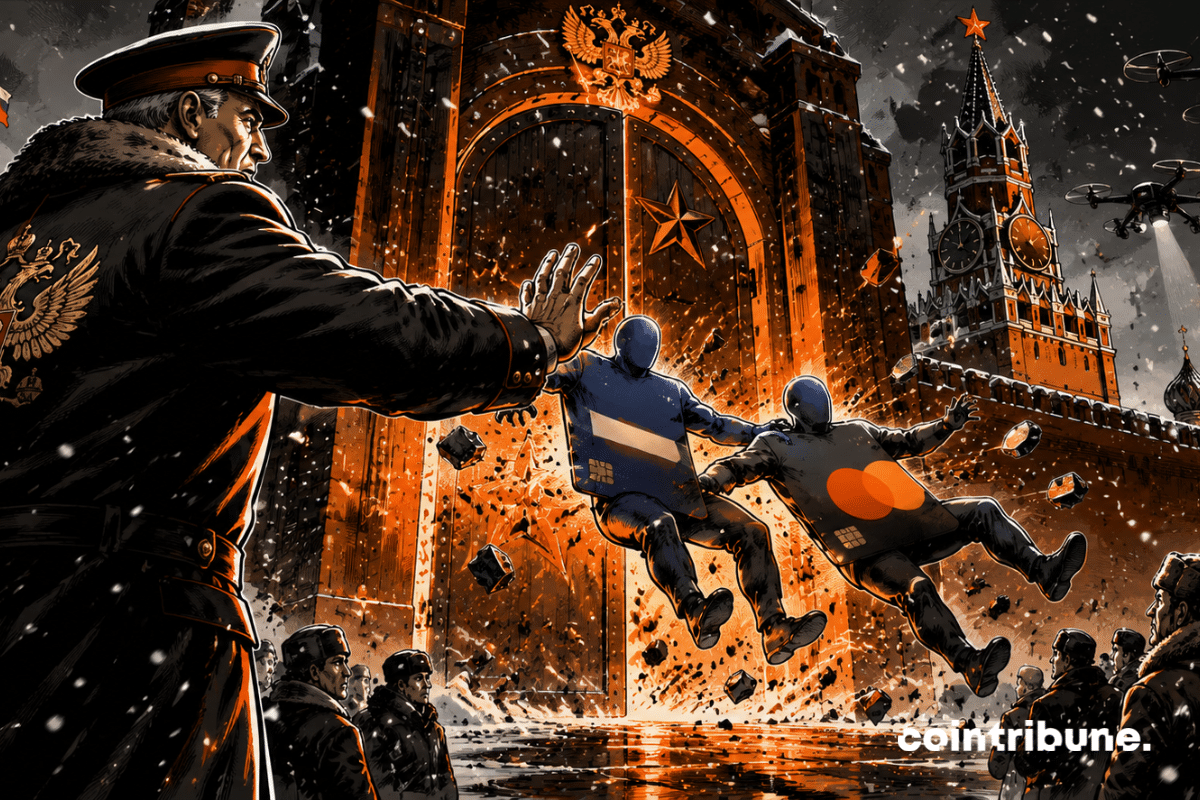
Since their withdrawal from the Russian market in 2022, Visa and Mastercard have gradually lost ground. But this time, Moscow is taking a new step. The Bank of Russia now estimates that the two American giants no longer have their place in the national financial ecosystem, while their market share has fallen below 17%.
In brief
- The Bank of Russia asks Visa and Mastercard to permanently withdraw from the Russian market.
- Their market share has fallen below 17%, compared to more than 75% on international markets.
- The Mir system issued 476.5 million cards in January 2026.
Visa and Mastercard, giants that have become ghosts in Russia
On Monday, Alla Bakina, director of the National Payment Systems Department of the Bank of Russia, clearly stated Moscow's position: Visa and Mastercard must permanently leave the Russian market.
According to her, these companies no longer provide the services they previously guaranteed, while the Russian national system continues to bear the technical costs associated with their presence.
This statement marks a new step in Russian financial strategy since Western sanctions imposed after the start of the conflict in Ukraine in 2022. At the time, Visa and Mastercard suspended their operations in the country. Yet millions of cards still continued to work locally thanks to Russian infrastructure.
But today, their influence has become marginal. According to the Bank of Russia, their share in national payments has fallen below 17%. In parallel, Russian banks are gradually replacing these cards with Mirthe national system launched in 2014 after the first geopolitical tensions with the West.
Mir takes over, a smooth transition
The Mir system, launched in 2014, is today the mainstay of Russian payments. As of January 2026, it has issued more than 476.5 million cards. Russian banks are gradually replacing expired Visa and Mastercard cards without waiting for formal instructions, the movement is already well underway.
Ilya Grashchenkov, director of the Center for Regional Policy Development, wants to be reassuring: the transition will be “gradual and calm, without loss of funds, without interruption of payments”. No bank runs, no chaos. The system holds.
This decline by Visa and Mastercard is not an isolated phenomenon. In Brussels, the European Central Bank is also accelerating its work on the digital euro, relying on open standards to reduce the continent's dependence on American infrastructure.
China, for its part, is strengthening its sovereign payment system and gradually cutting its financial ties with Washington. The world of payments is rapidly fragmenting.
Russia is not chasing Visa and Mastercard: it is simply noting that they have already left. What is at stake here goes well beyond Moscow, it is proof that monetary sovereignty has once again become a strategic priority, on both sides of the Atlantic and in Beijing. The hegemony of Western payment networks, long considered immutable, is showing its first real cracks.
Maximize your Tremplin.io experience with our 'Read to Earn' program! For every article you read, earn points and access exclusive rewards. Sign up now and start earning benefits.


![EthCC[7] in Brussels: Dive into the European regulatory landscape, the scalability of blockchain and the emergence of L3](https://tremplin.io/wp-content/uploads/2024/06/1718154672_EthCC7-in-Brussels-Dive-into-the-European-regulatory-landscape-the-768x512.png)
