
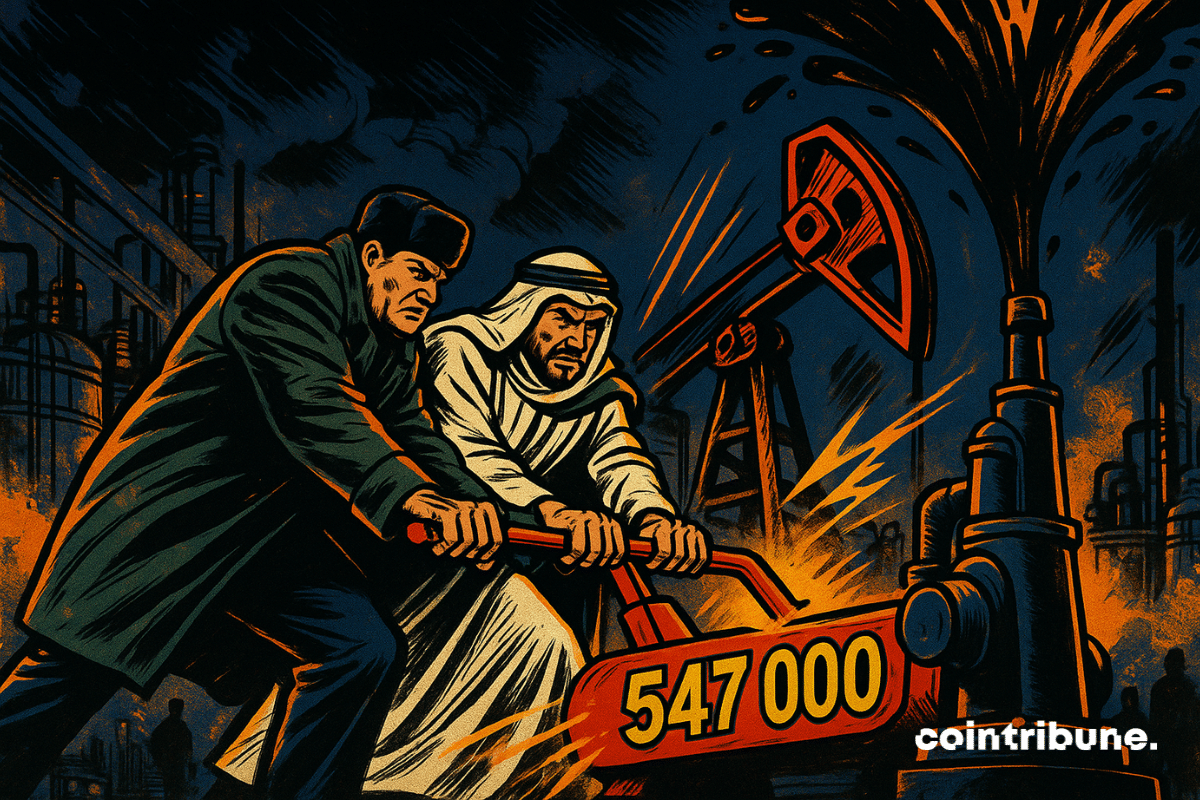
Saudi Arabia, Russia and their partners within OPEC+ announce a coordinated increase in oil production of 547,000 barrels per day. A strategic decision that upsets the fragile balance of the world market and could revive geopolitical tensions, while the showdown between Washington and Moscow is intensifying.
In short
- OPEC+ increases its production by 547,000 barrels per day, or 0.6% of world consumption.
- Saudi Arabia and Russia lead this initiative to reconquer market share.
- Trump threatens new sanctions against Russia and its business partners.
- India maintains its Russian imports despite American pressures.
Russia and Saudi Arabia want to regain control
On Sunday August 3, eight producer countries gathered within OPEC+ formalized their agreement to increase their daily production by 547,000 barrels.
This decision, conducted jointly by Saudi Arabia and Russia, is part of a long -term strategy aimed at recovering the lost market share in previous restrictive policies.
This increase is certainly a modest fraction of the 100 million barrels consumed daily worldwide. However, it testifies to a major paradigm change. After years of drastic cuts intended to maintain the high lessons, the oil giants now favor the volume on prices.
The immediate impact is already felt in the markets. Brent, international reference, stagnates around $ 70 a barrel. A level that contrasts strongly with the summits of $ 120 affected in the spring of 2022, during the Russian invasion of Ukraine.
For French consumers, this stabilization could maintain prices at the pump at their current levels: 1.62 euros per liter of diesel and 1.66 euros for petrol.
The prospective vision of OPEC+ focuses on increasing demand until the middle of the century. This anticipation comes into direct contradiction with the projections of the International Energy Agency, which provides for stabilization from 2030, in particular with the effect of the democratization of electric vehicles.
Geopolitical tensions redraw the energy spectrum
L'OPEC+ announcement intervenes in a particularly volatile geopolitical context. Donald Trump recently hardened the tone towards Moscow, granting “ten days” to Russia to resolve the Ukrainian conflict.
This ultimatum is accompanied by concrete threats: ” We will impose customs duties and other things “Said the American president.
Among the measures envisaged is an indirect surcharge of 100 % on imports of Russian products, hydrocarbons included. This maneuver aims directly India, which in 2025 became the second world importer of Russian oil, with 1.6 million barrels per day.
But New Delhi does not give in to pressure. The Indian government has clearly expressed its desire to maintain its energy relations with Moscow, affirming the primacy of its strategic interests on American injunctions.
This posture illustrates the growing fragmentation of the global trade system, marked by the emergence of rival economic blocks such as the BRICS and the erosion of Western unilateralism.
In this context of rapid recomposition, the prospects for the oil market are becoming more and more opaque. The reversals of American trade policy, combined with persistent geopolitical instability, plunge the energy industry into an area of prolonged turbulence.
It is in this tense atmosphere that OPEC+ engages in a major strategic turn. The increase in production decided by the cartel exceeds the simple cyclical adjustment: it marks a political and economic offensive.
In this new game of influence, each barrel becomes a diplomatic lever, each energy alliance, a declaration of sovereignty.
In short, Russia, Saudi Arabia and their allies want to preserve their central role in a global change order. For them, it is no longer just a question of regulating the market, but of redefining the rules of power in a world that has become deeply multipolar.
Maximize your Cointribne experience with our 'Read to Earn' program! For each article you read, earn points and access exclusive rewards. Sign up now and start accumulating advantages.


