
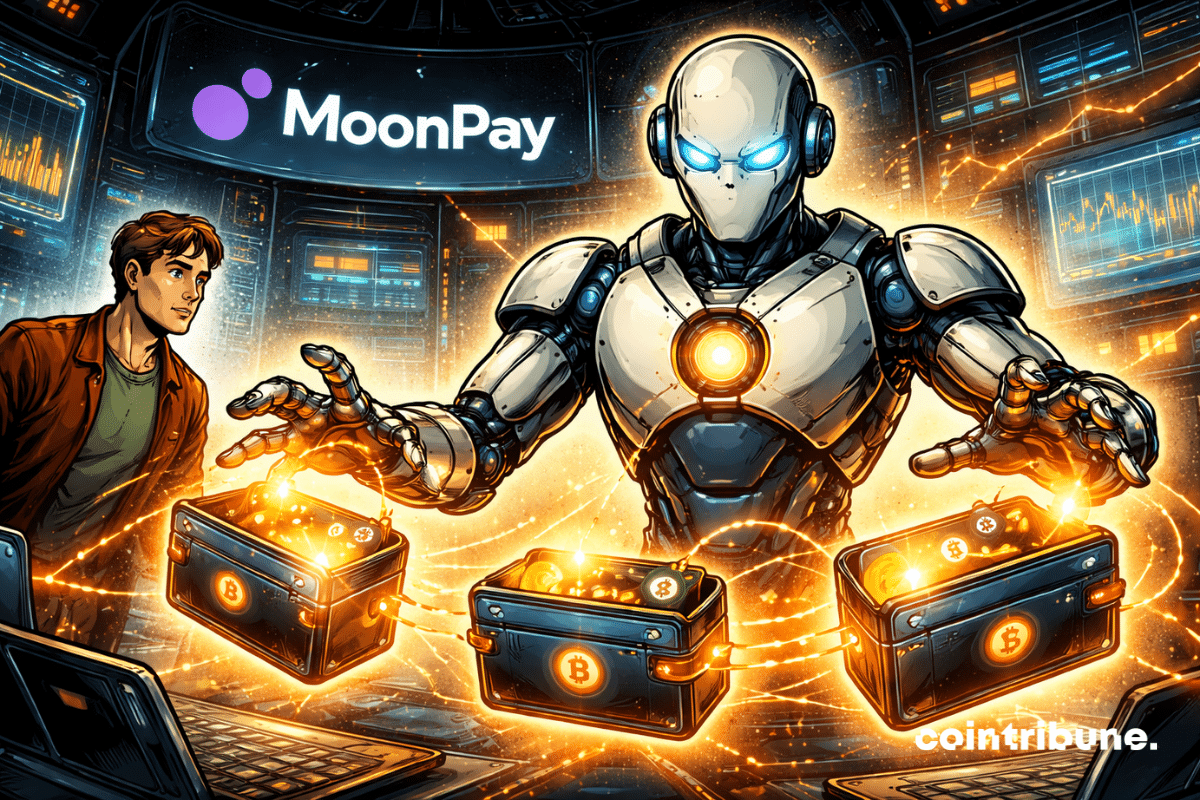
For several years, MoonPay has been advancing in crypto like an artisan turned architect, multiplying ideas to structure a still unstable market. The firm does not just support flows, it attempts to redefine the uses linked to artificial intelligence. Now, she is tackling an explosive subject, that of wallets used by autonomous AI agents. A gray zone where security, fragmentation and the absence of standards still slow down the real expansion of this emerging economy.
In brief
- MoonPay launches an open source standard to unify wallets used by crypto AI agents.
- The system protects private keys with encrypted and isolated local storage.
- AI agents can manage funds across multiple blockchains with a single interface.
- Strict rules limit spending and regulate automated transactions in the crypto ecosystem.
MoonPay tackles the chaos of crypto wallets used by AI agents
First, MoonPay sets foot in a territory that is still poorly marked, that of crypto wallets manipulated by dispersed AI agents. Each tool previously operated with its own keys, its own formats and its own technical limits. As a result, funds remained fragmented, often stuck in mutually incompatible silos.
THE open source standard proposed breaks this logic by bringing together the assets in a single coherent environment. This change allows an AI agent to operate with a global view of its available financial resources.
The agent economy had payment rails. She did not have a wallet standard. We created one, opened it, and now the full stack exists.
Ivan Soto-Wright, CEO and co-founder of MoonPay
Behind this initiative, MoonPay seeks to lay a common basis for sustainably structuring crypto driven by artificial intelligence.
A unique crypto wallet for AI, secure and designed to survive human flaws
Next, MoonPay is banking on a simple but extremely effective idea, removing private keys from the hands of AI agents. The system relies on an encrypted local vault, capable of storing keys without ever exposing them. Each transaction is signed in an isolated environment, then the key immediately disappears from active memory.
This mechanism greatly limits the risks linked to leaks or handling errors. At the same time, a rules engine governs each operation, imposing precise ceilings and restrictions. The standard also allows compatibility between several major blockchains, facilitating use in different crypto environments.
On-chain payments come from wallet addresses, and each chain represents them differently. A unified representation allows an agent to focus on its main task rather than on details.
Sam Blackshear, co-founder and CTO of Mysten Labs
This approach aims to make AI truly operational in the crypto ecosystem.
Behind innovation, a silent war on the security of autonomous agents
Ultimately, this evolution goes well beyond MoonPay, as the entire crypto industry is moving towards massive automation driven by artificial intelligence. AI agents are no longer simple tools, they become actors capable of executing transactions and interacting with complex systems.
This rise in power raises major questions around the security and control of automated decisions. Companies are increasing initiatives to integrate these agents into their financial infrastructures. In this context, standards become essential to avoid technical and economic chaos. MoonPay therefore attempts to impose discipline before the ecosystem becomes further fragmented.
The subject goes beyond technology, because it concerns the trust placed in autonomous systems capable of manipulating value.
Key takeaways
- More than fifteen major players participate in this open source standard;
- The system covers several important blockchains in the current crypto ecosystem;
- Private keys are never exposed to AI agents;
- The standard introduces strict rules to govern each transaction.
All in all, the question of private keys remains central to the rise of automated trading driven by artificial intelligence. A solution developed with Ledger introduces a reinforced hardware signature, limiting critical exposures. This advance could sustainably secure AI agents in crypto. It remains to be seen whether this approach will be sufficient to contain the possible excesses of these autonomous systems.
Maximize your Tremplin.io experience with our 'Read to Earn' program! For every article you read, earn points and access exclusive rewards. Sign up now and start earning benefits.


