

The Central Bank of China has just carried out a major medium -term loan operation to support its banking system. This injection of 300 billion yuan (approximately 41.83 billion dollars) is part of a larger strategy aimed at maintaining favorable liquidity conditions in an uncertain economic context.
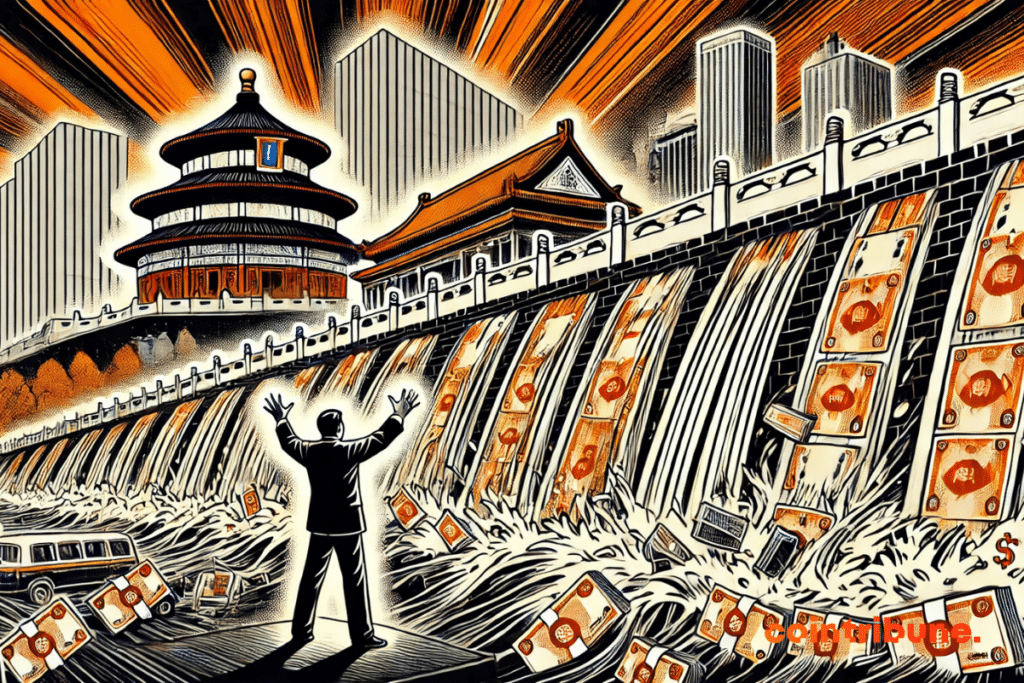
China injects 300 billion yuan to stabilize its economy
The Banque Populaire de China (PBOC) launched this Tuesday a medium -term loan operation (MLF) of 300 billion yuan with a maturity of one year. The applied interest rate remains stable at 2%, unchanged from previous operations, according to the official press release published on the Central Bank site. This intervention occurs in a context where Beijing actively seeks to stabilize its economy in the face of interior and external challenges.
This operation represents a partial renewal, since 500 billion yuan of MLF loan will expire this month. After this last injection, the total balance of MLF loans now reaches 4.09 Billions of Yuan. The difference between the amounts due to the recent injection testifies to a calibrated adjustment on the part of the Chinese monetary authorities.
Wang Qing, chief macroeconomic analyst at Golden Credit Rating, recall that the central bank had already proceeded in January to take direct boarding schools of 1,700 billion yuan, equivalent to an early release of medium -term liquidity. This sequential strategy aims to maintain abundant liquidity while avoiding excessive expansion of the central bank assessment.
A monetary strategy in a tense economic and geopolitical context
China's accommodating monetary policy pursues several simultaneous objectives: helping banks increase their credit supply, facilitate the issue of state bonds and stabilize market expectations. These measures are part of a broader effort of support for an economy which struggles to regain its dynamism before the pandemic, especially in the real estate and consumption sectors.
This MLF operation also intervenes in a context of increased trade tensions with the United States. Since Donald Trump's return to the White House, Washington has imposed new customs taxes on Chinese imports and threatened the group of BRICS, of which China is a founding member, of punitive rates of up to 100%. Faced with these pressures, Beijing seeks to strengthen its internal economic and financial resilience.
Analysts believe that the PBOC should maintain this accommodating orientation in the coming months. The current level of MLF rates, combined with other tools such as compulsory banking reserve ratios, should continue to support sufficient liquidity to meet the financing needs of the real economy, while avoiding too aggressive measures that might destabilize the yuan.
In short, this MLF operation of 300 billion yuan prefigures more massive interventions to come. In September 2024, Beijing planned to inject 1000 billion yuan (142 billion dollars) into its state banks, the largest since the 2008 crisis. Faced with the fall in bank profitability and geopolitical tensions with Washington, the China intensifies its efforts to stabilize its financial system and support its vulnerable economy.
Maximize your Cointribne experience with our 'Read to Earn' program! For each article you read, earn points and access exclusive rewards. Sign up now and start accumulating advantages.


