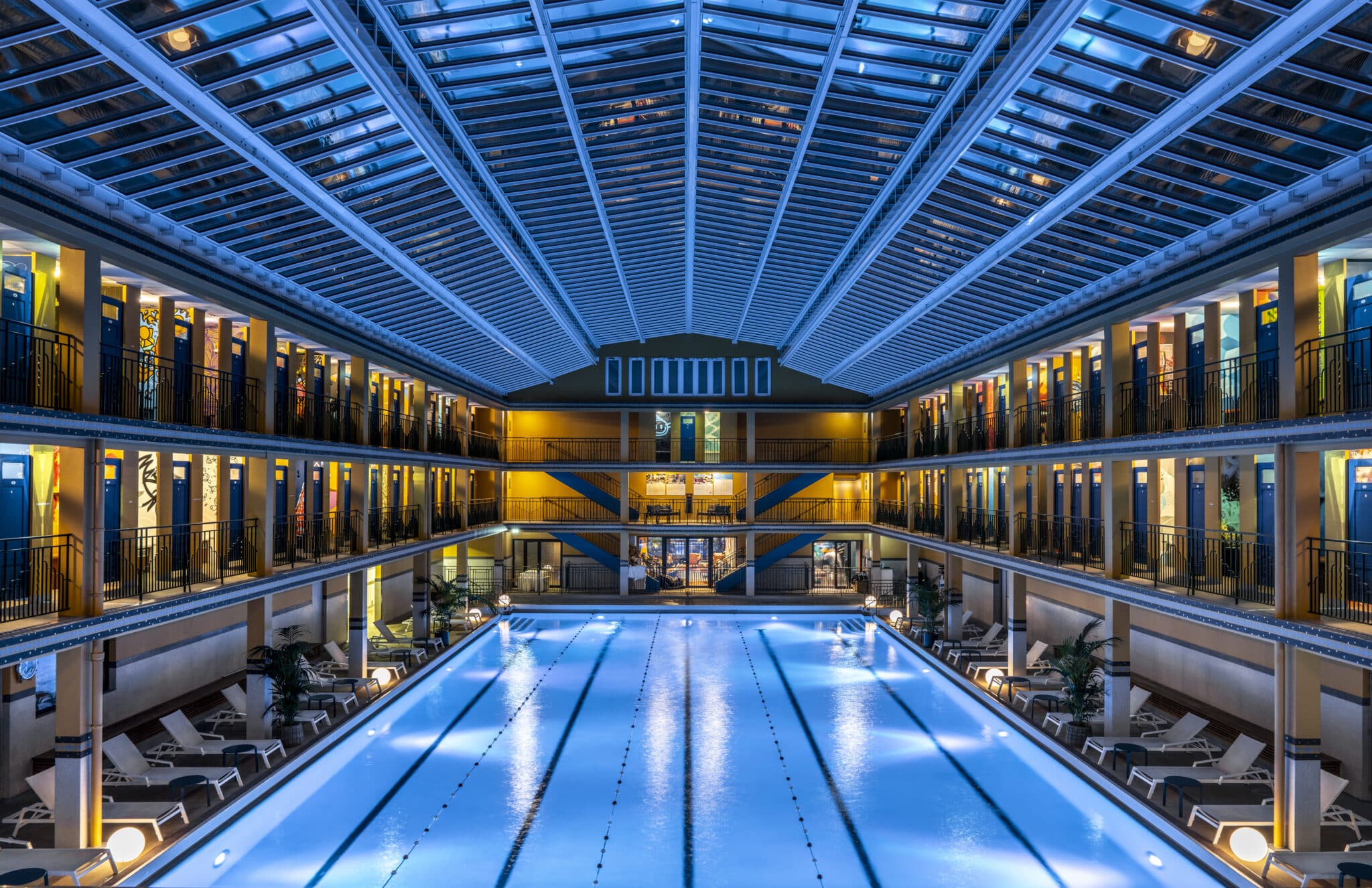
Inaugurated in 1929, Molitor was for 60 years the most popular swimming pool in Paris for its two pools and its avant-garde atmosphere. Closed in 1989 and classified as a historic monument, the place is taken over by artists and the dilapidated building becomes the temple of an alternative culture mixing street art, artistic performances, concerts, etc. Now transformed into a luxury hotel complex, Molitor MGallery has always highlighted this artistic side. A facet that the establishment wishes to share with collectors with a new collection of NFT d’Art.
Molitor Paris, a place of expression of urban art
To understand how Molitor Paris has become a mecca for urban art, we must delve into its history.
An Art Deco style nautical complex
When it opened, Molitor quickly established its own character. It opened its doors in 1929 as a municipal swimming pool located in the 16e arrondissement of Paris.. The place has become a must on the Parisian scene, mainly thanks to its two emblematic swimming pools: the outdoor swimming pool or “The place to be” of the city and the indoor swimming pool, both resolutely Art Deco.
At Molitor, you can swim, tan (and skate there in winter!), but that’s not all. Fashion is also launched there. Some of the most provocative trends of the time were born in Molitor. The first modern bikini designed by Louis Réard, for example, was unveiled at the Molitor swimming pool in 1946. The place also hosted fashion shows, galas and other prestigious parties.
Urban art takes over Molitor
In the 1970s, the Molitor swimming pool began to lose its splendor. Its popularity declined and the establishment ended up closing in 1989. It was then classified as a historic monument to avoid its destruction. With the swimming pool closed, the premises are taken over by street artists, graffiti artists in particular, who have transformed the establishment into an immense urban art space. Le Molitor has become a hub for graffiti art in Paris.
The Olympic-size pools have become the scene of rave parties, alternative concerts and teknivals. Skateboarders have found the perfect place to ride. In 2008, the Accor group undertook to renovate the Molitor’s summer and winter swimming pools. A luxury hotel and a wellness center will also be included in the construction.
Molitor, now a hotel complex of the MGallery brand, reopened its doors in 2014. We find the original Art Deco architecture. The heritage of free art is also preserved.
Many renowned artists have been invited there over the years to tell the story of contemporary urban art through frescoes that cover the old cabins changing room in the indoor pool, from wall to ceiling. Each of its 78 cabins makes up an immense gallery of contemporary urban art. Every year, the establishment organizes cultural events highlighting this art.
From wall to digital
For 2023, Molitor invites new artists who will express themselves on this cult scene of urban art: the walls of the winter basin. This year, Molitor is innovating by offering its first collection of NFTs created by 4 exceptional artists: Does, Astro, Nasty and Marko93. From their physical works made in 2018, the 4 street artists each produced a collection of 100 NFTs of art. The physical works will be destroyed within the year. The collectors of the 400 NFT works will keep a part of these digitized works. The 400 NFT works are part of The Legacy Collection.
Molitor will put these 400 digital works on sale. For collectors, the acquisition will provide access to unusual experiences. The 400 collectors will be invited to the Legacy Party, which will be held on November 25. It is, so to speak, an opening of another kind. 40 other collectors drawn at random will also have the chance to enjoy a seated dinner in the indoor pool. Finally, 4 lucky collectors (always drawn at random) will be able to meet the 4 authors of the works as part of a preview visit to the cabins.
4 artists for 400 NFT
The Legacy Collection is signed by 4 exceptional artists: Does, Astro, Marko93 and Nasty.
DOES
DOES, whose real name is Joos van Barneveld, is a multidisciplinary artist from the street art world. DOES is a painter, sculptor, graffiti artist and former Dutch professional footballer. His style is recognizable by his well-balanced color schemes and his ability to control the purity of contours. His specialty being controlled dripping with dizzying and stretched colors
DOES constantly pushes the limits of its artistic research to move towards new conceptual directions. In its evolution, he considers graffiti as an archive that embodies his artistic roots.
Astro
Astro is a self-taught French street artist, born in 1981. He created his first graffiti in 2000 in the Parisian suburbs. At the start of his artistic career, Astro had a preference for lettering and for wildstyle, a complex graffiti style where letters jumble together.
He then turns to a more abstract expression mixing curves, geometry and calligraphy. With his technique, his play of shadows and his sense of perspective, Astro creates pieces that create pieces, with this characteristic optical illusion which appears as a signature.
Marco
Marko 93 grew up in Paris. He started street art and graffiti in the 80s, inspired by the hip hop movement, already very popular in Europe and the United States. The artist stands out for his particular style, calligraffiti, a clever mix of graffiti and Arabic calligraphy executed in an abstract style. Although the artist has a keen eye for design, his work seems to evoke spontaneity and casualness due to the inclusion of paint drips and splattered edges.
Marko is also a talented light painter. He has cultivated this art since 1999 and has used it on numerous occasions to deliver committed messages, such as messages of peace, to the four corners of the globe. He reinvents light painting by using the computer and the camera to capture and restore streaks of light in real time.
Nasty
Nasty is a notorious French street artist. He is best known for his enameled RATP signs which he has used for over 25 years. In 1988, he left his mark on walls and subways with his art and thus made a name for himself in the French graffiti scene. With his contemporaries, he strongly influenced and defined the codes of Parisian graffiti culture of the 90s. His signature? Sleek lettering, explosive colors and applied outlines.
His style is particularly characterized by bright colors, such as pink, purple or blue, to break up the gloomy gray of the concrete. For Nasty, what could have been childishness and vandalism turned into an incredible artistic journey, punctuated by exhibitions in galleries and museums as well as equally enriching collaborations with brands.
The Legacy Collection: the project roadmap
The Molitor Paris hotel will present its The Legacy Collection project to NFT art collectors on August 31. The establishment will at the same time open its waitlist to them. The private sale will be launched a month later, on September 29, followed closely by the public sale the next day (September 30). Molitor will then meet the 400 collectors for the Legacy Party which will be held on November 25, 2023, in the indoor swimming pool. A collector’s dinner at the bottom of the indoor swimming pool will also be organized in early 2024.
Conclusion
Molitor Paris shares, perpetuates and immortalizes the artistic spirit of the establishment with its NFT street art collection, The Legacy Collection. In addition to ensuring the prosperity of street art, Molitor opens this still too exclusive and marginalized universe to a wider audience thanks to this project.
To register for the waitlist, go to project website. There will be 400 NFTs, 100 per artist, each NFT being unique. Sale price: 590 euros, or 0.35 ETH.
Receive a summary of the news in the world of cryptocurrencies by subscribing to our new service daily and weekly so you don’t miss anything of the Tremplin.io essentials!