
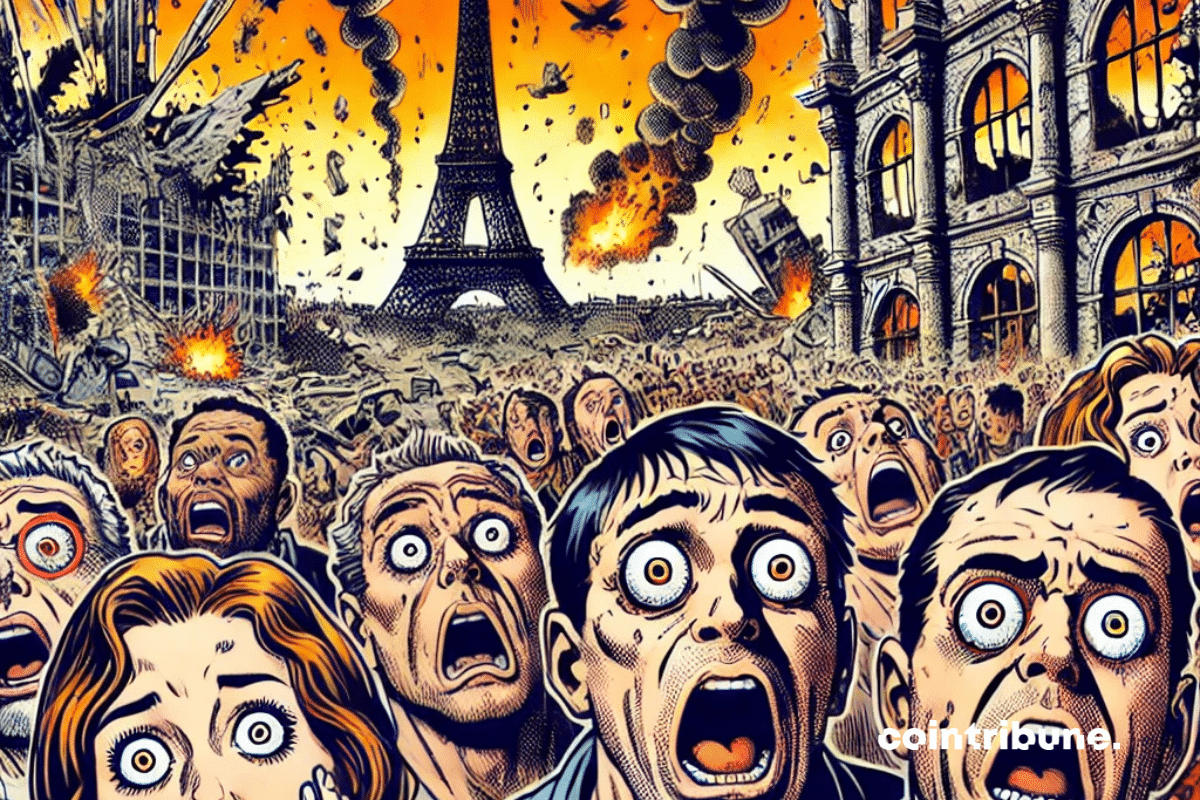
The French deficit is exploding! A parliamentary commission of inquiry is looking into the causes of this slippage. While France seems to be sinking into an unprecedented debt spiral, Macron appears to be solely responsible for this ruin.
A commission of inquiry: a turning point
The finance committee of the National Assembly is transformed into commission of inquiry. Its mission: to understand the causes of variations and discrepancies in tax and budget forecasts. Eric Coquerel and Eric Ciotti will carry out the investigationwith extensive powers to access administration documents.
This decision marks a significant shift in the balance of power. For the first time in a long time, Parliament seems to be regaining control over crucial questions of public finances. This commission will have the power to summon witnesses and demand the production of documents, including those usually kept confidential by the executive.
The trial of Emmanuel Macron?
Bruno Le Maire's hearing will be closely scrutinized. The Minister of the Economy and Finance will have to explain the reasons for this budgetary slippage. But beyond his person, the entire economic policy of the five-year term will be scrutinized.
Some commentators are already wondering about the role of the head of state in the cover-up of the seriousness of the situation for several months. Gérard Larcher, President of the Senate, made a statement full of meaning: “We have not been told everything. » This statement suggests that crucial information may have been deliberately hidden to Parliament and to the French.
This commission could mark the start of a real trial of macronism. Parliament seems to be regaining control in the face of a weakened executive.
Macron's damning record
Emmanuel Macron appears as a failed reformer. Coming to power in 2017, he promised to consolidate public finances and revive the economy. The result is quite different.
The debt exploded, increasing by almost 1 trillion euros under his mandate. This dizzying increase represents nearly 50% increase in just seven years.
The Covid crisis certainly played a role, with a “whatever it takes” which cost twice as much as elsewhere in Europe. But this policy is not enough to explain the extent of the slippage. The very structure of the French state, with its very broad scope of action, seems to have amplified the effects of the crisis.
Macron did not reform pensions
Structural reforms, such as that of pensionswere too timid or poorly conducted. The reform of points pensions, initially planned for 2019, was abandoned in the face of social protest. Its replacement by a timid reform in 2023 did not make it possible to fix the underlying problems of the system.
The loss of the absolute majority in the Assembly paralyzed government action. Unable to pass its reforms without compromise, the executive found itself in a situation of unprecedented institutional blockage.
France in the debt spiral
The situation is alarming. The debt burden could reach 120 billion euros per year within 7 to 8 years. This dizzying figure would represent nearly 40% of the current state budget. To understand the scale of the problem, we must understand the mechanism of debt.
Every year, it will be necessary to find an additional 15 billion euros just to pay the interest. This mechanical increase is due to the rise in interest ratesafter a decade of artificially low rates thanks to the policy of the European Central Bank.
The problem is made worse by the fact that France continues to have a large deficit. With a deficit of 5% of GDP, that's around 150 billion euros of additional debt each year. This new debt will have to be financed at higher rates, creating a snowball effect.
The French tax system is also problematic. He prevents enrichment while allowing the richest to remain so. This dynamic slows down social mobility and innovation. In France, 70% of great fortunes are inheritedcompared to only 30% in the United States or the United Kingdom.
This tax structure creates a rent economywhere it is difficult to get rich through work and innovation, but relatively easy to keep an acquired fortune. This lack of economic dynamism weighs heavily on the country's ability to generate growth and therefore repay its debt.
Macron euthanized the 5th Republic
The current crisis could accelerate a transformation of the French political regime. The transition to a more parliamentary system, with the introduction of proportional representation, seems inevitable.
This development would allow better control of administrations and more intelligent politicization of the population. The public debate would become more mature, less centered on the person of the president.
In a parliamentary system, important decisions are made in Parliament, forcing commentators and citizens to be interested in the substance of policies rather than the personalities of leaders.
The marginalization of Emmanuel Macron in front of Parliament is already visible. From absolute master in January, capable of passing a law on immigration against the advice of Parliament, he today finds himself largely constrained by the deputies. This loss of presidential power perhaps marks the end of the “republican monarchy” established by the Fifth Republic.
The introduction of proportional representation would speed up this process. It would make it almost impossible to obtain an absolute majority for a single party, forcing the formation of coalitions. This system would favor consensus and compromise, rather than the current binary confrontation.
Macron, the future Louis 16?
The parallels with the pre-revolutionary period of 1789 are striking. As Louis XVI, Macron appears incapable of carrying out the necessary reforms in the face of the explosion of debt.
In 1789, the kingdom's debt reached approximately 80% of the GDP at the time. Debt service represented 42% of state revenue. Today, although the situation is not yet as serious, the trend is worrying. We could reach 30% of revenues dedicated to debt service by 2027.
The first reaction of the deputies in 1789 was to seize the property of the clergy in an attempt to replenish the state coffers. Today, some parliamentarians seem tempted by the same approach, multiplying proposals for new taxes.
However, history shows that real liberal reforms only intervened at a later stage. The Allarde decree and the Le Chapelier law, which truly liberalized the French economy, were only passed in March and June 1791, almost two years after the start of the Revolution.
Parliament against the Elysée
A positive aspect of this crisis is that complex subjects such as taxation, the state budget or the functioning of institutions are increasingly discussed, including outside expert circles.
This development is crucial for the future of the country. A more informed and more engaged population is better able to understand the issues and participate in the democratic debate.
This political maturity is a necessary condition for carrying out the difficult reforms that are required.
We are already seeing an evolution in the public debate. The media are starting to take a closer interest in budgetary issues, beyond simple announcement effects. Citizens demand more transparency on the use of public money.
This collective awareness could be the prelude to deeper changes.
The challenges ahead
France is faced with crucial choices. To avoid bankruptcy, it will be necessary to find approximately 200 billion euros in savings per year over the next ten years. A colossal challenge which will require deep structural reforms.
Liberalization of the economy seems inevitable. Like Allarde's decree in 1791, which abolished corporations and their stifling regulations, France will have to tackle the normative jungle that hinders its economy.
State reform is also a priority project. The scope of action of the French State, much wider than that of its European neighbors, will have to be rethought. This reform will be painful, because it will call into question many social achievements.
Finally, the tax system will need to be fundamentally overhauled. The objective will be to create a dynamic favorable to enrichment through work and innovation, rather than through income and inheritance.
Macron has ruined the country
France finds itself at a turning point in its history. The debt crisis could precipitate a profound overhaul of its institutions and its economic and social model.
Macronism appears to be the last gasp of a system running out of steam.
The parliamentary commission of inquiry could be the starting point of a new political era. One thing is certain: the years to come promise to be eventful and full of debates for French society.
Maximize your Tremplin.io experience with our 'Read to Earn' program! For every article you read, earn points and access exclusive rewards. Sign up now and start earning benefits.


