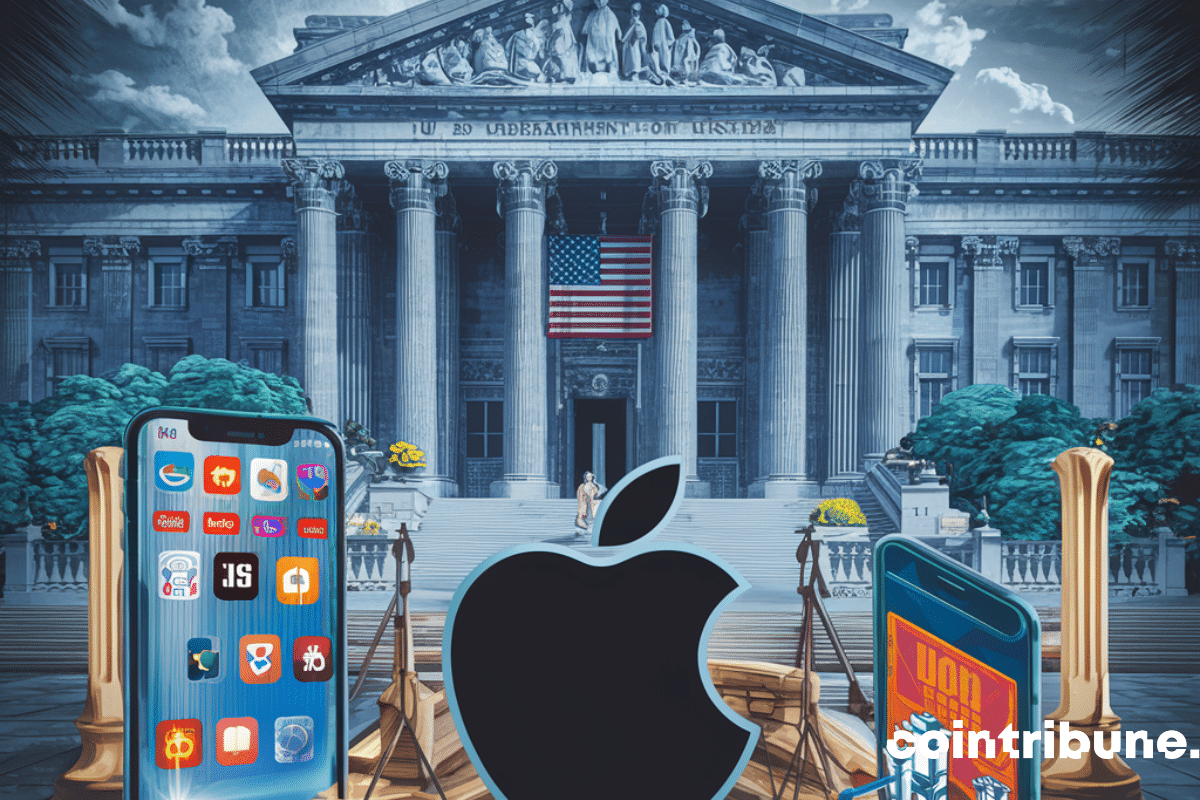
The United States Department of Justice (DOJ) has launched a major antitrust offensive against Apple. According to the DOJ, the tech giant’s App Store rules restrict competition and stifle innovation, particularly in the crypto sector, arbitrarily penalizing developers for the benefit of Apple’s monopoly.
Apple in the sights of the DOJ for its anticompetitive practices
This Thursday, March 21, the United States Department of Justice (DOJ), supported by 16 state attorneys general, filed a complaint against Apple, alleging that App Store rules and the monopoly power of the business hamper competition and stifle innovation, particularly in the crypto sector.
The DOJ claims that Apple has a monopoly in the smartphone market, which it uses to force developers to comply with its changing rules and restrictions. According to the ministry, these practices would allow Apple to charge higher fees, thwart innovation and suppress competitive alternatives.
App Store guidelines and developer agreements mandate a proprietary payment system, locking developers and users into Apple’s platform. This situation is impacting many sectors, including financial services and cryptos.
Apple’s 30% tax, levied on apps and in-app purchases, is at the heart of the problem. This fee, combined with the incompatibility of Apple’s payment systems with crypto, has made it economically unviable for many crypto apps to offer in-app purchases.
Although Apple offers some businesses and government customers the ability to offer their own apps through custom stores, App Store users and developers do not have access to them because they would compete with Apple’s fees. ‘business.
Arbitrary rules that penalize crypto applications
According to the Justice Department, Apple often enforces its App Store rules arbitrarily, penalizing and restricting developers who take advantage of technologies that threaten its monopoly power.
Crypto-related applications have particularly suffered. Some non-fungible token (NFT) marketplaces, like OpenSea, have had to disable features on their iOS apps due to the 30% tax levied on NFT sales.
Social app Damus was also forced to remove a BTC tipping feature after Apple delisted it for not using its in-app payment system.
Even web applications, available through a browser and outside the App Store, remain under the control of Apple, which requires the use of its WebKit browser engine.
The DOJ further claims that Apple has denied access to competing digital wallets offering enhanced features.
Apple defends itself by citing privacy and security
Faced with these allegations, an Apple spokesperson declared told Cointelegraph that the complaint was “factually and legally erroneous” and that the company would vigorously defend itself. Apple believes this lawsuit would set a dangerous precedent by giving the government the power to interfere in technological design.
In Europe, Apple had to open up under regulatory pressure, while maintaining a right of oversight in the name of user confidentiality and security.
This trial illustrates the growing tensions between tech giants and regulators eager to stimulate competition in a booming digital market, particularly in decentralized finance (DeFi). Its outcome will be decisive for the future of crypto applications and the weight of GAFAM.
Maximize your Tremplin.io experience with our ‘Read to Earn’ program! For every article you read, earn points and access exclusive rewards. Sign up now and start earning benefits.