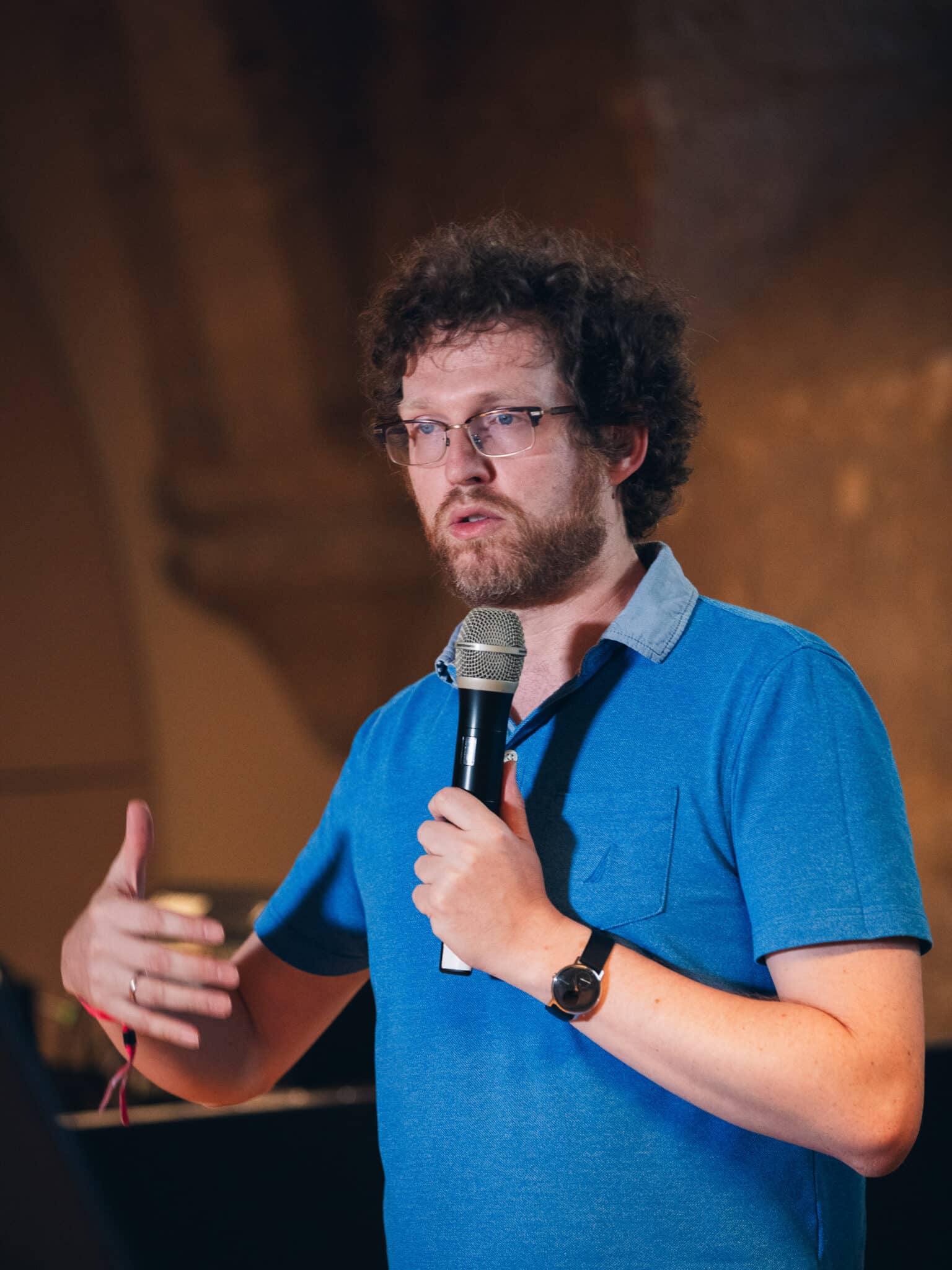
Being a Core Developer for Ethereum is a demanding and exciting experience, as revealed in our interview with Guillaume Ballet, Core Developer on Ethereum. In a hyper-decentralized global ecosystem, Core Developers are immersed in an open community, where every voice counts.
Can you describe what it is to be a Core Developer for Ethereum?
It’s simple, it’s my life’s work. We are part of a global, decentralized community where every member has a say. Communication is mainly done through Pool Requests on GitHub when we want to make changes or add new features. The process is very horizontal, but also very challenging from the point of view of the directive. You have to look for information everywhere and remain open to permanent innovations, because there are always new ideas. However, it is crucial not to get too attached to one idea, because there are too many to be able to realize them all.
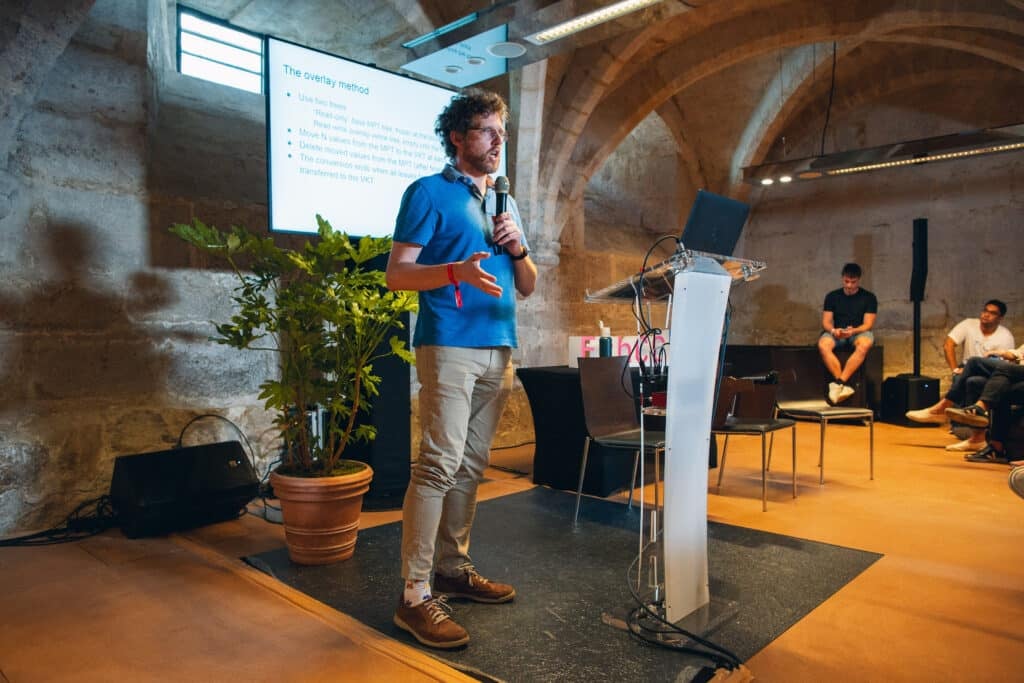
On the meeting side, we try to meet every 3-6 months depending on events and our availability. There are so many events that we could be there every 2 weeks, but it is more interesting to space out these meetings while focusing on the important moments. ETHCC is one of those very important meeting places for developers, even if we see that the business part is developing more and more, there are still many side-events dedicated to developers, perfect for discussion. Find our live article about the ETHCC 6.
How is the development and in particular the respect of the new roadmap put forward by the Foundation going?
Development on Ethereum is a collaborative process. We meet weekly in meetings called Ethereum All Core Developers, or ACDs, to discuss new proposals, called Ethereum Improvement Proposals (EIPs), which are the equivalent of Bitcoin’s BIPs.
Decisions about implementations are made as a groupwith different groups such as GETH, Lighthouse and Nethermind deciding to implement based on their perceived importance.
The idea is not to be closed to new ideas, because the blockchain must evolve to face all future challenges. There are about 200 Core Developers on Ethereum, and depending on the topic of discussion at the ACDs the number of developers present may vary, Vitalik and his team also join the DCOs from time to time to discuss with us, there is no balance of power.
The development roadmap, established by the Ethereum Foundation, is an essential tool for coordinating our efforts. It is regularly updated by contributors, including Vitalik, the co-founder of Ethereum. Decisions are not made centrally, and the process involves heated debates between ideas and implementations. Sometimes drastic changes may be required to improve the user experience, but this can conflict with established business models.
What are the next big challenges for Core Developers and the Ethereum blockchain?
One of the main challenges we face is Ethereum scalability. The massive success of blockchain has led to an increasing demand on computing resources, which can hamper its performance.
For example, the Binance Smart Chain (BSC), has experienced scalability issues and will need to make changes to deal with them in the future. There is strong pressure to increase the gas limit to accommodate more transactions, but we must also be careful not to compromise the stability and security of the system. Gas is a market, so it is impossible to increase its limits without consequences for the rest of the Ethereum economy.
We are also working on Layer2 solutions to make Ethereum cheaper and more accessible. The “Proto Danksharding” will make it possible to divide the gas into two types: generalist gas and data gas. The first will be used for current transactions, while the second will be for Layer2 which store their data. This will allow finer accounting and fairer costs for users.
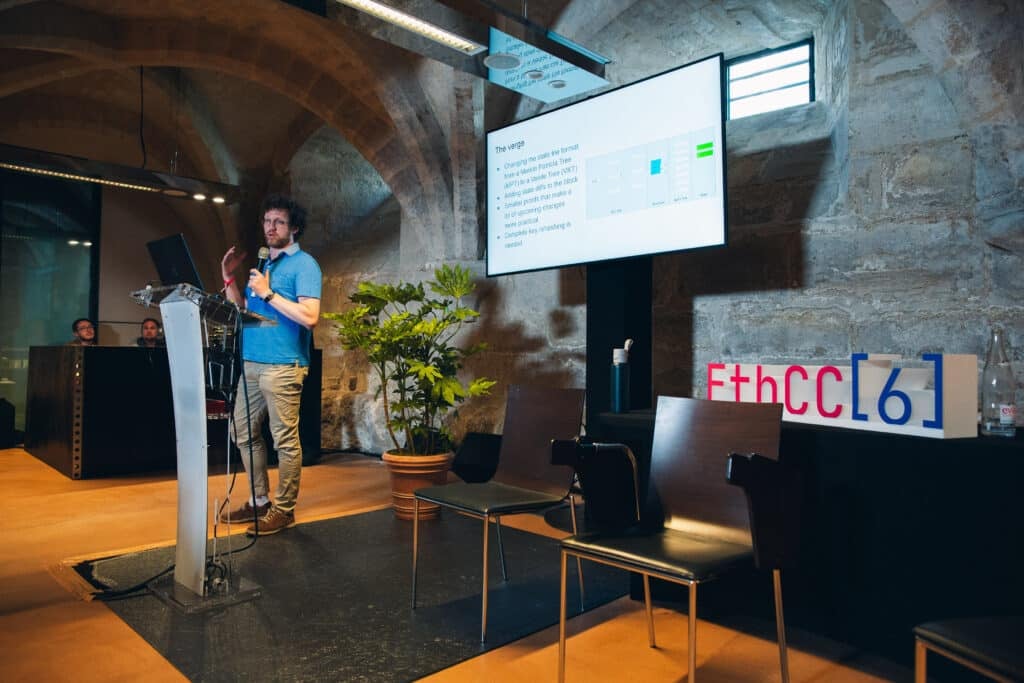
Finally, we are working on the transition to the “rod“, which will make Ethereum stateless by changing block format and adding state proofs. This will load a block without needing to download all previous blocks. Eventually, this could allow Ethereum to be stored on a mobile phone. To learn more about “the verge”, you can review Guillaume’s conference at ETHCC 6.
Ethereum is a victim of its own success and each change will provoke many reactions, between financial, business and development pressures, a balance must be found to ensure that the Ethereum blockchain will still be here in 100 years.
Why work on Ethereum and not on Bitcoin?
Innovation is a key part of our motivation to work on Ethereum. Many innovations have appeared on this blockchain, and many talented developers have chosen to invest in it, including Vitalik, the co-founder of Ethereum. The decentralized aspect of Ethereum allows for more flexibility and scalability than is possible on Bitcoin, whose initial vision is sometimes perceived as too rigid and maximalist. Ethereum also provides opportunities for experimentation, allowing us to be at the forefront of new technologies and potential solutions for future problems.
We can notice that many innovations on BTC do not come from Bitcoin but are modifications of innovations present on Ethereum.
For you, what does Ethereum represent in the future?
I believe in a blockchain that will be here in 50-100 yearsand that’s what makes me work late at night and gives me confidence in our project.
For me, Ethereum is much more than just a technology. I believe that in the future, Ethereum will continue to exist as a medium of exchange and an instrument of peace.. It will allow trade without artificial barriers, such as borders or closed banking systems. The possibility of communicating with people I could never have met in my life is particularly exciting. I believe Ethereum will play a crucial role in improving the global economyincluding helping to solve economic development problems, especially in regions like Africa where economic barriers impede progress.
Ethereum’s decentralization provides unparalleled stability and securitymaking it a driver for more sustainable and equitable economic solutions.
In sum, Ethereum is a driving force for change, and I am confident that it will continue to play a vital role in the future, beyond our individual lives. This is what motivates me to work late nights and dedicate my professional life to this revolutionary technology.. In order to find out more about the life of an Ethereum core developer, Guillaume Ballet has a podcast available on all classic platforms: Ethplorateurs, don’t hesitate to check it out!
Receive a digest of news in the world of cryptocurrencies by subscribing to our new service of daily and weekly so you don’t miss any of the essential Tremplin.io!