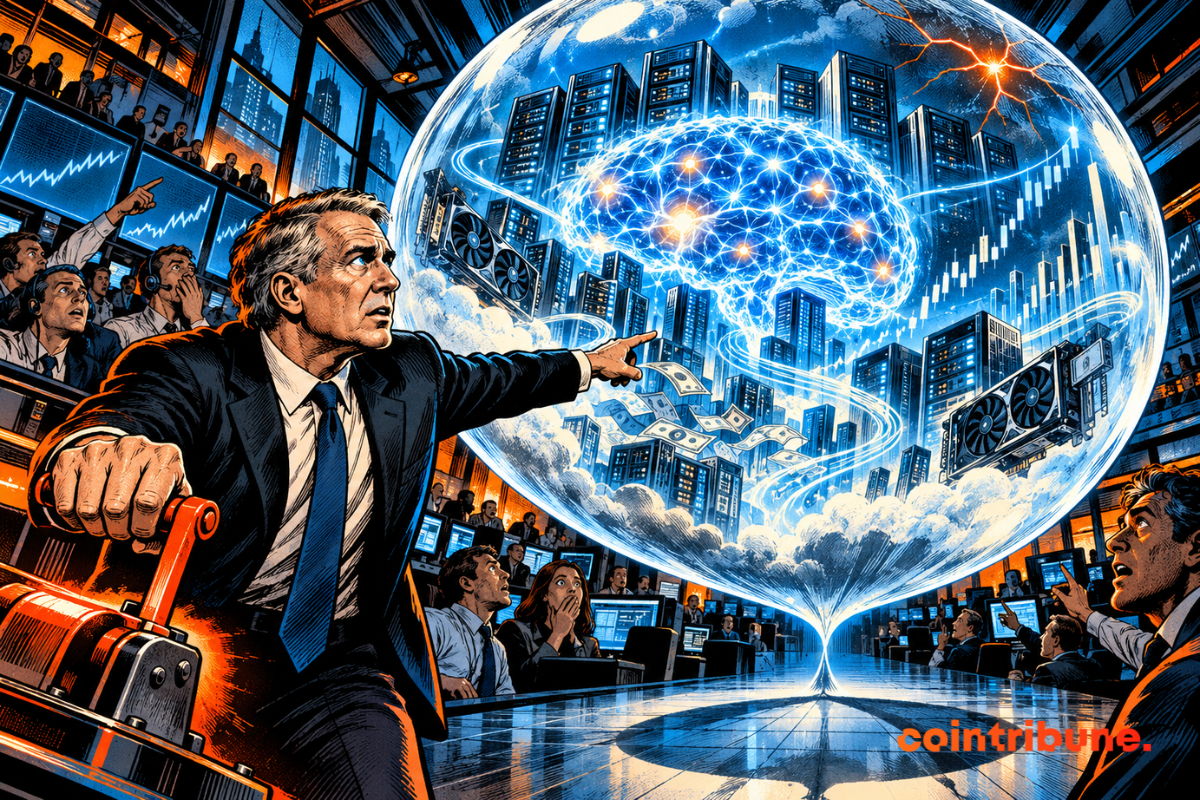
Ken Griffin says investors are “almost certainly” in an AI bubble. The founder of Citadel does not, however, question the technology itself. His concern mainly concerns the sums involved, the cost of GPUs and the difficulty many companies have in transforming their expenses into productivity gains. For him, a correction can eliminate many players while allowing the future giants of the sector to emerge.

In brief
- Ken Griffin believes that the AI market almost certainly has the characteristics of a bubble.
- It warns in particular of a possible overcapacity in GPUs and of the still uncertain profitability of investments.
- Still, Griffin believes the survivors could dominate the market for several decades.
Ken Griffin almost certainly sees a bubble in AI
Ken Griffin delivered his diagnosis at the Future of Global Markets conference organized by Citadel in New York. The billionaire thus joins several investors who are already wondering about a possible overheating of valuations linked to AI.
However, its position remains more nuanced than a simple call to sell. “Any radical transformation of our economy is usually linked to a bubble,” he explained. Griffin cites the Internet in particular. By the end of the 1990s, companies without a real business model had reached valuations that were difficult to defend.
Many disappeared after the dot-com bubble burst. Amazon stayed. Griffin even admits to regretting having sold his own Amazon shares too early. For AI, he sees a comparable mechanic. Markets are already anticipating an immense transformation of the economy while not all companies have yet proven that they can generate enough money with this technology.
However, investments continue to rise. According to LSEG data reported this week, Amazon, CoreWeave, Google, Meta, Microsoft and Oracle had already issued around $193 billion in bonds in early August to finance, directly or indirectly, their AI-related infrastructure. In 2024, this figure was still only 16.7 billion.
GPUs could become much less profitable
Griffin is particularly looking at the flea market. He compares GPUs to seats on an airplane: once infrastructure is purchased, the additional cost of using unused capacity becomes relatively small.
The problem begins when supply exceeds demand. Griffin recalls what happened with fiber optics in the early 2000s. Telecom operators installed a lot of capacity thinking that demand would immediately follow.
She didn’t follow fast enough. Prices have collapsed. The boss of Citadel is now wondering if certain AI chips could experience the same scenario. GPUs five or six years old still continue to be rented at prices that he considers particularly high.
He doubts that this situation can last another five or six years. The questions no longer only concern investors. In August, ECB economists already considered a correction in technological stocks linked to AI likely.
Businesses are also starting to look more closely at their invoices. Griffin believes that corporate America has had very uneven results with its AI models. Some really save time and productivity. Others spend a lot without yet being able to precisely measure the return.
OpenAI and Anthropic charge some of the most efficient models on the market. But for some tasks, much less expensive open source models may be sufficient. This comparison becomes important when bills reach millions of dollars.
An AI bubble can burst without killing the technology
Griffin therefore does not see the possible existence of a bubble as proof that AI is overvalued as a whole. His own group already uses the technology extensively. At Citadel, some AI agents can reduce research work that previously took weeks to a few hours. The gain is very concrete.
Griffin also thinks that AI could open a particularly favorable period for entrepreneurs. Small businesses will be able to automate functions once reserved for much wealthier groups. On the other hand, not all actors currently valued as future winners will probably survive.
This is where its parallel with the Internet bubble makes sense. Internet technology did not disappear after 2000. It became much more important. But many of the companies considered revolutionary at the time have disappeared.
The survivors took a huge lead. Griffin believes the same scenario can happen with AI. Companies that weather an eventual correction could become the market leaders of the coming decades.
The current risk comes mainly from the gap between investments and the income still generated. The debate has become even stronger this year despite Nvidia’s impressive results. In February, its performance had already raised questions about the sustainability of massive spending on AI. Griffin gives no date for a breakup. He also doesn’t advise getting out of AI-related stocks. His warning is simpler: a technology can truly transform the world and, at the same time, be at the center of a financial bubble. The Internet has already shown it.
Maximize your Tremplin.io experience with our ‘Read to Earn’ program! For every article you read, earn points and access exclusive rewards. Sign up now and start earning benefits.