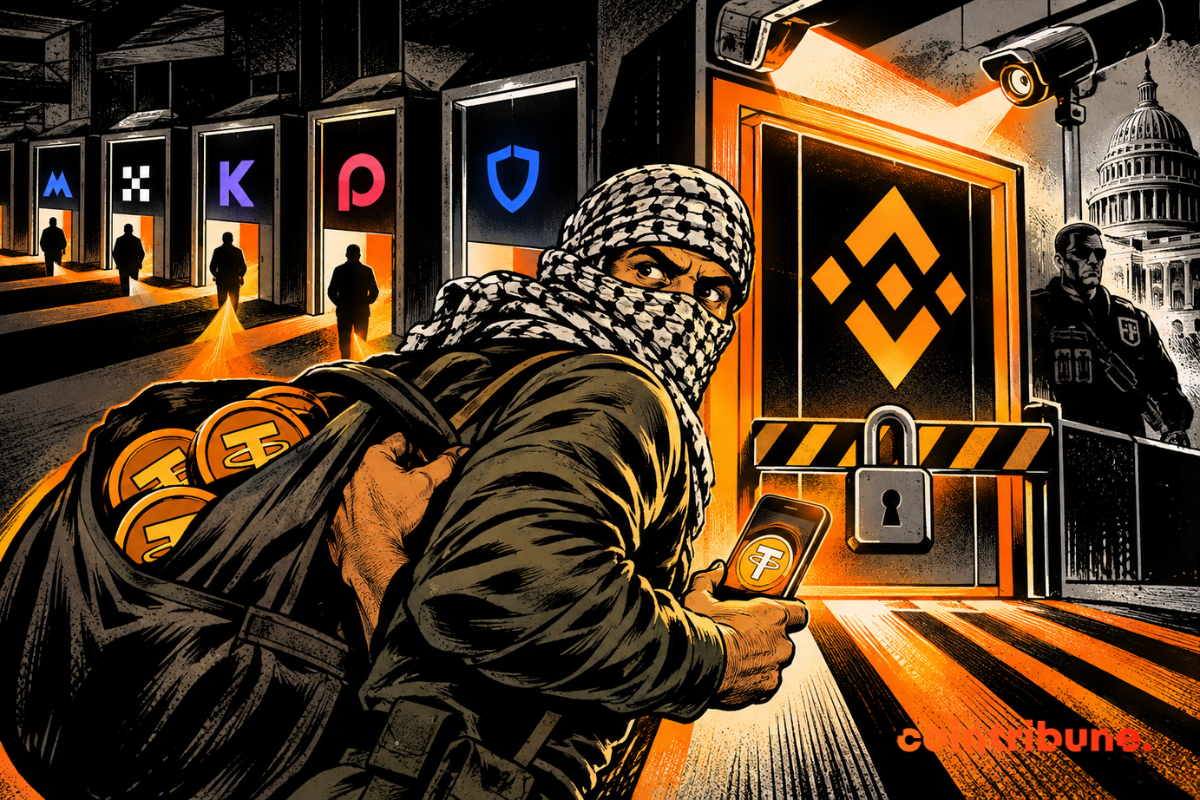
In a letter submitted to an American legal file opened by the FBI, the armed wing of Hamas snubs Binance. The Al-Qassam Brigades recommends that its donors channel their crypto funds through Bybit, OKX or RedotPay rather than through the world’s leading crypto platform (considered too risky). Certainly, this instruction dates from 2025. However, it today raises a question about the control of crypto exchanges and the traceability of funds.
In brief
- A letter from Al-Qassam Brigades, the armed wing of Hamas, advises against Binance for crypto donations.
- The group instead recommends Bybit, OKX, Kast and RedotPay for moving crypto funds.
- The document, dated February 10, 2025, was revealed on September 16, 2026 by the DoJ.
- The US Treasury estimates crypto flows linked to Hamas at $165 million before October 2023.
- Binance says this sidelining proves the effectiveness of its anti-money laundering controls.
Why does the Al-Qassam Brigades distrust Binance for its crypto transfers?
The message is dated February 10, 2025. An informant from the Federal Bureau of Investigation (FBI) received it from the Al-Qassam brigades. The document was then made public on September 16, 2026 by the US Department of Justice (DoJ) as part of a asset seizure warrant filed in early September. Currently, the case is in federal court for the District of Columbia in Washington.
In the section devoted to crypto donations, the armed wing of Hamas sends a clear message: it is preferable to do not use the Binance crypto exchange to transfer funds. Al-Qassam also recommends not providing any real data on the identity of the recipient. The goal: to avoid blocking the digital wallet. The instructions even go so far as to suggest providing false information about the beneficiary of the transfer.
Good to know: on March 27, 2025, the US Department of Justice announced around $201,400 worth of crypto seized in investigation involving more than 1.5 million dollars since October 2024. It mentioned at least 17 collection addresses. That’s not all! A blockchain analysis reveals that the address announced as usable only once nevertheless received 34 deposits between February 11 and 21. The total crypto donations amount to 25,211 USDT.
These information are of particular importance as they contradict the security promise of Hamas’s message.
Bybit, OKX, Kast, RedotPay: the exchanges now favored by Hamas
Rather than Binance, Al-Qassam Brigades is pushing towards other crypto exchanges. In the list are:
- Bybit;
- OKX;
- Kast;
- RedotPay;
- the Trust Wallet app.
There letter even specifies a workaround method: Binance can be used to buy currencies only, then you have to go through another application to finalize the crypto transfer.
Hamas also bets on Tether’s USDT stablecoin routed via the TRC-20 crypto network. This technical layer makes it possible to create and circulate fungible tokens on the Tron blockchain.
Crypto analysts agree on one point: this choice is not trivial. The fact is that stablecoins offer:
- a stable value;
- reduced transaction fees;
- global liquidity.
What makes it a popular whitening tool both legitimate actors and sanctioned groups. For example, USDT today finds itself at the heart of a new bet from Russia’s largest bank. For several years, Russia has been the subject of various international sanctions.
The response from Binance and the other crypto players cited in the file was not long in coming!
According to Noah Perlman, Director of Compliance at Binance, the fact that a terrorist group recommends avoiding Binance demonstrates that its monitoring devices work. He recalls that the crypto platform invests massively in:
- sanction screening;
- monitoring crypto transactions;
- cooperation with judicial authorities.
For its part, OKX asserts that the wallet address mentioned in the letter had already been identified internally as linked to illicit activity. Any attempt to transfer crypto to it would therefore have been automatically blocked.
The crypto exchange Kast, for its part, highlights a compliance team of more than 50 people as well as technological partnerships with Elliptic, Sumsub and Sardine. Their mission: to ensure identity verification and detection of suspicious flows.
Bybit declined to comment, while RedotPay did not respond to requests.
Millions of dollars in crypto linked to Hamas funding
In October 2023, the Wall Street Journal reports a well-known fact: Hamas-linked wallets received approximately $41 million in crypto between 2020 and 2023. The same newspaper then mentions a US Treasury investigation into $165 million in crypto transactions likely to have contributed to the financing of the group before the attacks of October 7, 2023.
In its Terrorism Financing Risk Assessment for 2026, Treasury also confirms that Hamas and Islamic State continue to use digital assets for certain donations and transfers. However, he specifies that traditional financial circuits remain by far the preferred channel for these groups.
Ahead, US authorities seized more than $560,000 in crypto assets linked to Hamas. Binance is currently the subject of legal action brought by victims of the October 7 attacks.
In any case, this legal file reveals a simple reality: the more a crypto platform strengthens its compliance, the more illicit actors circumvent it. Binance, OKX and other crypto exchanges will now have to deal with increased surveillance while the investigation into flows linked to Hamas continues.
Maximize your Tremplin.io experience with our ‘Read to Earn’ program! For every article you read, earn points and access exclusive rewards. Sign up now and start earning benefits.