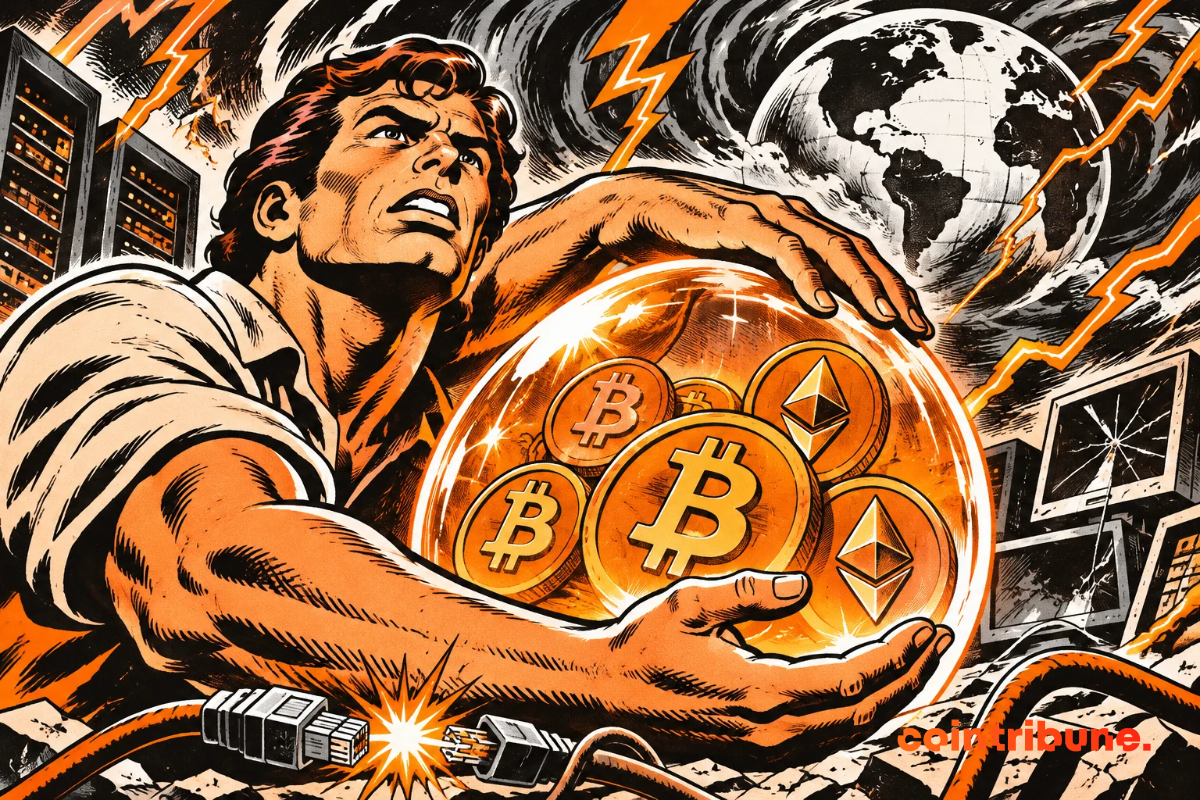
A global outage that shuts down Bitcoin, Ethereum and Solana machines for five minutes would shut down these networks. It would not erase your cryptos however. In this thought experiment, all validation machines shut down, while their disks remain intact. The blocks already recorded then remain there, and only the production of new blocks is interrupted.
In brief
- 60.65%: this is the theoretical probability of not seeing any Bitcoin blocks for five minutes, even without any outages.
- 25 slots: this is the number of opportunities to produce a block that Ethereum would miss in five minutes of total shutdown.
- 20%: this is the share of offline staking that Alpenglow tolerates, active on Solana since October 21, 2026.
- 9 epochs: On May 12, 2023, Ethereum went about an hour without finalizing any blocks, according to the Prysm team.
Global blackout: the hypothesis and its limits
Let’s imagine that all the equipment on the large blockchains turns off at the same time. Five minutes later, the power comes back on. The machines restart, but not all at the same pace. This scenario allows us to separate two often confused ideas: maintaining a history and continuing to extend it. It also sheds light on the notion of finality, this moment when a transaction becomes final, which Ethereum researchers want to accelerate.
The hypothesis, however, remains artificial. A shutdown of public grids would not shut down everything, as many data centers have batteries and generators. We therefore assume a complete shutdown of all machines. Disks, databases and backups remain intact.
Bitcoin: five minutes without a block is nothing abnormal
Bitcoin does not produce a block every ten minutes at a fixed time. Mining remains a lottery. According to the Bitcoin technical documentationthe network adjusts the difficulty every 2,016 blocks. It therefore aims for two weeks, or ten minutes per block on average according to our calculation.
This rhythm allows a simple calculation. Suppose the blocks arrive randomly, at a constant rate. The probability of seeing none in five minutes then reaches 60.65%. Five minutes without a block therefore does not prove a breakdown. This is a theoretical model, not a measurement of the actual network.
During a total shutdown, on the other hand, no miner is looking for any more blocks. When power returns, the miners resume from the last channel they know. If groups restart separately, two branches can coexist for a while. The nodes then follow the chain that required the most work and abandon the other. The Bitcoin white paper also provides that nodes leave and return freely.
Nodes can leave and rejoin the network at will, accepting the proof-of-work chain as proof of what happened while they were gone.
Satoshi Nakamoto, Bitcoin white paper2008
Ethereum: 25 slots lost, but no heavy penalty
Ethereum follows a different clock. Each slot, or “slot,” lasts 12 seconds, and 32 slots form an epoch of 6.4 minutes. A 300 second outage therefore covers 25 slots. These lost opportunities cannot be made up for: the network simply resumes at the following slots.
The purpose poses a more serious issue. To finalize blocks, validators representing at least two-thirds of the staked ether must agree on checkpoints. During the shutdown, no votes circulate, and the finality freezes. The blocks already finalized, however, remain acquired. Only a recent transaction, not yet finalized, requires a new verification after recovery.
Ethereum also has an emergency procedure. According to his rewards and penalties pageit only starts after more than four epochs without finality, or more than 25.6 minutes. Five minutes of stopping is therefore not enough to trigger it. However, two thirds of the ether involved must vote again within approximately twenty minutes. Furthermore, the same page specifies that there is no “no penalty for not having proposed a block”. On the other hand, each missed vote costs a small penalty, equivalent to the reward not received. An absence does not mean “slashing”, this sanction reserved for serious faults.
Ethereum has already experienced a loss of real purpose. According to the Prysm team reportthe network didn’t finalize anything for 9 epochs on May 12, 2023, or about an hour. Several clients then struggled to process certain votes, and the participation of validators had fallen to 30.7%. The emergency procedure was then triggered.
Solana: a brand new consensus in the face of total shutdown
Solana changed settings twice in October 2026. On October 9, the duration of a slot reached 200 milliseconds, up from 400 in August. This decline took four steps. On October 21, the network activated Alpenglow, a new consensus that replaces TowerBFT. According to the Solana Foundationit aims for a finality of around 150 milliseconds.
Alpenglow tolerates up to 20% offline staking, in addition to 20% malicious staking. A global outage would far exceed this threshold. The 150 milliseconds therefore say nothing about the recovery time after a total stop.
Solana has already experienced a complete shutdown, of a different nature. On December 4, 2020, a duplicate launched validator released conflicting blocks. It revealed a known block propagation flaw, and confirmations stopped. According to the Solana’s report393 validators had to coordinate a restart, achieved in less than six hours. Around thirty blocks provisionally confirmed were then lost. According to the report, they contained no transfers.
Global outage: what happens to your funds
After the recovery, three cases arise.
- A transaction finalized remains registered, as long as intact copies of the string remain. On the other hand, a coordinated reorganization or restart can, rarely, roll back a transaction that has only been confirmed. On Bitcoin, its strength grows with each subsequent block added.
- A transaction sent but not included may disappear from queues on reboot. Before sending it back, check its status to avoid paying twice. On Solana, a transaction also expires if its reference “blockhash” is more than 150 blocks old. Since moving to 200 milliseconds, that’s about 30 seconds.
- An inaccessible wallet or platform does not clear your balance. The latter remains on the blockchain, even if the application which displays it no longer responds.
Your wallet does not contain your cryptos. He keeps the keys that allow them to be spent. After a breakdown, the challenge remains to find these keys and a coherent chain.
Global blackout: the real unknown remains reconnection
Five minutes without power does not mean five minutes of interruption. A data center, an access provider or a connection node each restart at their own pace. No specification therefore makes it possible to calculate an overall recovery time. Furthermore, DeFi exchanges and applications could remain unavailable even after the blocks return.
Rotor, the second part of Alpenglow, must replace the Solana block diffusion system. As of November 1, 2026, it did not yet have a deployment date, according to the Solana Foundation. Our Alpenglow activation article details this timeline.
Maximize your Tremplin.io experience with our ‘Read to Earn’ program! For every article you read, earn points and access exclusive rewards. Sign up now and start earning benefits.