
With the institutionalization of bitcoin, we have more and more products emerging. It can become a slight headache to have to choose between the ETF or bitcoin, and especially the other different products. This is where we will highlight the disadvantages and advantages of each.
The race against time to obtain a spot bitcoin ETF
During 2023, we had several firms (ETF producer like Blackrock) who submitted requests to be able to produce SPOT ETFs. In order to fully understand the principle of a spot ETF compared to bitcoin, we will already explain the ETF offer that we have had on the market for the past two years. The bitcoin ETFs that have been offered since 2021 are based on futures contracts which are derivative products. Consequently, the evolution of the price of the product will depend on the evolution of the futures contract and not the bitcoin itself. On the other hand, these ETFs do not buy bitcoins, which implies that buyers of this type of ETF do not hold bitcoins either.
Just to clarify, futures are contracts (derivatives) that are traded on a centralized market. The buyer or seller bets on the future price of an underlying, so they must deliver the contract at a future date and at a pre-determined price.
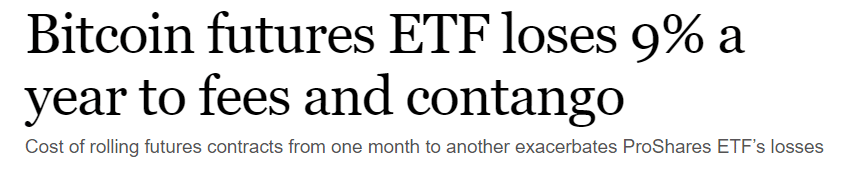
Since there are contract dates, the process of rolling over from one contract to a new contract may cost a fee depending on the time of purchase. For example, if we look at the BITO ETF which is based on the variation of bitcoin futures, we can say that there may be significant fees. Here is the example of the BITO ETF which generated rolling costs of 9%.
It is initially for this kind of reason that all ETF producers fight to obtain the approval of the SEC in order to offer a SPOT ETF. This kind of ETF can make it possible to best replicate the variation of bitcoin. This has the direct consequence of attracting regular investors and funds to integrate bitcoin via an institutionalized product.
What is Grayscale?
Grayscale is an American digital asset management company. The Grayscale bitcoin TRUST was there long before the arrival of ETFs. This allowed investors to access bitcoin without necessarily going through a cryptocurrency platform. The product was available in several brokerage firms, so it gave investors the opportunity to access bitcoin through their brokerage firm. He was in a way one of the precursors to the institutionalization of bitcoin.
What is premium GBTC?
GBTC trades at a premium to the SPOT price of bitcoin. For example, it can trade at +15% of the bitcoin price or -15% of the bitcoin price. It all depends on both market supply and demand but also on the type of market. For example, the premium can quickly ignite when we bullrun and reach a 100% premium to the bitcoin price. In this type of case, it is better to avoid buying the premium at 100% by risk of having to assume both a drop in bitcoin but also a drop in the premium. Here is an example from the 2017 bullrun:
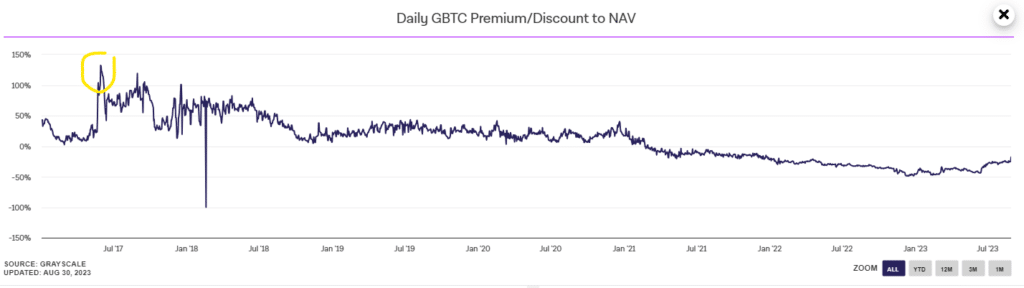
In the opposite case, that is to say in a bear market, the premium can quickly devalue significantly. For example, during the last bear market, we had the premium drop to -48% (see photo below). This allows you to have a hell of a discount on the premium. In any case, there may also be an arbitration game that can take place between the different products.
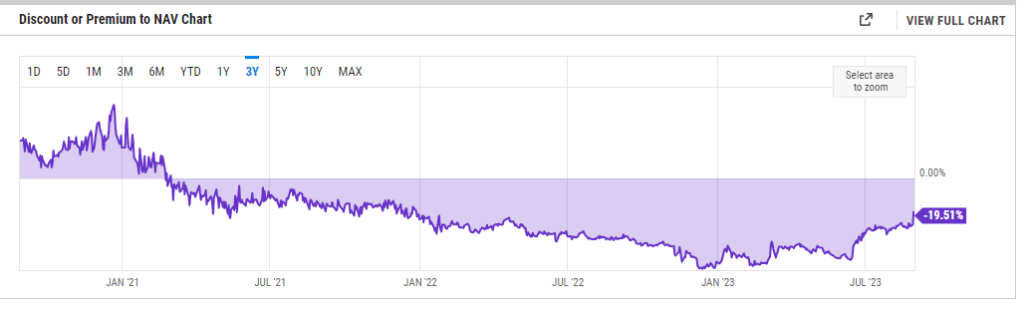
In addition to the approaching bear market in 2022, GBTC premium also went through a difficult period when ETF companies started producing Bitcoin ETFs. As ETF producers responded to demand for the big bullrun of 2020-2021, there were fewer requests for GBTC. ETF producers such as Blackrock are primarily there to make money, and where there is demand there is of course money to be made. This is why in 2021, we had several bitcoin ETF releases that tracked the variation of bitcoin futures. This directly impacted GBTC since the premium went negative in 2021 even before the decline in bitcoin.
The transformation of GBTC into a SPOT ETF
During the transition from GBTC to a SPOT ETF, GBTC holders will see their premium converted into ETF shares. There will be no particular maneuver to do but the type of product will change. As explained previously, GBTC operated at a premium to the spot price. Sometimes, the premium evolves more quickly than bitcoin itself, particularly in a bullrun where it loses value more than bitcoin during bear markets. The difference with the transformation to a SPOT ETF is that the variation in price will really follow the variation of bitcoin.
The arrival of the first SPOT ETF is a big change for the cryptocurrency world. To make this type of ETF, it involves buying more and more bitcoins since the ETF will follow the movement of bitcoin and not a derivative product like the future. This is why lately, we have seen BLACKROCK massively buy bitcoins before submitting its request to the SEC. Even if it refused the spot ETF as well as several of its colleagues, the fact that it accepted the GBTC request will leave room to accept the others subsequently.
Spot ETF or bitcoin: which one to choose?
To start this chapter, we will exclude ETFs on futures since they do not buy bitcoin in parallel. Therefore, there is less interest to hold.
As with any product, there are obviously pros and cons. In order to choose what suits us best, we must understand the different particularities. As for the spot ETF, here are the advantages:
- Accessibility via regular brokerage platforms, which remains simpler if you already have a brokerage account for stocks.
- Easier for fund managers to add bitcoin (as an asset class) via ETFs in different funds
- Lower or much lower fees than those presented on cryptocurrency platforms
- Spot ETFs charge less fees than futures-based ETFs
- Possibility of more easily adding ETFs to tax optimization accounts. As bitcoin is not a centralized product initially, it is not accepted in this type of account. (example: TFSA in Canada, 401k in the US…)
- The product becomes a centralized asset just like other ETFs, which increases the credibility of bitcoin. ETFs are more fashionable products.
On another note, here are the disadvantages of the ETF vs bitcoin:
- No possibility of being able to store the bitcoin ETF on a key while bitcoin does
- No possibility of paying in ETF while bitcoin is a currency that can be used
The impacts of a spot ETF and other derivative products
The adoption curve is a whole process. During this, institutions are part of the beginning of the curve.
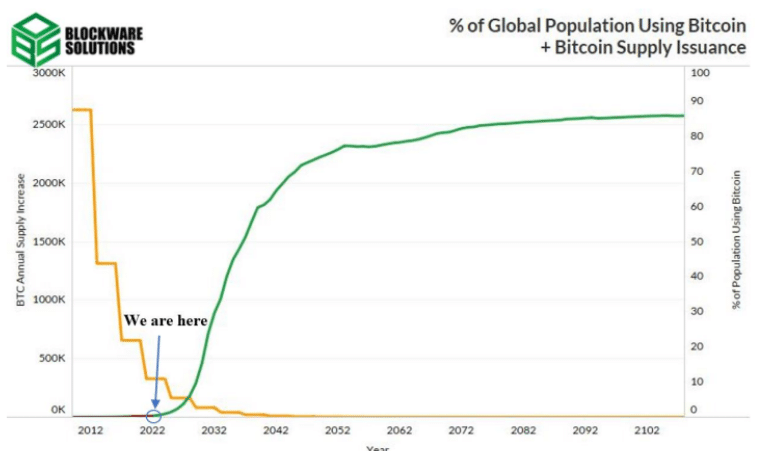
Obviously, there are consequences to wanting institutions to participate, particularly the institutionalization of bitcoin. This gives it more credibility and popularity, but it can also be contrary to bitcoin’s initial values. When we talk about values, it is to preserve bitcoin as a safe haven and anti-institutional. If eventually it becomes institutionalized, it also becomes under the control of institutions that are better off to manipulate it. On the other hand, more types of products increase the possibilities of arbitrage.
Conclusion
There are pros and cons for each type of product. It is better to target your needs in order to choose the one that meets our needs is objective. If its objective is to save taxes on gains as much as possible, ETFs seem to meet this need. If the need is to protect against the system and other currencies, it is better to preserve the bitcoin itself on a key. This does not prevent you from choosing both equally in order to optimize the usefulness of each.
Receive a digest of news in the world of cryptocurrencies by subscribing to our new service of daily and weekly so you don’t miss anything of the Tremplin.io essentials!


