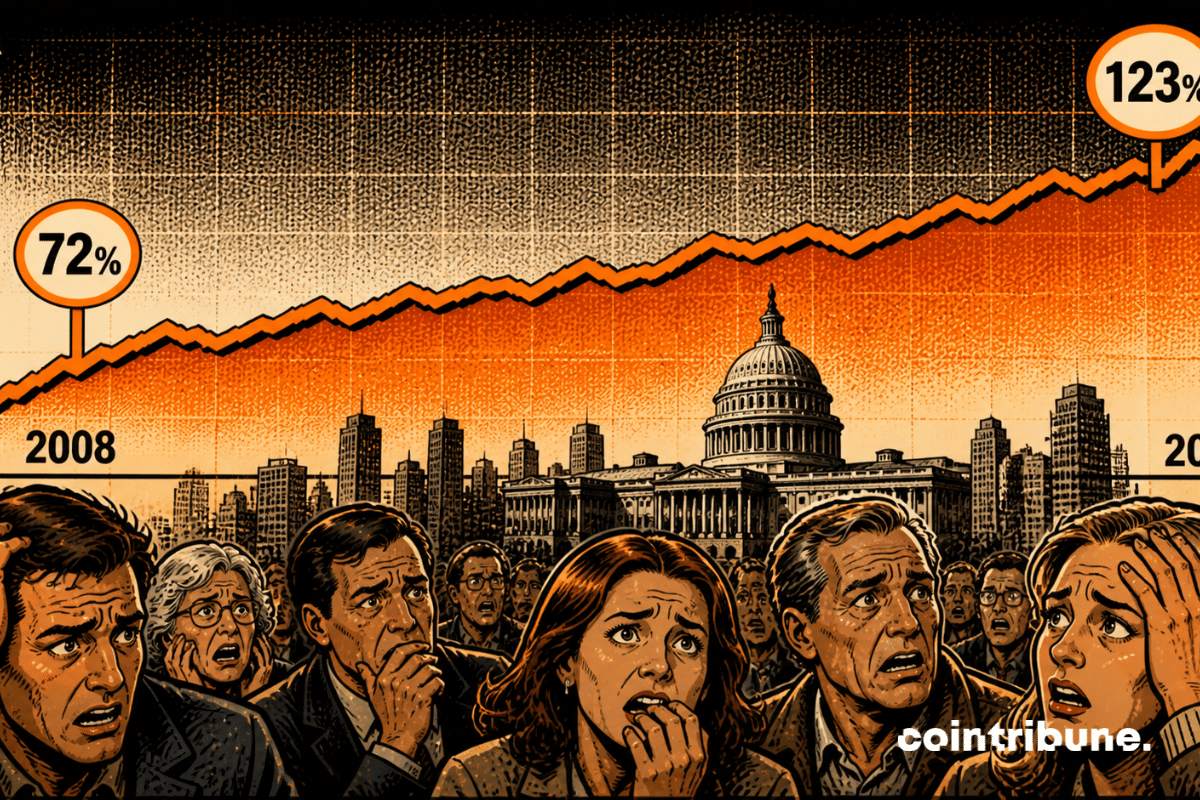
The United States has just crossed a historic threshold. Indeed, their debt now exceeds the size of their economy. This shift is part of a lasting trajectory, marked by repeated deficits and postponed budgetary decisions. Despite these imbalances, market confidence remains intact, revealing a growing tension between the perceived solidity of the world's leading power and the reality of its public finances.
In brief
- The United States has crossed a historic threshold with a debt now greater than the size of its economy, revealing an imbalance unprecedented outside of a period of major crisis.
- American public finances are sinking into a dynamic of persistent deficits, fueled by high structural spending and increasing interest costs.
- Long-term projections indicate continued worsening, with debt likely to reach even higher levels in the coming years.
- Despite these signals, the markets maintain their confidence, creating a marked contrast between the perceived solidity of the United States and the reality of its public finances.
A debt that now exceeds the American economy
The American public debt has reached an unprecedented milestone by reaching 100.2% of gross domestic product, or 31,270 billion dollars of debt for 31,220 billion of GDP. This level had not been observed since the Second World War, but in a radically different context.
Thus, the United States is now living “beyond its means”, in a context marked by a “bipartisan abdication of difficult choices” according to Maya MacGuineas.
Here is some key figures :
- Total debt: $31.27 trillion;
- GDP: $31,220 billion;
- The debt/GDP ratio: 100.2%;
- The projected deficit for 2026: $1.9 trillion (5.8% of GDP);
- Debt interest: potentially more than $1,000 billion per year.
In detail, American public finances remain marked by high and persistent deficits. This dynamic is explained by significant structural expenditure, particularly in pensions and health, to which is added the increasing burden of debt service. The rapid increase in interest rates gradually reduces budgetary room for maneuver and reinforces the lasting nature of the imbalance.
A trajectory considered worrying by the markets and agencies
Beyond the current observation, medium-term projections show an even more worrying trajectory. American debt could reach 118% to 120% of GDP by 2035-2036, confirming the establishment of a lasting imbalance.
This development triggers reactions from the rating agencies. Fitch refers to a “long-term deterioration” of public finances, while Moody's has downgraded the American rating in 2025.
In a context of American debt out of control, bitcoin stands out as a credible monetary alternative, offering a decentralized store of value in the face of state budgetary excesses.
Certain recent political choices also fuel this dynamic. Tax reform under Donald Trump is expected to add $4.7 trillion to the debt, while a Supreme Court ruling could result in a loss of $1.7 trillion in tax revenue.
These elements reinforce the idea of a trajectory that is difficult to reverse in the short term, even though the United States continues to benefit from a major advantage: the central role of the dollar and the depth of its financial markets.
This contradiction feeds a paradox. Despite a critical budgetary situation, the United States retains the confidence of international investors. This status could evolve if the current dynamic continues, opening the way to restructuring in global capital flows and to a gradual questioning of certain financial balances established through dedollarization.
Maximize your Tremplin.io experience with our 'Read to Earn' program! For every article you read, earn points and access exclusive rewards. Sign up now and start earning benefits.