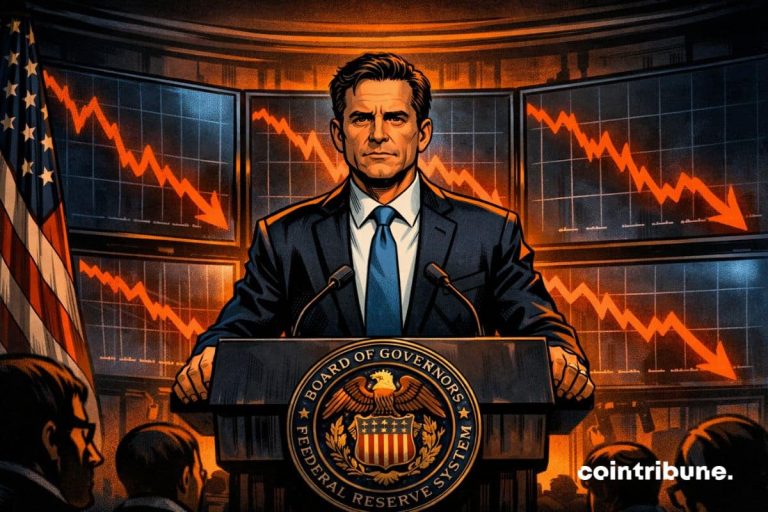

The cryptocurrency market is going through a new period of tension, as hopes of recovery lose ground. For Wintermute, the rebound in bitcoin observed since July did not reflect a real reversal of the trend. This analysis echoes the concerns of Mike McGlone, strategist at Bloomberg Intelligence, who anticipates a much broader correction. His scenario even envisages a return of BTC to $10,000, in a context of fragility in the financial markets.

In brief
- Mike McGlone maintains his prediction of bitcoin at $10,000 in the face of correction risks.
- Wintermute considers the July rebound to be a false signal of lasting recovery.
- Arthur Hayes anticipates a possible return of BTC to $55,000.
- Spot Bitcoin ETFs saw over $4 billion in outflows in November.
Bitcoin: Mike McGlone fears the bursting of a speculative bubble
Mike McGlone maintains his $10,000 bitcoin target. In his latest analysis, the head of commodities at Bloomberg Intelligence points to a prolonged excess of liquidity and speculation. According to him, this situation has supported prices for too long. The current change in trend could therefore cause a correction that would go far beyond the cryptocurrency market.
The strategist does not rule out occasional increases in the coming weeks. However, he sees them as episodes of optimism within a deeper bear market. In particular, he predicts heavy losses for secondary cryptocurrencies, including Dogecoin. Some could even lose almost all their value if selling pressure intensifies.
Strategy could also face serious difficulties if bitcoin continues its decline. Michael Saylor’s company remains particularly exposed to changes in asset prices. However, McGlone especially emphasizes the risks affecting traditional markets. In particular, he anticipates a negative close for the S&P 500 in 2026, which would constitute its third annual decline since 2009.
Financial markets threatened by a broader correction
McGlone’s concerns also extend to metals, energy and other commodities. According to its forecasts, these assets could suffer further declines in the coming months. A reduction in inflation could, however, allow the American Federal Reserve to relax its monetary policy. However, this development would not necessarily be enough to erase the effects of years of abundant liquidity.
The strategist believes that markets have reached levels that are too high relative to the size of the economy and public debt. Under these conditions, a significant correction seems difficult to avoid. He sums up this concern by stating that “ the stock market year of a lifetime is more likely to end like a lion than like a lamb “. This perspective reflects his fears regarding the end of 2026.
Arthur Hayes also shares concerns about the continuation of the cycle, but his scenario remains less severe. The co-founder of BitMEX consider a return of bitcoin towards $55,000. In particular, he is monitoring the weakness of the Asian markets, while South Korea and Taiwan have already taken emergency measures to support their stock markets. Despite these interventions, the selling pressure has not yet dissipated.
Wintermute confirms the fragility of the bitcoin rebound
L’analysis de Wintermute reinforces doubts about the strength of the recovery that began in July. The firm believes that investors may have confused a temporary rebound with a true bull market return. This distinction becomes important since bitcoin fell below its 200-week moving average. This level was then around $68,000, according to the information communicated.
Flows from US exchange-traded funds also confirm this weakness. Bitcoin spot ETFs saw nearly $1.8 billion in outflows over the past week. After an initial influx on Monday, withdrawals continued for four consecutive sessions. In November, total outflows exceeded $4 billion, a sign of a marked decline in institutional demand.
These withdrawals occur when the market would need new purchases to regain its balance. Institutional investors appear to be reducing their exposure, which limits the support provided to prices. Wintermute therefore believes that the bear market has not yet ended. The company sums up its position unambiguously: the rebound recorded after the July low was an illusion.
What happens next will depend in particular on the ability of buyers to return to the market and absorb sales. If ETF outflows continue, pressure could remain strong on prices. The McGlone and Hayes scenarios, however, show very different levels of risk. For bitcoin, the end of the bear market therefore remains to be confirmed.
Maximize your Tremplin.io experience with our ‘Read to Earn’ program! For every article you read, earn points and access exclusive rewards. Sign up now and start earning benefits.