
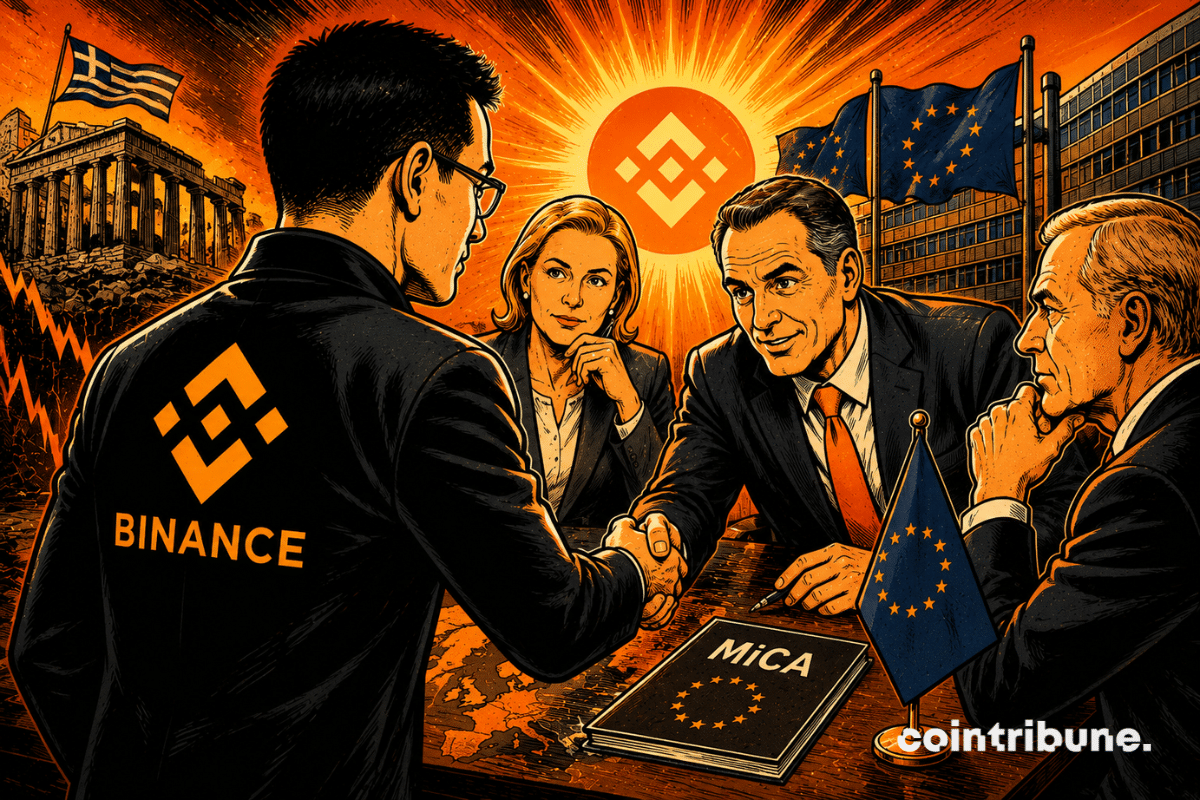
The entry into force of MiCA was expected to normalize the European crypto market, but recent revelations from Binance prove the opposite. By revealing behind the scenes of a fragmented reality, the sector giant exposes a paradox. While the European Union displays unprecedented severity, several regulators are discreetly courting the exchange behind the scenes. This issue therefore calls into question the effectiveness of continental legal barriers in the face of mobile capital. Such a standoff marks a major geopolitical tipping point.
In brief
- Binance reveals that several European regulators have quietly invited it to apply for new licenses, despite difficulties encountered with MiCA.
- The withdrawal of its license application in Greece reveals the divergences between European ambitions and national realities.
- The new MiCA rules would have pushed a majority of outgoing capital into unhosted wallets rather than regulated platforms.
- Faced with uncertainties in Europe, Binance is accelerating its expansion in Asia by increasing partnerships and strategic establishments.
The regulatory behind the scenes of a European paradox
Richard Teng, co-CEO of Binance, formally revealed that several regulatory authorities had actively invited the platform to apply for new licenses on European soil. This outstretched hand, however, comes in a paradoxical context, marked by the voluntary withdrawal, on June 24, of the MiCA license application that the company had submitted to the Greek regulator. Several key elements provide information on this strategic turnaround:
- A regulatory surprise in the face of a file deemed compliant: the withdrawal came after reports indicating that the Greek authorities planned to reject the request. Richard Teng expressed a strong incomprehension: “This took us completely by surprise, because we had submitted a fully compliant file. Moreover, the regulators themselves had confirmed this to us” ;
- The desire to protect the user experience: faced with administrative delays and to avoid a sudden blocking of services, management preferred to cut things short. The leader clarified: “We are not sure why approval continued to be delayed. We preferred to withdraw our request, because otherwise our users would have faced a transition period that was far too short.;
- Confidential invitations to Europe: despite this setback, other European jurisdictions are trying to attract the exchange, although Richard Teng describes these discussions as “premature”and refuses to name the countries concerned.
For professionals in the sector, these confidential negotiations demonstrate the duality of state positions vis-à-vis the world leader in exchange platforms. On the one hand, the harmonization desired by the European Securities and Markets Authority (ESMA) has imposed iron discipline since the end of the transition period on 1er July, prohibiting serving European customers without a MiCA approved entity. On the other hand, economic attractiveness pushes certain countries of the Union to formulate discreet invitations to maintain activity on their territory. This regulatory chess game illustrates the complexity of the practical application of a single legislative text on a continent where national economic interests sometimes remain divergent.
The exodus of capital towards DeFi
The figures resulting from this regulatory transition highlight an unexpected phenomenon which directly contradicts the consumer protection ambitions of the European Union. According to Richard Teng’s statements, the restrictions imposed by the new legal framework did not benefit already registered local platforms, but rather pushed investors towards exodus and complete lack of control.
The co-CEO of Binance thus revealed a major statistic: “Among EU users who subsequently withdrew their funds from our platform, 70% of those funds were transferred to unhosted wallets. Only 30% were referred to entities regulated by MiCA”. This massive withdrawal movement directly calls into question the effectiveness of centralized regulatory policies in the face of a public that favors the sovereignty of its assets over institutional compliance.
Such a movement to restructure portfolios was reflected concretely in the industry’s accounting records. Binance saw $1.23 billion in net outflows during the week of June 29, marking a dramatic 207% increase from the previous week’s $400 million. At the same time, this transition has intensified competition between platforms already holding the precious European key. For example, the OKX exchange saw downloads of its application jump 158% between June 24 and July 5, directly benefiting from the forced reorganization of the European Union market.
The geopolitical shift and the aggressive expansion of Binance in Asia
Faced with persistent frictions on the Old Continent, Binance is accelerating its regulatory deployment in the Asia-Pacific region, capitalizing on new markets to maintain its global growth. Richard Teng recalled the strength of this geographic expansion by declaring: “We are now deployed in many regions in Asia, from Japan to Korea, Thailand, Indonesia and Australia. We have just announced our arrival in the Philippines, and other countries will follow very soon”. This strategy demonstrates a clear desire to diversify legal risks by firmly anchoring itself in jurisdictions with very buoyant economic dynamics, thus offsetting the legislative tightening observed at the European level.
In the Philippines, this return was orchestrated via a structural alliance with BlockShoals Technologies, following access restrictions imposed by local authorities in 2024. The legal articulation there is particularly subtle, because the agreement allows Binance to offer crypto trading under the supervision of the country’s Securities and Exchange Commission (SEC). However, neither entity has the central bank’s license to process peso transfers or virtual asset services regulated by the latter. This hybrid implementation model reveals the technical agility of the platform to re-enter key markets despite initially hostile contexts.
In the long term, this situation creates a polarized outlook for the overall crypto industry. On the one hand, the fact that 70% of flight capital chose autonomous custody proves that regulatory severity can paradoxically push users outside the scope of State supervision, creating a major challenge for ESMA. On the other hand, Binance’s ability to bounce back instantly in Asia while being courted in Europe shows that liquidity remains porous across borders. The future will tell whether the strict model of the European Union will succeed in standardizing the global ecosystem or whether it will end up isolating it for the benefit of more agile and pragmatic Asian jurisdictions.
Maximize your Tremplin.io experience with our ‘Read to Earn’ program! For every article you read, earn points and access exclusive rewards. Sign up now and start earning benefits.


