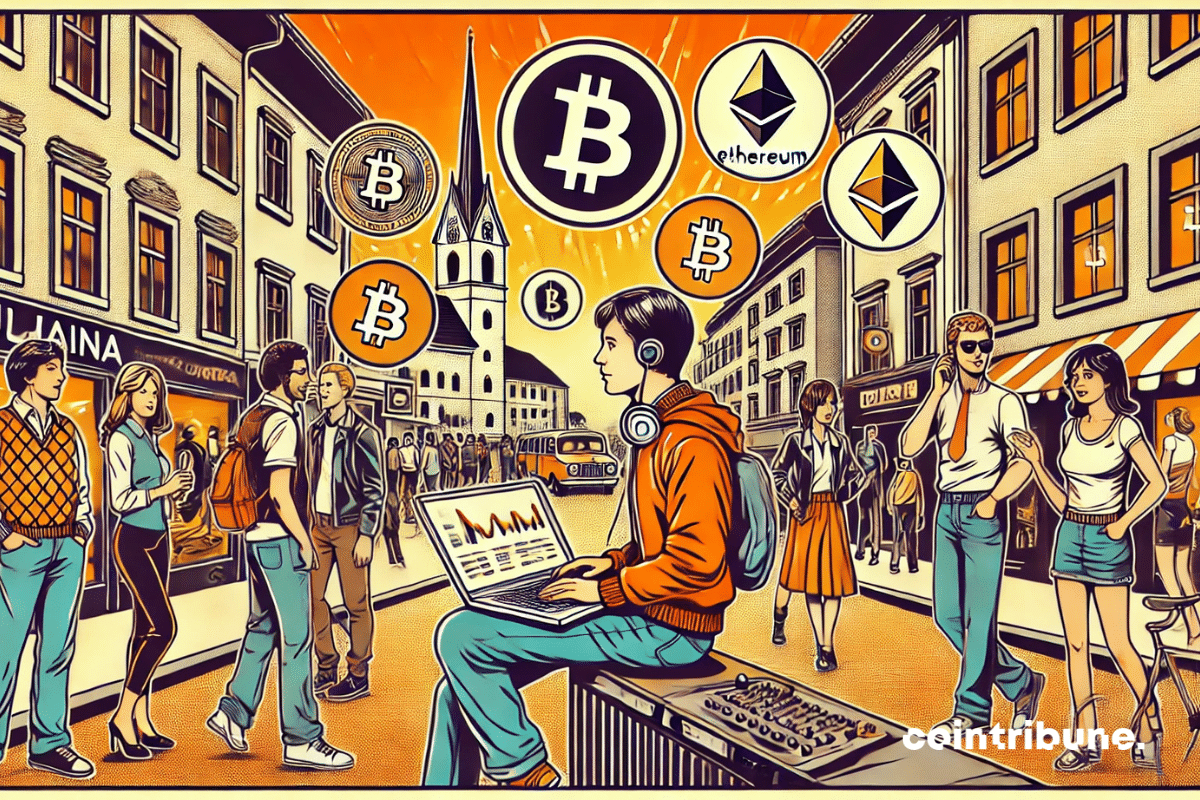
Global financial geography is experiencing a spectacular moult. Far from the sanitized skyscrapers of Wall Street or Swiss Centennial Banks, a new cartography emerges: that of the cities that have married the blockchain revolution without complexes. Ljubljana, Slovenian capital nestled between the Alps and the Balkans, embodies this metamorphosis. With a regulatory audacity and an crypto culture already anchored, it now outperforms Hong Kong and Zurich. How did this city of 300,000 inhabitants succeed in dominating the game? The answer is nestled in a subtle mixture of legislative pragmatism, agile infrastructure and almost organic popular adoption.
In short
- Ljubljana becomes a crypto capital thanks to a clear legal framework and natural local adoption.
- The city favors regulatory simplicity in place of the tax-to-life tax advantages.
- Cryptos are used there daily, from cafes to integrated distributors everywhere.
- Ljubljana embodies a new model: agile, connected and turned towards real innovation.
Ljubljana: the improbable alchemy of a Crypto capital
Unlike Dubai or Singapore, Ljubljana has not built its crypto reputation by launching pharaonic projects. His success germinates elsewhere: in his Kavarnas (cafes) where miners and blockchain developers discuss Potica in hand. Here, crypto is not an exotic financial product, but a daily tool. Take Monero, a crypto confidentiality: its local co -founder has instilled a culture of Privacy Tech long before the GDPR (General Data Protection Regulations) became a European mantra.
While the EU procrastinates on Mica, Slovenia opted for a minimalist approach: a limpid tax framework (0% VAT on crypto transactions), legal recognition of smart contracts from 2020. Result? Companies do not come for tax loopholes, but for rare legal security. “In Zurich, we are still negotiating definitions. Here, we code “summary AnaCEO of a decentralized borrowing platform.
With only 155 Crypto distributors, Ljubljana seems modest against Sydney (330). However, its urban compactness creates a unique density. The ATMs are not relegated to shopping centers, but integrated into libraries, bus stops, even organic grocery stores. A ubiquity that normalizes use, attracting skateboarders as much as curious retirees. If Ljubljana symbolizes this new era, it is only the symptom of a much larger rebalancing.
Cryptofinance redraws the global urban hierarchy
New York, London, Geneva… These names resounded as synonyms of financial power. Today, their hegemony is cracking. Crypto, volatile and nomadic wealth, flees the tatillon jurisdictions for more lenient skies.
Dubai is betting on flash licenses in 48 hours, Lisbon seduces with hackathons on the edge of the Tagus. But Ljubljana offers better: an ecosystem where regulators and entrepreneurs speak the same language – literally. Most Slovenian officials master Blockchain Technical English, avoiding costly misunderstandings.
In 2023, 40 % of Zurich's Devs Blockchain migrated to the east. For what ? The cost of living, of course. But above all, access to concrete projects. “In Switzerland, I wrote legal relationships. In Slovenia, I deploy oracles on DAO networks ”testifies Marko, ex-jurist who became CTO. Winning cities are those that transform theorists into builders.
Zug or Puerto Rico thought they were attracting cryptocurrency with 0 %rates. Error. Serious actors prefer moderate taxation (12 % in Slovenia) but stable to tax mirages. “A law can change overnight in a paradise. Here, we have a roadmap until 2030 “explains a Crypto fund manager based in Ljubljana. Behind these changes, a rigorous methodology reveals the real winners.
The cryptocurrency index: beyond myths, the figures that count
Affirm that 25.3 % of emiratis hold cryptos can impress. But what are these figures worth if 80 % of portfolios contain less than $ 1,000? The Multipolitan index lays two criteria: the adoption rate and the concentration of wealth. Result ? Slovenia, with $ 240,000 in average volume per user, crushes behemoths like India ($ 1,200).
Abu Dhabi trusses the top of the ranking with an internet speed of 398 Mbit/s. But Ljubljana, at 190 Mbit/s, proves that quality takes precedence over quantity. Its 95 % fiber coverage allows high frequency trading without latency – a decisive advantage against Zurich, where the surrounding rural areas weigh the average.
How to measure popular craze? By the number of businesses accepting BTC – 12 % in Ljubljana, compared to 3 % in Hong Kong. Or by events such as the Winter Festival Crypto, a mixture of technical conferences and electro concerts where ETH payments replace the cash. A social alchemy that traditional indices ignore.
Ljubljana is not a model to copy, but a signal to decipher. Its strength? Having understood that the cryptocurrency cannot be decreed, it is cultivated-in the laws as in the minds. While the United States is getting bogged down in regulatory wars and Hong Kong is trying a shy come-back, the new capitals bet on something else: a symbiosis between hard innovation and soft adoption. Tomorrow, the financial power will no longer belong to the richest, but most agile – cities – those where a student can launch a deffi protocol before his philosophy lesson, where a coffee accepts the BTC as an alternative currency, where regulators listen before legislating.
Maximize your Cointribne experience with our 'Read to Earn' program! For each article you read, earn points and access exclusive rewards. Sign up now and start accumulating advantages.