
Financing blockchain networks remains a major challenge for decentralized projects. Ethereum is today facing a new governance proposal that could change the participation of validators. The mechanism presented aims to redirect part of the staking rewards towards financing the ecosystem, including the tools, research and infrastructure necessary for the development of the network.

In brief
- A new proposal wants to allow Ethereum validators to redirect part of their staking rewards towards funding the ecosystem.
- The mechanism provides for a contribution of between 0% and 10% of rewards, which may become mandatory if a majority approves.
- This initiative seeks to address the lack of funding for tools, research and infrastructure used by the entire network.
- Redirecting 5% to 10% of rewards could generate up to 70,000 ETH per year to support ecosystem projects.
- The proposal raises governance risks, including a possible concentration of power among certain validators.
Ethereum: validators could contribute more to financing the network
Ethereum's technical structure highlights clear buyer exhaustion in the face of liquidity outflows, a context that comes as the network also goes through new debates around its evolution. A new proposal submitted in the governance discussions introduces a mechanism called “ Validator Redirected Revenue “. This idea would allow operators who secure the network to dedicate a portion of their staking rewards to supporting the ecosystem.
Validators could choose a redirection rate of between 0% and 10% of their staking revenue. However, if a majority of them validates a rate greater than zero, this contribution would become obligatory for all participants in the network.
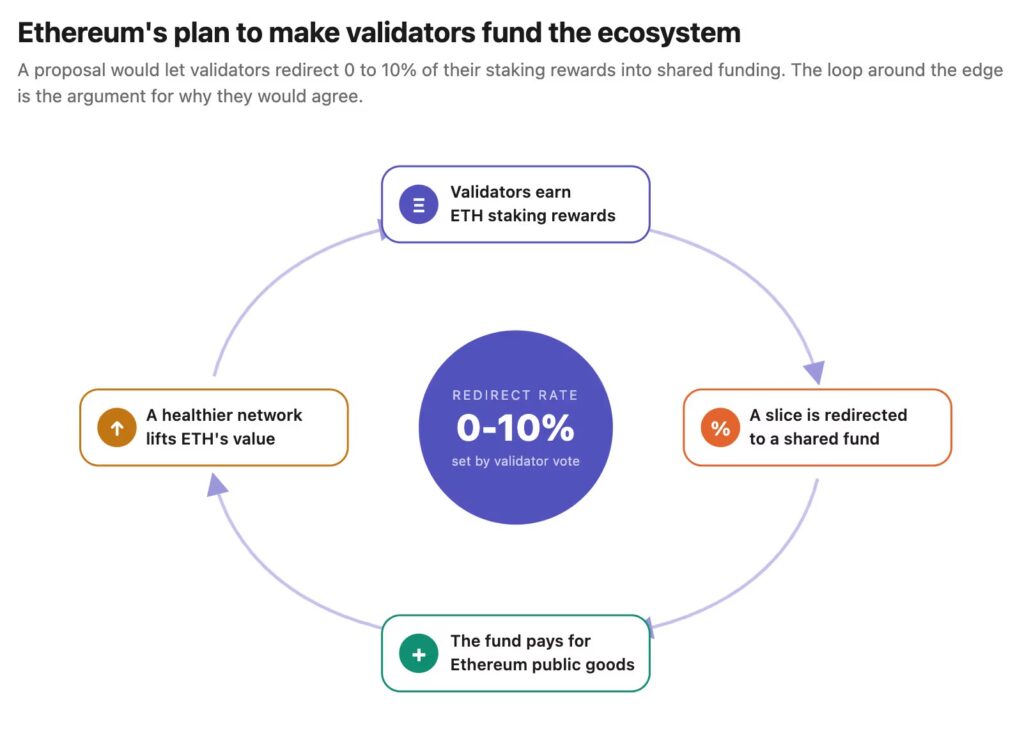
This measure seeks, according to the research forum, to respond to the problem of financing public goods linked to Ethereum. Many projects use common infrastructures, development tools or even security research, without always participating directly in the associated costs.
Currently, funding depends mainly on the Ethereum Foundation, donors or a few committed teams. This situation leads to a lack of resources for certain services essential to the operation and evolution of the network.
Validators play a central role in protocol security. They block ether, verify transactions, and receive staking rewards in exchange for their participation.
With this proposal, part of these rewards could be used to finance collective work that supports the ecosystem. The objective, according to the forum, is to further distribute the burden between the actors who benefit from the operation of the network.
A redistribution of rewards which raises several questions
According to estimates presented in the proposal, validators currently receive approximately 700,000 ETH per year in staking rewards. A redirection of between 5% and 10% could allow around 50,000 to 70,000 ETH to be dedicated each year to funding network-related projects, or around $120 million at current ether prices.
These amounts could be distributed to different addresses chosen by the validators. The mechanism would work through a distribution contract capable of automatically applying their financing preferences.
Ethereum validators could therefore define their beneficiaries in advance, without having to vote individually for each new funding request. This method seeks to simplify the management of contributions while leaving decision-making power to network operators.
However, this approach raises several governance questions. One of the risks identified concerns the possibility of excessive coordination appearing between certain validators.
If a majority of players decided to increase the redirection rate, they could theoretically strongly influence the destination of funds. The question of control and transparency of allocations therefore remains at the center of discussions.
Another point concerns ether holders who use staking services. The majority of staking assets come not only from people operating their own validators, but also from specialized platforms and protocols.
In this model, operators could choose the financing directions. However, the possible reduction in rewards would be indirectly borne by the users who delegate their ETH to them.
Crypto governance: the possible limits of a new financing model
The proposal also revives the debate around the monetary issue of the network. Some participants believe that if validators agree to reduce their rewards, another solution could be to directly reduce the issuance of ETH.
This question shows the complexity of choices related to blockchain governance. Financing common infrastructure must strike a balance between the needs of the network and the interests of the different participants.
The proposed mechanism therefore represents an avenue for reflection rather than a definitive decision. Discussions must still continue before possible integration into an official voting process.
At this stage, Ethereum is exploring several options to ensure sustainable funding for its ecosystem. The next step will depend on discussions between validators, developers and community members to determine whether this model can meet the needs of the network while maintaining its principles of decentralization.
Maximize your Tremplin.io experience with our 'Read to Earn' program! For every article you read, earn points and access exclusive rewards. Sign up now and start earning benefits.