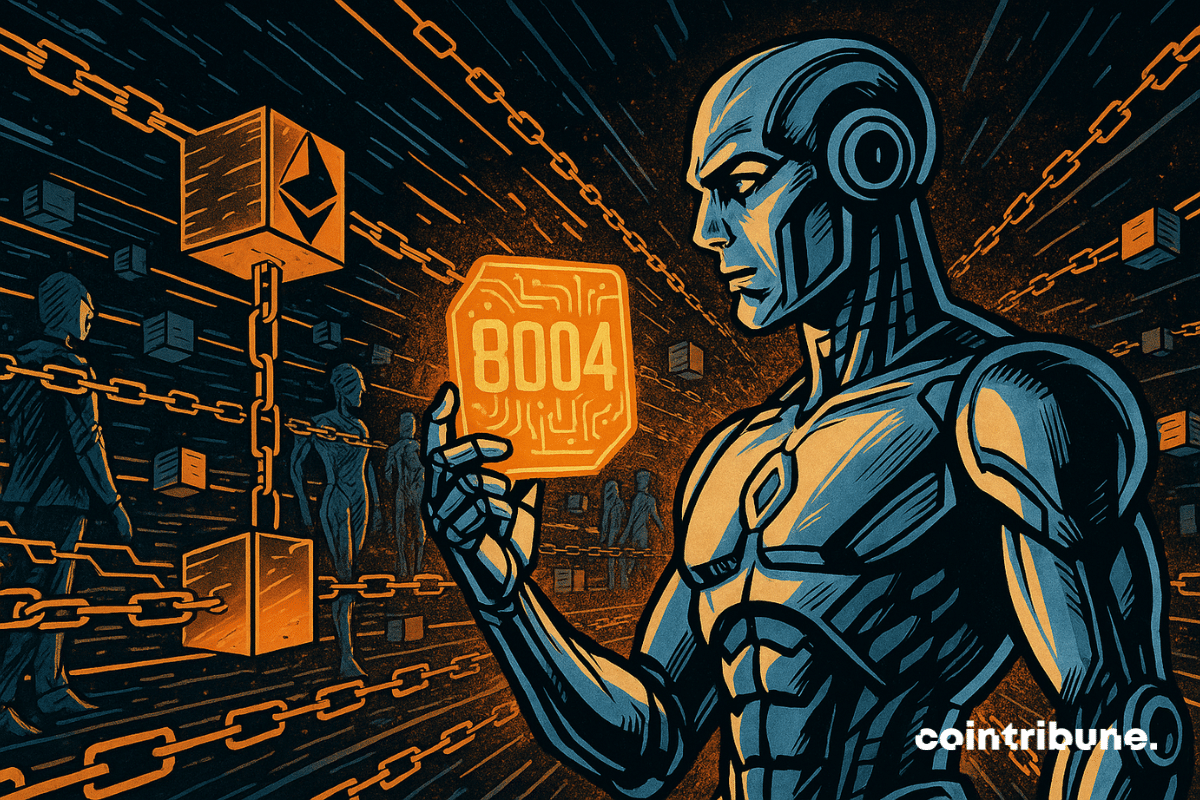
The union between artificial intelligence and blockchain raises as many hopes as doubts. But at Ethereum, experimentation remains a compass. Failing to blindly kiss each buzzword, the foundation refines its tools, takes the time to consult and structures the debate. The new ERC-8004 standard, nicknamed Trustless Agents, is part of this dynamic. It promises an infrastructure dedicated to an economy of autonomous agents, without prior confidence. Should we see the base of a future web3 piloted by AI?
In short
- ERC -8004 is based on three registers: identity, reputation and validation, all recorded on Ethereum.
- The A2A protocol allows AI agents to communicate, cooperate and trust themselves automatically.
- This standard is supported by Ethereum Foundation, Linux Foundation, Google, Nethermind, and other heavy goods vehicles.
- Binji highlights the arrival of a “machine economy” based on an incorruptible base.
A new era for Ethereum: the emergence of agents' trustless
Ethereum Improvement proposal ERC -8004, nicknamed Trustless Agents, marks a breakthrough for the web 3 ecosystem. Carried by Davide Crapis (Ethereum Foundation), this standard introduces an interaction architecture between autonomous agents, often fueled by artificial intelligence, without requiring prior confidence. It relies on three key on-chain registers: “identity”, “reputation” and “validation”.
L'ERC-8004 Extends the A2A protocol (agent -to -agent), already in use, adding this distributed layer of confidence. Each agent IA can thus speak ” who I am “,” What I did ” And ” Here is the proof ». These light registers allow interactions between agents without knowing or depending on a central authority. It is no longer the man who governs validation, but decentralized architecture.
Behind This developmenta clear objective: to offer a reliable base to the economy of autonomous AIs. As Davide Crapis said, initiator of the ERC, on Ethereum Magicians:
This standard extends the agent-to-agent (A2A) protocol with a layer of confidence that allows participants to discover, choose and interact with agents beyond organizational borders, without prior confidence being necessary.
And this approach seduces far beyond Ethereum circles. From Google to Nethermind, several giants contributed to the proposal. The active support of Linux Foundation to host the A2A protocol adds weight to this initiative.
Ethereum and the economy of autonomous agents: a step towards the smart web3
The ERC-8004 does not simply offer a technical standard: it aims to reorganize the rules of the game around the interaction between artificial intelligences. Thanks to three on-chain registers (identity, reputation, validation), Ethereum intends to lay the foundations for an economy of autonomous agents, where the machines interact without prior confidence, but with verifiability.
This idea is not theoretical. It is based on the A2A protocol already adopted in certain tech circles, and which the ERC-8004 completes with a distributed layer of confidence. Each agent can now point out what he knows how to do, prove his identity, present his history of interactions, and even subject his actions to a third validation. This is what some observers call “Skeleton of Trust”.
Ryan Lee, analyst at Bitget, summarizes it as follows:
Think about it as a way of giving Ethereum the infrastructure necessary to accommodate intelligent and autonomous agents, capable of negotiating DEFI strategies, to govern DAOS or to trigger contracts in real time, all on an open and verifiable layer.
This technical base, although complex, prepares Ethereum to become the pillar of decentralized AI.
Towards an AI plug-and-play on the blockchain? The significant facts to follow
The revolution will not come at once. But weak signals already appear. Coinbase, for example, tests the HTTP 402 protocol with its X402 system, allowing IA agents to pay without human intervention. The EIP-3009, coupled with Payment by Stablecoins, creates an infrastructure where the machines act, decide and pay. Ethereum, by becoming a playground for these agents, naturally attracts developers, researchers and entrepreneurs.
Ethereum could thus become the memory of AI, the spine of an economy where agents learn, evolve, and interact in a transparent and resilient ecosystem.
What to remember on ERC-8004 and Ethereum IA:
- The ERC-8004 was proposed on August 13, 2025 by Davide Crapis de l'Ethereum Foundation;
- The standard is based on three registers: identity, reputation, validation, all light and on-chain;
- Actors like Google, Consensys, Eigen Labs participated in its writing;
- The A2A protocol is hosted by Linux Foundation and used by more than 50 partners;
- Tests are underway with X402 of Coinbase, to allow the AI to pay in stable -coxins without humans.
In the crypto universe, looks are often turned outwards, towards friction of the centralized world. With the announced death of LLM and the emergence of autonomous AI agents, Ethereum seems to offer the right base. A field where artificial intelligence can evolve freely, with incorruptible memory and codified interactions. Trustless agents are only the first stammerings.
Maximize your Cointribne experience with our 'Read to Earn' program! For each article you read, earn points and access exclusive rewards. Sign up now and start accumulating advantages.