

The Ethereum crypto ecosystem has just reached a new high in its recent history. Since September 3, 2026, the demand for blobs (those cheap data spaces used by rollups) has reached unprecedented levels. This performance attests to the growing adoption of layer 2 solutions. But not only that! It also validates Ethereum’s scalability strategy while reviving a less visible problem: the financing of its developers.

In brief
- Ethereum has set a new record for usage of its blobs, at 6.7 per block on a daily average.
- Demand now exceeds the peaks observed at the end of 2025, driven by rollups.
- The crypto network is running at only 40-50% of its current target of 14 blobs per block.
- Four capacity increases have taken place since Dencun; a fifth is under study.
- Funding for client teams remains a barrier according to Protocol Guild.
Why is Ethereum reaching 6.7 blobs per block?
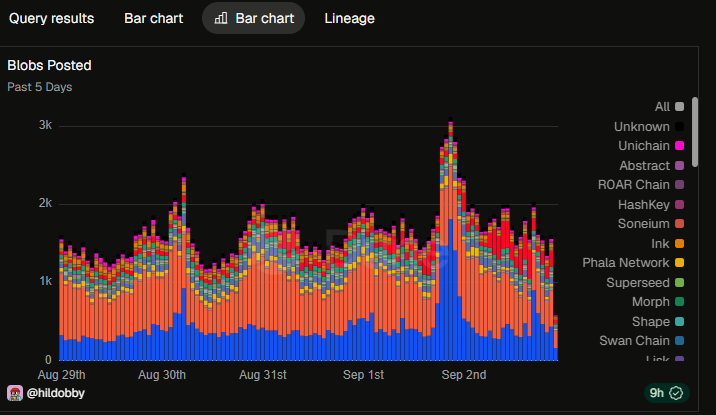
On September 3, Trent Van Epps, former member of the Ethereum Foundation and organizer of Protocol Guild, reported a three-day rolling average of 5.9 blobs per block. The daily average even reached 6.7, (i.e. well above the previous peaks at the end of 2025).
In Ethereum technical jargon, a blob refers to cheap temporary storage space introduced by the Dencun upgrade (EIP-4844 standard) in 2024. Rollups are Layer 2 (L2) crypto networks like Arbitrum, Optimism or Base. They deposit their batches of transactions there before having them validated by the Ethereum main chain.
The principle is simple: the higher the number of blobs used per block, the more activity passing through the Ethereum data availability layer is important.
This record therefore means that Layer 2s are publishing more batches of transactions in the Ethereum data layer. Each blob contains 4,096 32-byte elements, or approximately 128 KiB. At 6.7 units, the theoretical volume therefore approaches 858 KiB per block.
How did Ethereum increase its capacity by 2.3x?
After a low observed in spring 2026, the use of blobs on Ethereum started to rise again. Even better! It now exceeds the previous peaks recorded at the end of 2025.
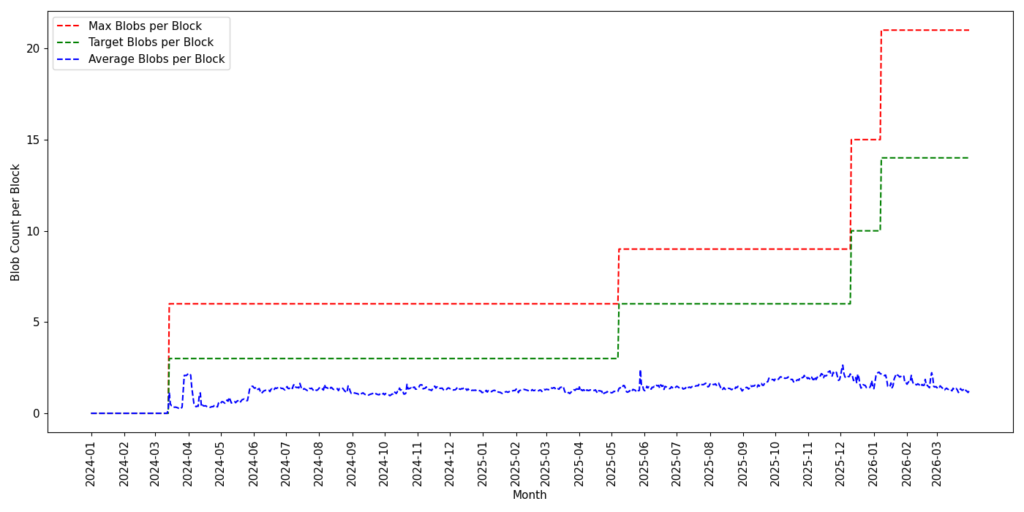
In reality, the Ethereum blob capacity has continued to increase in successive stages since the launch of Dencun:
- 3/6 blobs (target/maximum) at Dencun launch in 2024;
- 6/9 blobs with Pectra update;
- 10/15 blobs with the BPO1 level;
- 14/21 blobs with BPO2, effective January 2026 (the level currently in effect on Ethereum).
The Ethereum crypto network thus has 2.3 times more targeted capacity than before Fusaka. “Blobs offer rollups a cheaper way to publish data to Ethereum,” explains the official documentation. Data from EIP-4844 disappears from nodes after 4096 epochs, approximately 18 days. This reduces storage while maintaining their verifiability during the useful period.
However, the Ethereum crypto network remains far from saturation. In fact, current activity only represents 40 to 50% of the current target. The latter is set at 14 blobs per block. The ceiling of 21 constitutes the technical limit per block. This margin further protects the transaction costs of rollups against a structural surge.
Decryption: Ethereum is busy, but not yet full.
What is at stake with the next capacity increase on the crypto blockchain?
The question that now agitates Ethereum’s crypto developers is that of the timing of a fifth bearing to a target of 21/32 blobs. For some, more blobs means lower transaction fees for rollups and their users. The counterpart? Increased bandwidth burden on Ethereum node operators.
For others, the brake could above all become human. According to Trent Van Epps, for example, funding for the client teams that run Ethereum remains insufficient given the size of the network. In June, the development of Ethereum core required approximately $30 million annually. Protocol Guild is said to have distributed nearly $40 million in four years, not enough on its own. Expanding data availability therefore depends as much on human resources as on code.
That’s not all! This debate is also part of the Glamsterdam perspective. This is the next major update of the crypto network, which is due raise Ethereum’s global gas limit.
In any case, this record usage of blobs on Ethereum confirms the growing adoption of rollups. The next catalyst to watch: the outcome of the debate on an increase to 21/32 blobs.
Maximize your Tremplin.io experience with our ‘Read to Earn’ program! For every article you read, earn points and access exclusive rewards. Sign up now and start earning benefits.


